

Subaru Discontinued These Models (But We Wish They Hadn't)

You could almost think of Subaru as the AMC of Japanese carmakers. Just as AMC was the fourth-place American manufacturer, trailing far behind the Big Three of GM, Ford, and Chrysler, Subaru is in fourth place among Japanese brands in the U.S. by a big margin. AMC competed in the marketplace with unconventional models and a focus on four-wheel drive (4WD) long before all-wheel drive (AWD) became common in today's SUVs. Likewise, Subaru has always specialized in quirky, offbeat models.
As a result, Subaru has made some of the most unique models of the past several decades. On roads packed with millions of good but often anonymous small cars, Subies have always stood out. Even today, it would be hard to mistake a WRX, a CrossTrek, or an Outback for a Toyota, Honda, or Hyundai. Plus, since 1988, Subaru's STI badge has stood for its rally car heritage, adorning enthusiast favorites like the WRX STI. Sadly, the new WRX STI S210 won't be sold here in the States.
The WRX STI is just one of many fun, unorthodox Subaru models that fans would like to have back. Some of them were economy cars that we bought as our beloved first new cars. Many were all-wheel drive workhorses that carried us through stormy northern winters. Others were sporty models with wildly unique styling. Some were fast. And some Subies were all of these things, to someone, somewhere along the line. These are the models we wish Subaru had never discontinued.
Subaru 360
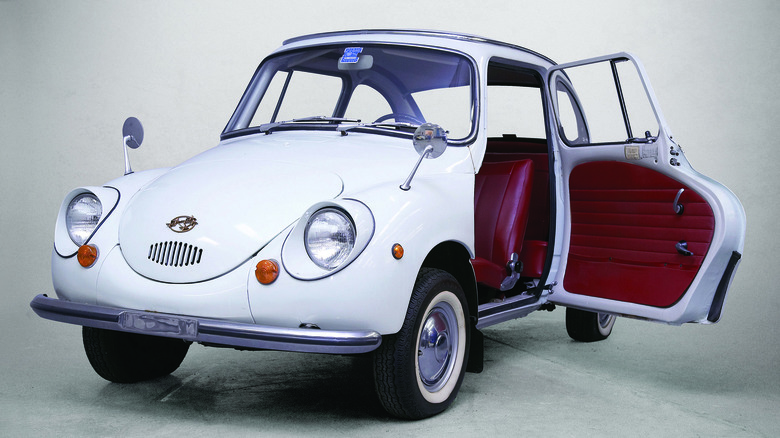
In the 1990 Dudley Moore movie "Crazy People," an advertising executive suffering a nervous breakdown begins to tell the truth in his ads. This gets him sent to an insane asylum by his employer. He could have written the first American ad campaign for the Subaru 360, which proudly proclaimed the car to be "cheap and ugly." Ironically, the model is beloved by collectors now. Ugly was probably always a matter of opinion, anyway; This bug-eyed little car with a surprisingly swoopy beltline and comically upright greenhouse could just as easily qualify as cute.
It's hard to dispute that it was cheap, though. In 1968, when Malcolm Bricklin and Harvey Lamm brought the 360 to the States as Subaru of America's first model, it cost all of $1,297. This comes out to less than $10,000 today. Plus, with a fuel efficiency rating of 66 miles per gallon, it was cheap to run, too, thanks to its rear-mounted 25-horsepower engine. To keep prices down, it was only available in white with a red interior.
Alas, Subaru struggled to sell the 360 in America. Folks in this country weren't too concerned about fuel economy in 1968, right at the height of the muscle car era. Plus, it lacked some amenities Americans were used to; We once took a deep dive into the puzzler of whether the Subaru 360 even has a trunk. It also didn't help that Subaru had to deal with a bad Consumer Reports review claiming it was unsafe for American roads. It wasn't an auspicious start, but in time, Americans would warm up to the new arrival.
Subaru BRAT
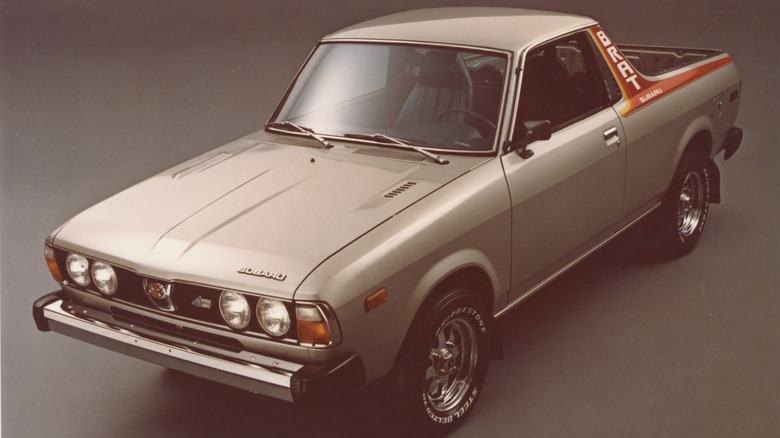
Subaru claimed that BRAT stood for "Bi-Drive Recreational All-Terrain Transporter." Really, Subaru? C'mon. One might almost suspect Subaru just wanted to call the thing a brat and came up with the acronym to justify it. The little BRAT pickup was one of the coolest vehicles Subaru ever made, or at least we think so. From the moment it launched in 1978, it exemplified Subaru's creative approach to car design and engineering, although it was a pickup truck rather than a car.
Or was it? It was based on a Subaru Leone station wagon with the rear of the passenger cabin converted into a truck bed. Therefore, the U.S. government was prepared to declare it a truck, which meant it would have been subject to the protectionist "chicken tax," a 25% import tariff on light pickups. To avoid the tax, Subaru mounted a pair of rear-facing jump seats in the bed. Believe it or not, this was enough to get it reclassified as a passenger car, subject to only a 2.5% import tax.
In 1978, the BRAT featured a 1.6-liter, 67-hp boxer four-cylinder engine, later upgraded to a 1.8-liter, 73-hp version. A short-lived turbo model offered 95 hp and 123 pound-feet of torque, which was pretty respectable in this tiny trucklet. Its part-time all-wheel-drive system gave it decent dirt-road capabilities. The BRAT only lasted until 1987 in the U.S., despite its general bodaciousness. We definitely consider it an off-roader that deserves a modern revival.
Subaru GL Wagon
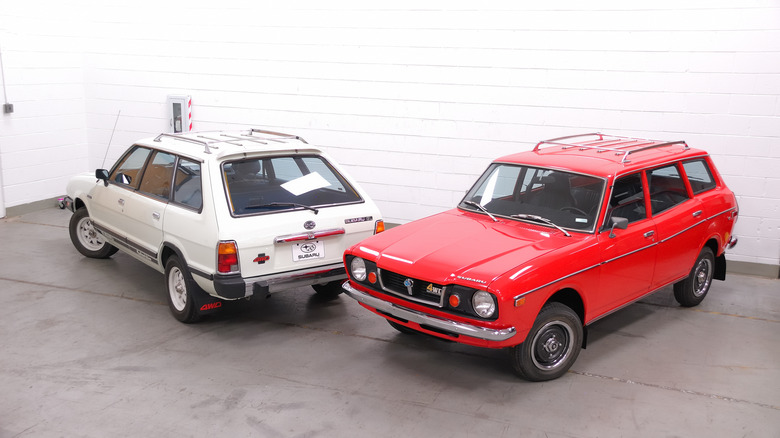
The DL/GL series of sedans and wagons was a mainstay of Subaru for decades, but the GL-trim wagon contained the true essence of a 1980s Subaru. This writer drove one as a medical courier in the 1990s, and any day that dispatch assigned it to me was a good one, right up until the day that its poor, overworked, high-mileage engine blew a spark plug in a doctor's office parking lot. Sadness!
Not that our company's little Subie was ever especially powerful. When Car and Driver reviewed the newly introduced turbo version of the Subaru GL 4WD Wagon in 1983, they declared that the turbocharger "boosts the GL's horsepower all the way to adequate." But they also noted that it was the official car of the U.S. ski team, hinting at the GL's real strength: go-anywhere gutsiness, in any kind of weather. The same was true of its descendants; one Subaru Legacy started after sitting on the bottom of a lake for three months.
Actually, we're falling into a popular misconception by referring to this car as the "GL." In Japan, this model was called the Leone. Since it was the only Subaru sold in America from 1972 until the introduction of the XT and the Justy in the 1980s, here it was just called "the Subaru," often followed by its trim level: either the downmarket DL trim or the GL trim. It would stay that way until the introduction of Subaru's next mass-market model, the Legacy, in 1990. At that time, to distinguish "the Subaru" from the new Legacy, the DL/GL cars were renamed the Loyale, the name the series would bear until the model was discontinued after 1994.
Subaru Justy
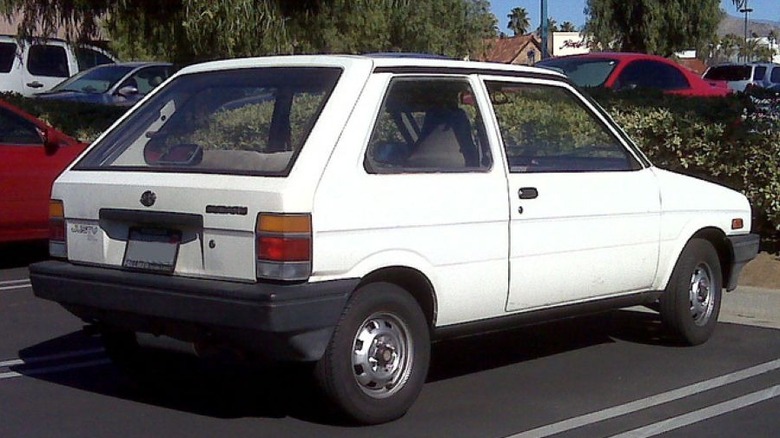
On paper, the Subaru Justy wasn't an especially impressive car, except for one thing: It offered 4WD in a cheap and tiny economy package. Modern car manufacturers could do worse than to bring that formula back. The cheapest 4WD Justy in 1988, the model's second year in the U.S. and the first in which it offered a 4x4 trim, was priced at $7,066. Using the U.S. Bureau of Labor Statistics' inflation calculator, that comes out to $19,836 in 2025. This undercuts the cheapest AWD in 2025, the $23,330 Nissan Kicks, by almost $3,500.
The Justy was a tiny hatchback, originally only available in the U.S. as a three-door model, although a five-door version became available in 1989. Between its small size and its 1.2-liter inline-three-cylinder motor, it was reasonably fuel-efficient. The Justy, as a subcompact car, was getting 36 mpg in the city and 39 mpg on the highway. This noticeably undercuts the AWD Nissan Kicks, which checks in at 27 mpg and 34 mpg, city and highway, respectively. So the Justy was cheap to buy and cheap to run.
Of course, the Justy achieved these impressive mileage figures with a 65 hp engine, so one couldn't expect autobahn-burning straight-line speed or acceleration from the little Subie. Plus, it offered an early example of a continuously variable transmission (CVT), the bane of enthusiast drivers. Luckily, a five-speed manual was available, too. Plus, if you're lucky enough to find a Justy that hasn't rusted out and its little three-cylinder isn't enough for you, you can always drop in a bigger engine, like this Justy with a twin-turbo Toyota V8.
Subaru XT
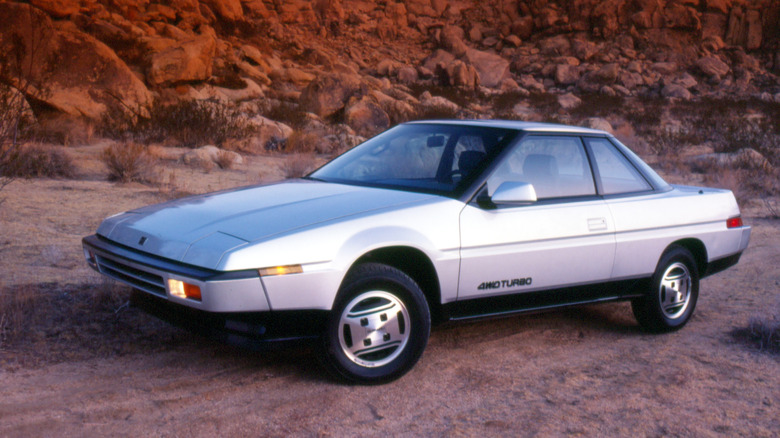
The 1980s often get a bad rap due to the lingering ill effects of the Malaise Era, when underpowered and blandly styled cars were common. But a few cars really bucked that trend, and one of the most striking was the alien wedge shape of the Subaru XT. Produced from 1985 through 1991, the XT has largely been forgotten, even though it was definitely a car that was far ahead of the curve, arguably paving the way for the WRX as well as sporty AWD SUVs from many manufacturers today.
The 1985 Subaru XT was a radical departure from Subaru's reputation as a purveyor of sensible, reliable, all-weather transportation. Subaru moved upmarket into sports-car territory with the XT, although, at a base price of $13,768, it was still an attainable dream. The 1985 XT offered a 111-hp, turbocharged 1.8-liter flat-four engine with an aluminum block and port injection. In a 2,640-pound car, this was good for a modest 10.3-second 0-60 time — decent for the mid-'80s, but nothing spectacular. The base engine was a non-turbo, 94-hp version of that powerplant.
The 1988 XT6 rectified the horsepower shortfall with a 145-hp, normally aspirated 2.7-liter flat-six, which was also constructed with an aluminum block and port injection. This boosted the 0-60 time to a more sporty 9.0 seconds. With a standard self-leveling air suspension and beefed-up anti-roll bars, brakes, wheels, and tires, the '88 also offered improvements in handling. To catch the zeitgeist of this offbeat Subie, watch a granny hoon an XT6 on some dirt roads in this over-the-top Subaru ad from the back in the day.
Subaru SVX
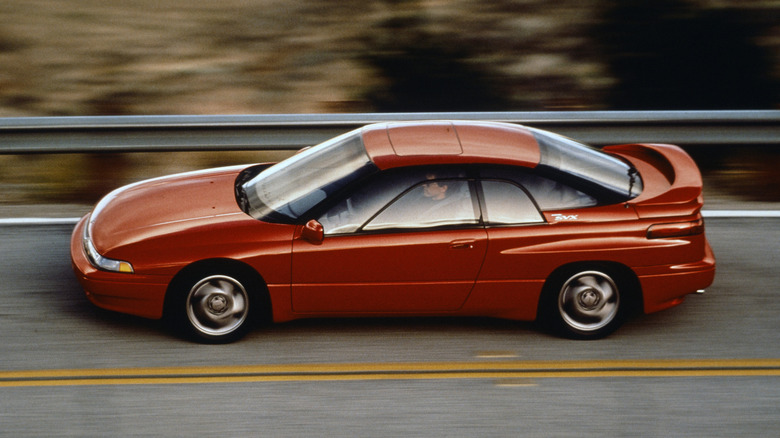
Following the trail blazed by the XT, the 1992-1997 SVX was another acid trip of a Subaru sports car. People didn't know what to make of it back in the day, but now it's a collectible classic. It was designed by Giorgetto Giugiaro, who also penned the DeLorean DMC-12, among other classics. It featured some of Giugiaro's signature design elements. For instance, the side windows featured a window-within-a-window design like that of the DeLorean. Imagine handing over your money at a toll booth through those tiny portals!
Plus, it was very aerodynamic for its day, with a drag coefficient of just 0.29. This resulted from a shape that was barely less of a wedge than the XT, although the SVX featured the rounded-off edges more typical of the 1990s. It also featured conventional headlights rather than the XT's pop-ups, although the SVX's lights were flush with the leading edge of its low, sleek hood. But the overall styling effect was unconventional, to say the least, from those side windows to a rear deck lid with its own built-in ducktail spoiler.
The overall effect was a slightly jarring mixture of sleek curves and odd angles, not quite coming together into a dream car style. And while it came with a 230-hp, six-cylinder box engine, it only offered a four-speed automatic transmission, leaving some enthusiast drivers cold. However, with a 0-60 time of about 7 seconds and a 154 mph top speed, along with AWD and a luxurious interior, it still offered a lot to like. You could argue that Subaru had made a BMW 8 Series for under $25,000.
Subaru Baja
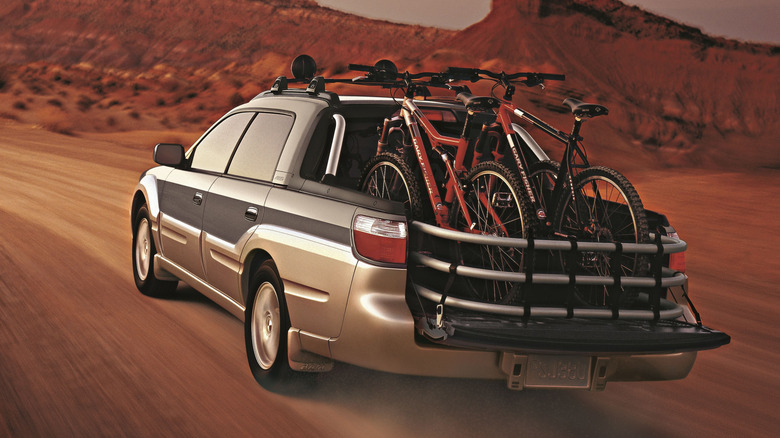
The Subaru Baja was a blast. It was a 21st-century BRAT, and we want it back. Well, some of us do, anyway, but those of us who like it, really like it. There's definitely an argument against turning the back of a Legacy wagon into a pickup bed that's too small for serious hauling, but at the same time, this little El Camino-like truck epitomizes the eccentric and offbeat nature of Subaru. It was built only from 2003 through 2006, making it rare and well worth preserving if you can get your hands on one.
The BRAT was the inspiration for the Baja, which was designed and built in America. If only it had rear-facing jump seats like the BRAT! But by the early 2000s, there was no chance that modern safety regulations would allow seats in the bed. Besides, unlike the BRAT, the Baja had a back seat in the passenger cabin. Plus, despite its small bed, the Baja did offer some cargo utility back there, with options like bed-extender rails and a bike rack.
The Baja initially came with a 165-hp, 2.5-liter engine, standard AWD, and a standard five-speed manual transmission, with a four-speed automatic as an option. A later turbo option boosted horsepower to 210, along with a fairly respectable 235 lb-ft of torque. It was rated for a 1,050-pound payload in its pickup bed, along with a modest 2,400-pound tow rating. Baja sales were disappointing, and Subaru opted not to produce a second generation.
Subaru Legacy
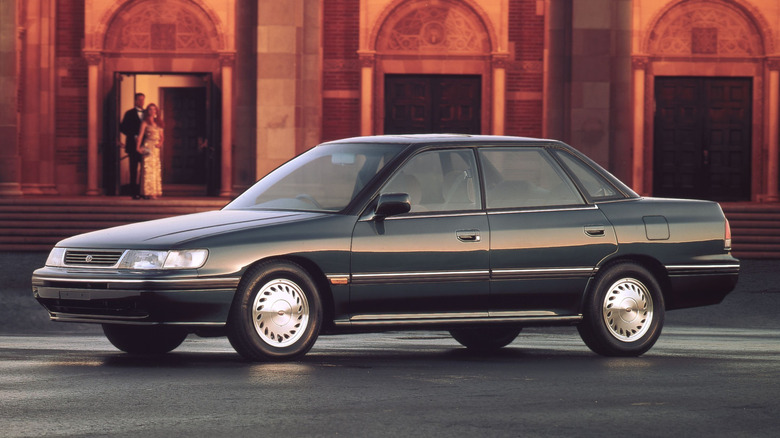
The Subaru Legacy is dead. Long live the Subaru Legacy! This one may catch some readers off guard, since the Legacy was in showrooms until quite recently. After an impressive 36-year run, Subaru discontinued the Legacy after the end of the 2025 model year. The 1990 Legacy arrived to do battle in the midsize sedan segment, taking Subaru up a size from the long-running "the Subaru" DL and GL that we looked at above (now renamed the Loyale). The Legacy was the first Subaru built in America.
The 1990 Legacy offered a choice of sedan or wagon bodies with front-wheel drive or AWD, although the AWD versions didn't offer significantly higher ground clearance or any other visual clues, unlike the later Outback versions of the Legacy. (The Outback, by the way, still exists for the 2026 model year, but with the demise of the Legacy, it's now an all-new, more SUV-like model.) In 1991, a turbocharged Sport version became available. By its second generation in 1997, AWD was standard in all Legacies, as well as all Subarus across the board.
The third generation, the one the Baja was based on, debuted in 2000. The fourth generation reintroduced turbocharging, but over the fifth and sixth generations, the Legacy lost its way a bit, becoming more mainstream but perhaps losing the slightly wild edge that distinguished Subarus. The seventh-generation, which debuted in 2020, offered a gutsy turbo and thoroughly modern style, but its mission as a mainstream Subaru was winding down. Subaru's lineup now leans heavily toward SUVs.