

Why Did Car Tires Switch From Inner Tubes To A Tubeless Design?

The wooden and metal wheels of 19th-century horse-drawn carriages started to evolve when American chemist Charles Goodyear created vulcanization, a process that made rubber stronger and more elastic. It didn't take long for rubber to become more suitable for tire making, as Englishman Robert William Thomson invented the world's first inflatable pneumatic tire out of vulcanized rubber in 1845. It was too expensive for commercialization back then, but that didn't stop the first solid rubber tires from debuting on the cabs of London by 1881.
It wasn't until 1911 that Philip Strauss patented the first pneumatic automobile tires with air-filled tubes, heralding the birth of tubed tires. They kept the motoring world rolling for more than half a century, though early models of tubed tires were less than satisfactory. Sure, the air cushion from the inner tube made those tires comfier on the road than solid rubber, but they were so delicate and fragile that they punctured easily and made flat tires a common problem for anyone driving a motorized automobile.
Things began evolving once more when American engineer Frank Herzegh invented the world's first tubeless tire while working for B.F. Goodrich in 1947. By 1952, the company gained patents for its invention, and the motoring world would never be the same again. As roads got better and cars went faster, tubed tires lost favor due to their propensity for punctures and overheating, which led to the tires frequently exploding and losing air pressure. From a safety aspect, tube tires weren't long for the world, and tubeless tires gained more acceptance for being lighter, cost-effective, and easier to repair.
What's the difference between tubed and tubeless tires?
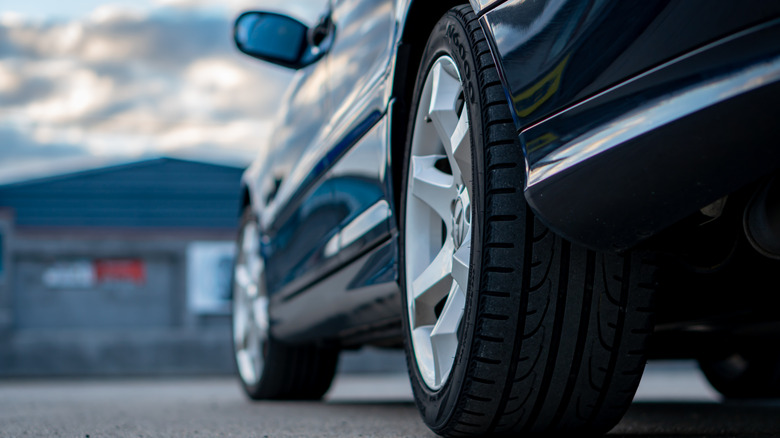
Tubed and tubeless tires are both round and made of rubber, but there's a significant difference in their construction. Tube tires came with a rubber tube filled with air, which was responsible for holding the tire's shape. The tube goes inside the tire when mounting it to the wheel, but the design creates friction between the them, causing intense heat to build up the faster you drive. Tube-type tires also instantly deflate when punctured, making them particularly unsafe on the road.
The introduction of tubeless tires solved most of the drawbacks inherent to tubed tires. For starters, they leak air more slowly and dissipate heat more effectively due to being mounted directly on the wheel, making them less prone to overheating and blowouts. And since tubeless tires have no inner tube, they are lighter and help reduce the weight of the vehicle, resulting in better fuel economy and a comfier ride. Tubeless tires are not immune to punctures, but they're easier to repair, and you can even fix the flat yourself.
Technology has enabled tire makers to move forward with run-flat tires that have reinforced sidewalls, although their stiff ride quality, added weight, and cost have made their real value questionable for car owners. The materials research division at Harvard has come up with a crack-resistant rubber material
that's almost ten times as strong as vulcanized rubber, but we'll have to wait and see if the innovation makes its way to modern cars soon. While some might ponder the future of tires having an airless design like the solid rubber of yore, tubeless tires will continue to reign until a more viable alternative offers more comfort, better puncture resistance, and safer on-road performance.