

How To Measure Lug Nut Patterns
Picture this: You've spotted a gorgeous set of refurbished carbon fiber wheels on Facebook Marketplace and thought "these will definitely fit my car," only to later learn the bolt pattern is not compatible. Yours is a four, and that carbon fiber's a five. Frustrating, right?
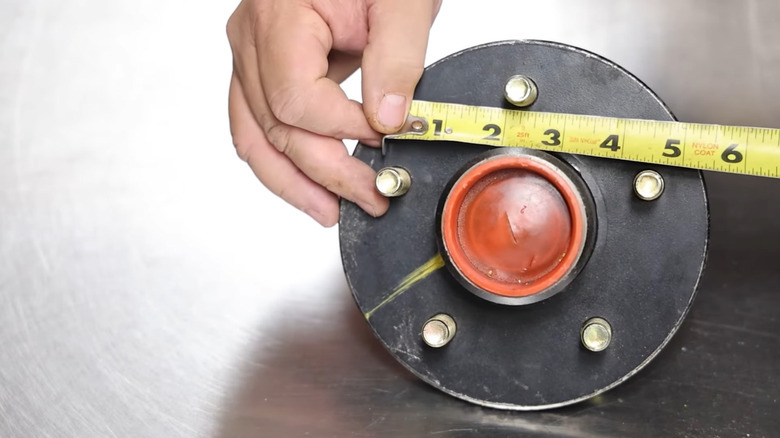
A wheel's lug nut pattern is determined by putting the number of studs together with the diameter of the imaginary circle they form. Measuring that pattern depends on how many lug nuts you have. Even-numbered patterns are the easiest. For four-lug wheels, you measure from the center of one stud to the center of the opposite stud. Six- and eight-lug wheels also follow this direct-across method, with 6-by-139.7 mm and 8-by-165.1 mm being among the most common truck sizes.
But five-lug wheels love chaos. Because there's no directly-opposite stud, you measure from the center of one lug to the outer diameter between the two opposite lug nuts over. Another method is to measure from the center of first lug to the outside edge of the lug two positions away. It feels weird, but it works. And it's how you verify whether you've got a common 5-by-114.3 mm size used on everything from 2005 Honda Accords to 2024 Ford Mustangs.
If you aren't up for the math, a bolt pattern gauge from your local parts store makes this painless. You can also check your owner's manual to see what you'll need for your specific vehicle. Measure once, and you'll only need to buy wheels once.
Why lug patterns matter
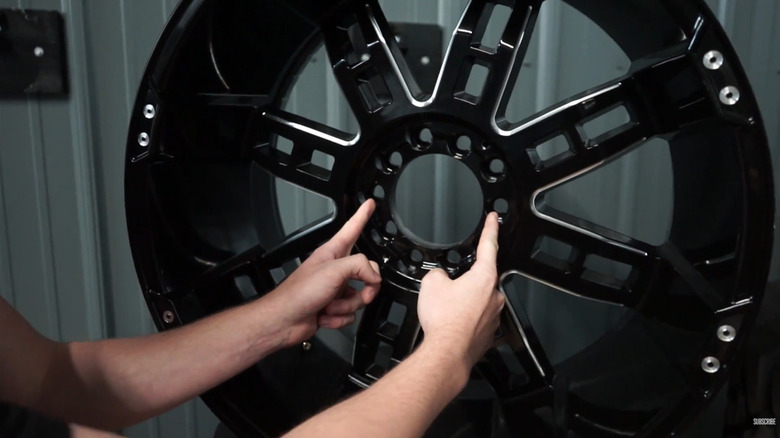
Obsessing over bolt patterns isn't just wheel-nerd behavior. If the pattern doesn't match, the wheel simply won't mount safely, if at all. Even if you can bolt it down, mismatched patterns can cause misalignment, uneven tire wear, vibration, or wobbling. Your wheel could even fly off of the highway mid-drive.
Some drivers try adapters like wheel spacers, although not everyone agrees on whether wheel spacers are safe to use. In theory, these adapters convert one bolt pattern to another. In practice, cheap or improperly-torqued adapters can cause problems on vehicle dynamics and wheel alignment. Quality matters, so choose spacers with high-grade materials – and don't let them make you forget to re-torque your wheels properly.
One common mistake you might make is thinking all 6-lug truck wheels are one-size-fits-all. The diameter must match. Another mistake is eyeballing the measurement, as a few millimeters can make a drastic result. Also, keep the offset in mind. A correct bolt pattern with the wrong offset can still ruin handling or rub your fenders. Before buying anything, cross-check your vehicle's pattern. It's way cheaper than learning about your lug nut patterns the hard way.