

The Pros & Cons Of 16 Cylinder Engines
We'll discuss 16-cylinder engine disadvantages, but there's no downside that can possibly overshadow this sound:
That's the supercharged 1.5-liter BRM V16 Type 15, and its exhaust note is obviously delicious. Engines with 16 cylinders are thirsty, complex, and heavy, but then, they were born to be excessive status symbols. In January 1930, Cadillac debuted the world's first V16, beating Marmon's 200-horsepower 490.8-cube V16 by about 10 months. The Barry White-smooth 165-to-185-horsepower Cadillac overhead valve (OHV) V16 used hydraulic lifters, the first passenger car to do so. Oh, and it could cost upwards of $9,200 in 1930, or almost $180,000 today.
Since then, 16-cylinder cars have only sporadically appeared. There were the Auto Union Type A, B, and C racecars, BRM's V16 and odd H16 Formula One engines, the Cizeta-Moroder V16T, the Bugatti Veyron/Chiron W16, and, uh, the Mosler Cadillac TwinStar. Yes, TwinStars technically just use two Northstar V8s. Genuine 16s are rare. Swedish engineer Pelle Soderstrom built a straight-16 out of Volvo four-cylinders, and there was even a radial-16 Grand Prix car: the 1935 Monaco-Trossi, which made BRM H16s seem reliable. Bugatti and Fiat also made U16s, because why not?
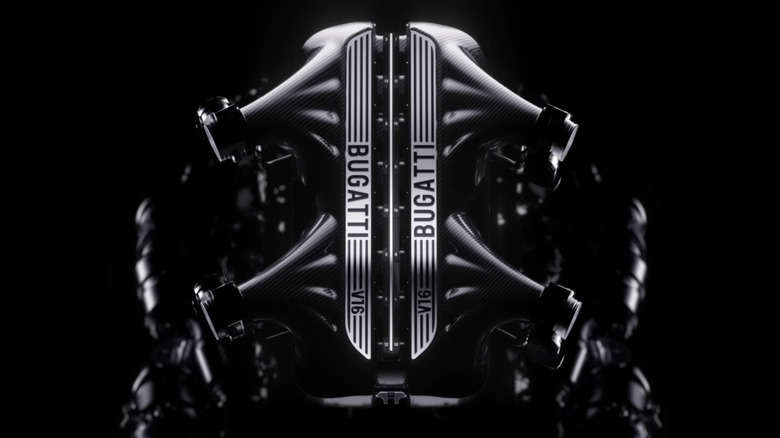
Currently, the Bugatti Tourbillon, which screams to 9,000 rpm in ICE-only mode, is the only available V16-powered car, and it's not even on the road yet (not that you or I will see one in the wild). Oh, you're going to bring up the Devel Sixteen, are you? Your childhood imaginary friend is more real. Anyway, before hitting the 16-cylinder cons, let's enjoy the pros.
Pros for V16s: smooth, elegant power
Aside from the chorus-of-angels soundtrack, the biggest advantage of 16-cylinder engines is their smoothness. The sheer number of power pulses overlapping makes them individually imperceptible, though they still require the proper crank design and firing order. Jason Fenske, patron saint of arcane engine knowledge and host of Engineering Explained, talked about this when covering the then recently-revealed naturally aspirated 3-foot Bugatti Tourbillon V16.
Four-stroke engines deliver a power stroke with every 720-degree rotation of the crank. Divide 720 by the 16 cylinders in a V16, and you can see that a cylinder fires every 45 degrees of crankshaft rotation. Each piston shares a crankpin with the piston next to it in the opposite bank, so when one piston in a V16 is at top dead center, its crankpin mate will be at top dead center 45 degrees later. Hence, the Cadillac V16's 45-degree V shape. Bugatti's Cosworth-developed Tourbillon V16 acts like two cross-plane crank 90-degree V8s set 45 degrees apart on a common crankshaft, which works, too.
In the days before widespread hybridization and forced induction (turbocharging and supercharging), there were pretty much two ways to make more power: increase displacement or increase cylinders. Cars like the Blitzen-Benz used a 21.5-liter four-cylinder, for instance, but power delivery wasn't exactly turbine-like. To improve refinement, cylinder count had to increase. 16s run efficiently at low speeds, avoiding bucking and pulsing thanks to an inherently Kansas-flat torque curve. Cadillac V16s could reportedly accelerate in top gear from just 2.5 mph to top speed, as the engine produced 300+ pound-feet of torque from 400 to 2,000 rpm.
Cons for V16s: everything else
16-cylinder engines are complex, huge, and expensive, which is why Porsche abandoned its 917 flat-16 — the lighter and shorter flat-12 already made stupendous oomph. As for vibration, V12s and inline-sixes are already famously smooth. Length is also excessive with V16s. The Tourbillon V16 is 39.3 inches, and the V16 in the 2003 Cadillac Sixteen concept is about 45 inches. Chevy LS V8s are under 29 inches. And, must we mention fuel mileage? Bugatti Veyrons get 15 mpg on the highway, and if you achieve 8 mpg with a Cadillac V16, you're on par.
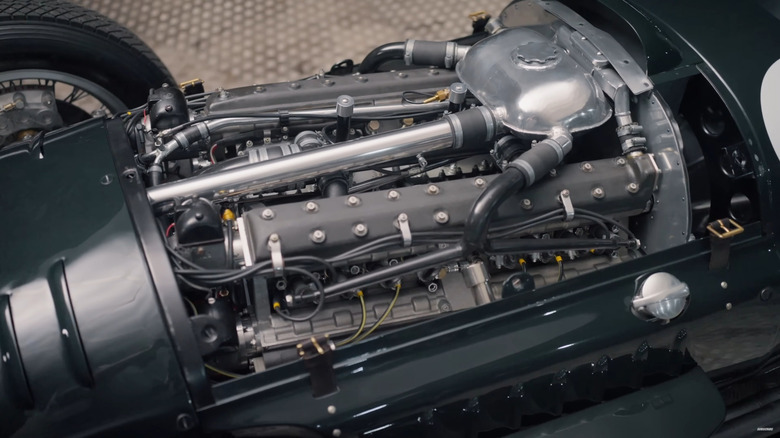
Also, the long V16 crankshaft can actually flex. BRM and Cizeta solved this with power take offs to transmit power, sort of splitting the engines into two V8s (both engines even had four separate heads). BRM's insane H16 avoided this issue, as it was two flat-eights sandwiched together, but it was still complex, unreliable, and obese. On a related note, V16s have a weight problem. Bugatti's W16 was one of the lighter 16s at 882 pounds. The original OHV Cadillac V16 weighed a Caterham Seven-rivaling 1,300 pounds.
Since 16s occupy considerable space, fitting necessary accoutrements in the engine bay can be challenge, especially while maintaining reasonable proportions. The 18.6-foot long 1,000-hp 2003 Cadillac Sixteen concept looks like it could fit a school bus under the hood. BMW's prototype 1988 six-speed manual V16 750iL, known as the Goldfisch, had massive air scoops (or gills) on the rear fenders because the cooling system is in the back. There just wasn't enough room up front.
Ah, V16s, you are gloriously excessive. No one needs a 16 cylinder, as turbocharging, supercharging, and hybridization can make up the power gap. But then, cars aren't always about needs.