

The Nissan Murano CrossCabriolet Failed Because It Should Have Never Happened
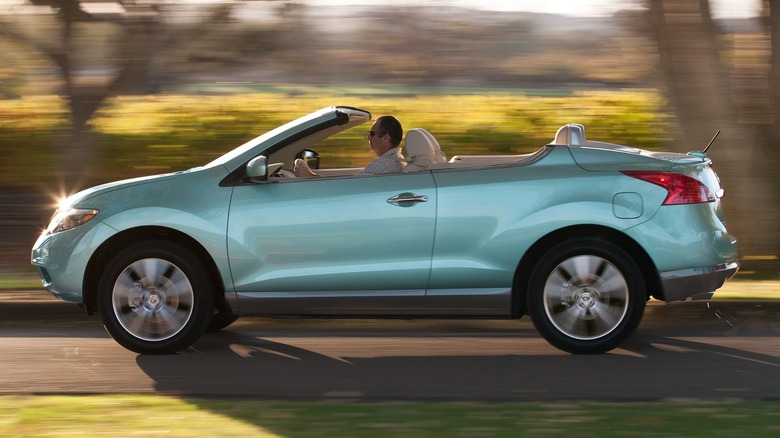
Throughout automotive history, certain models have advanced the industry, raised the bar, and continued to be iconic today. These are your picks for the most influential car designs of all time, but among those listed, you won't find the Nissan Murano CrossCabriolet — and for good reason. What happens when you take a crossover and make it a convertible? Not good things, as it turns out.
The first Nissan crossover SUV, the Murano, originally launched back in 2003. According to Bill Kirrane, the vice president and general manager of Nissan at the time, the inaugural Murano was described as, "Nissan's ... objective to develop a vehicle that truly stands out in the class in terms of styling, performance, comfort, convenience and technology -– offering unmatched levels of both fun and functionality." At the time, the Murano was praised by various automotive outlets for its robust V6, good handling, and bold style.
Fast-forward to 2011, and the bizarre CrossCabriolet (billed as the first-ever all-wheel convertible crossover) rolled onto dealer lots. It still offered a 3.5-liter V6, giving drivers control of 245 horsepower, and it included the same adventurous curvy exterior with one notable difference: The roof was gone. By 2014, just three years after its release, the CrossCabriolet was discontinued, as it just wasn't connecting with buyers.
Why didn't the Nissan Murano CrossCabriolet sell?
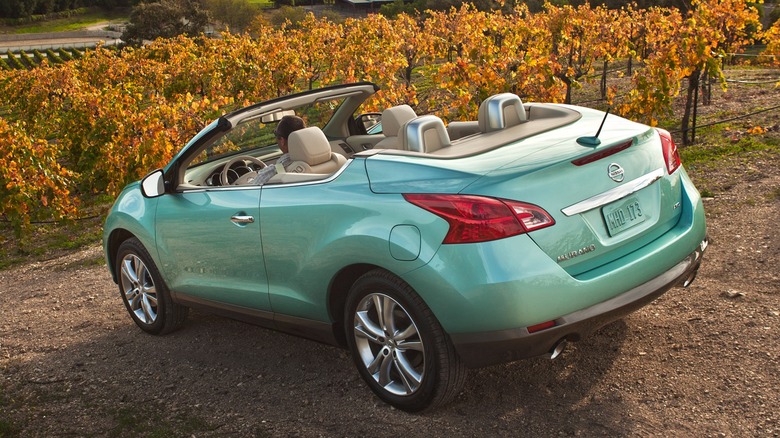
Given that the Murano was originally built to stand out among the growing crowd of crossovers and inject fun into the genre, wouldn't a convertible version just be an extension of the initial vision? Well, maybe, but the CrossCabriolet confused more than it impressed, with some inherent problems as a result of its soft-top convertible configuration. One of the major structural components of the standard Murano, the B-pillar (which is the post behind the front door) was removed. It also went from a four-door to a two-door, presumably to further exude sportiness. This resulted in the body of the crossover reportedly feeling less rigid, because of the missing supportive elements.
Even worse, some of the foundational aspects of the standard Murano — like functionality and convenience — were severely hampered by the CrossCabriolet design. Not only did the two-door change make it more difficult to enter and exit the back seat area, but the soft top folded down into what used to be all trunk space. When in convertible mode, space was reduced to a total of eight cubic feet of cargo room. This was a far cry from 2011's standard Murano, which featured 31.6 cubic feet of space behind the second row.
Only 6,000 CrossCabriolet models were made, each one a minimum of $5,000 more expensive than the mainstream Murano. However, some may be less critical when looking back on this risky design, especially if you can scoop one up today at a big discount. At $4,600, a 2011 Nissan Murano CrossCabriolet could be an ugly duckling at a swan's price, but only for the right buyer.
The CrossCabriolet's development was turbulent
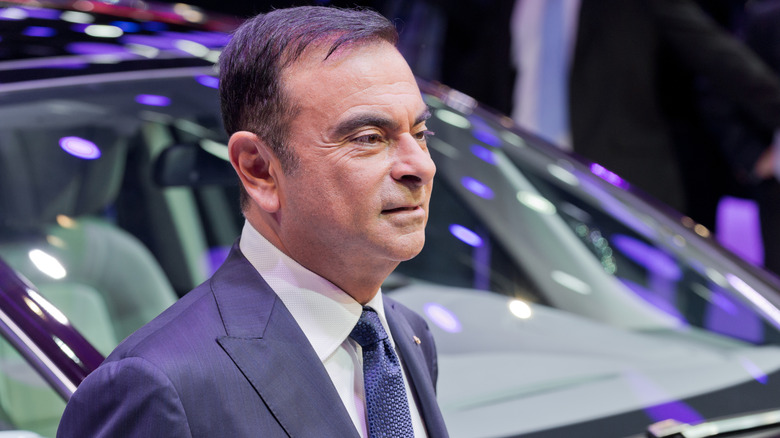
In 2011, Shiro Nakamura, Nissan's chief creative officer, stated that Carlos Ghosn was the mind behind the CrossCabriolet. If you're not familiar with Ghosn, he was Nissan's CEO for 16 years, but his tenure was anything but smooth. From allegations that he misappropriated funds to Ghosn's guitar-case escape from Japan, his behavior was certainly unconventional, to say the least. While it's not officially confirmed, rumor has it that the CrossCabriolet was a result of Ghosn's wife making a remark about turning the Murano into a convertible.
Vehicle development is typically both expensive and time-consuming, but those inside Nissan have stated the project was conceived in 2008. While the CrossCabriolet was a modified Murano, it apparently needed extensive work to be made into a convertible, hence its structural shortcomings. Imagine being an engineer at Nissan during this time and being told to transform the Murano into a two-door convertible within just a few years. Since there were no prior plans to take the crossover in this direction, it must've been quite a shock. Another executive at Nissan commented to Autoweek back when the CrossCabriolet first launched, explaining, "Typically, a vehicle like this would never have made it past the first planning meeting. Mr. Ghosn liked it."