

5 Old School Car Accessories No One Uses Anymore
Remember when people used to wear gloves just to drive? Yeah, neither do we. But gloves were a common driving accessory at one time. We suspect it was mostly a style choice. It's not as if people's hands were more delicate back then. However, driving gloves are but one item in a long line of car accessories that have long since fallen out of use. There's a reason, after all, why your parents refer to the 12V outlets in your car as "cigarette lighters". That's because they used to hold actual cigarette lighters.
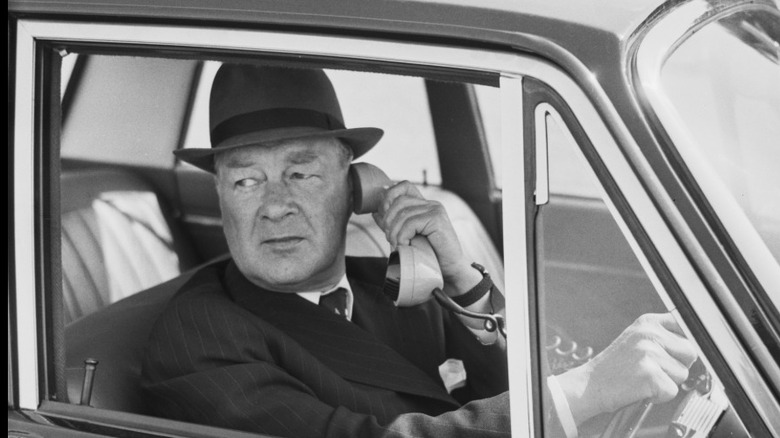
One of the more interesting car accessories, in our opinion, was the car phone. Before everyone adopted the digital leash known as the smartphone, successful businessmen needed some way to make and receive phone calls while they were on the road. And thus, the car phone was born. It became quite the status symbol for the wealthy until Steve Jobs came along and ruined it for them by introducing the iPhone. Soon, everyone could get distracted while they drove, but times have changed so much that today it's illegal to hold your phone while behind the wheel in many places.
Other notable car accessories include the in-dash minibar, which was actually a thing in some luxury cars for a brief time in the 1950s until common sense took over. Fiat offered a real espresso machine as an accessory for one of its models. The Brodie knob could be seen on lots of steering wheels until power steering came along. For a while before A/C was commonly found in cars, people were attaching swamp coolers to their vehicles. And we can't forget the many ways we've had to play music in our automobiles, including eight-track players, cassette tape players, CD players, CD changers, and even record players.
Car phones
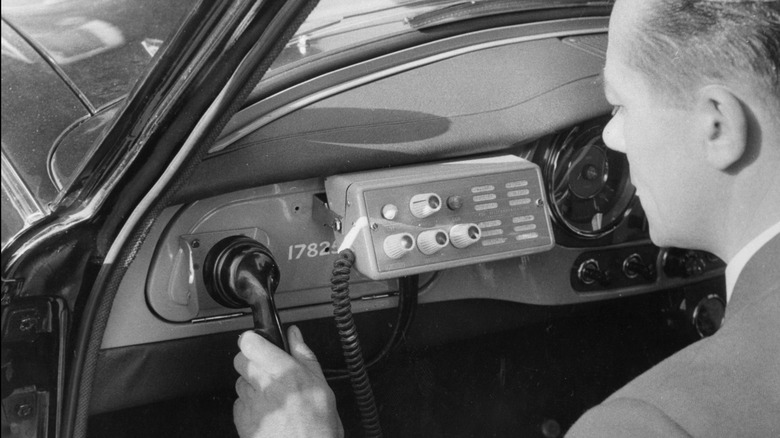
This may be hard for many of you to imagine, but there was a time when you could only reach most of us by phone if we were at home. You could call us at our place of work, but it had better be an emergency. It was a magical time, before smartphones and texting, when there were times of the day when we could just not be reached. And it was glorious. But Bell Telephone Company decided in 1946 that such a carefree lifestyle was just for the poor, and invented the car phone.
The original car phone was not some sleek little device that could fit in your pocket. No, the whole setup weighed 80 pounds, and most of it had to go in the trunk, where it took up a considerable amount of space. Why do we say it wasn't for poor people? It would cost you $25 to have the phone installed. Monthly service cost $15, and you'd have to pay 40 cents for a three-minute call. So? We probably spend more than that at Starbucks every month. But that was 1946 money. Today, that would be the equivalent of paying $365 for installation, $219 a month, and $5.85 for every three-minute call. Car phones would eventually get smaller and — we're guessing — cheaper, but they were still a status symbol of the well-to-do in the 1980s and 1990s. One particularly nostalgic software engineer got his 1993 car phone to connect to his smartphone.
Keep in mind that the older car phones had rotary dials. If you think drivers get distracted by their phones now, imagine getting out your Rolodex (ask your parents), looking up your friend's number, then physically working the phone dial, all while trying to drive.
Minibar in the glovebox and espresso machine in the cupholder
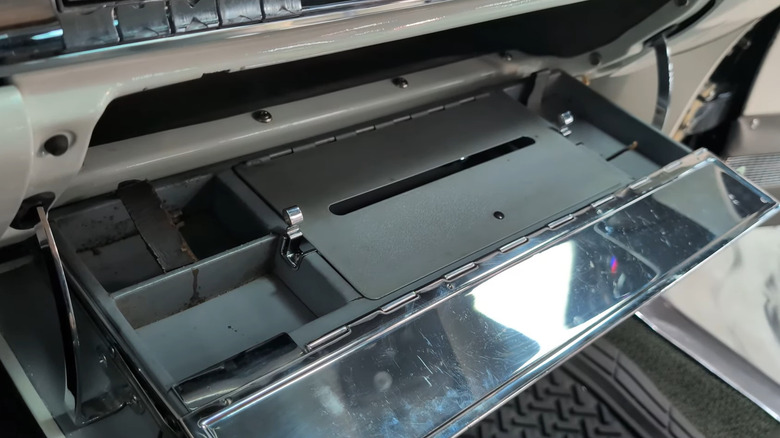
In 1957, someone at Cadillac looked at the Eldorado Brougham and apparently said, "You know what this car is missing? A minibar in the glovebox." That may seem like a ridiculous idea nowadays. It was a bit odd back then, too. It's not as if no one had drawn the connection between tipsy drivers and automobile accidents. Drunk driving laws had been around for decades. Sure, they weren't as strongly enforced as they would be starting in the 1960s, but most folks still understood that someone who couldn't walk straight probably shouldn't operate a motor vehicle down the freeway.
The minibar included shot glasses that had magnets in them to keep them in place. After all, you wouldn't want all that glass to jostle around and get broken. Why, that wouldn't be safe! Thankfully, Cadillac dropped this idea after 1957.
Maybe the closest thing to this today would be an option found in later models of the Rolls-Royce Cullinan. Customers who purchased these models could get their choice of a whiskey decanter or champagne chiller in the back seat. The 2025 Mercedes-Maybach GLS also has a champagne cooler. Presumably, you're not meant to crack open the Jack Daniel's (or whatever whiskey brand rich people drink) while the car is on the road, even as a passenger. But at least the champagne will be cold when you get to wherever you'll be drinking it.
At the complete opposite end of the serving-drinks-in-the-car spectrum is Fiat, which offered a "Coffee Experience" package with the 2013 500L. For an extra $300, customers could opt for a Lavazza espresso machine that fit neatly into one of the cup holders. Unfortunately for American coffee lovers, this was not available in the U.S.
Cassette tape players, eight-track players, and record players

We didn't take our music for granted back in the day. There was none of this listening to whatever you wanted whenever you wanted. If you wanted to hear your favorite song, you had to listen to the radio all day, hoping they would play it. Or you could call in at designated times and ask them to play it. The alternative, of course, was owning your favorite music on physical media.
Understandably, you'd want to listen to that music on the go, so you would need some way to play it in the car. We remember "upgrading" our factory-installed car stereos to aftermarket stereos with cassette tape players. The fancier cassette-playing stereos would play both sides of the cassette tapes, meaning you wouldn't have to eject them and flip them over once you listened to half of the songs. Some car stereos could play an eight-track cartridge, which was another kind of media that could play eight whole songs, and never needed flipping over! Then came the odd transition time when there were car stereos that could play both cassette tapes and CDs. Of course, CDs gave birth to another forgotten accessory: CD changers, which could hold at least six CDs and had to be mounted in the trunk.
But did you know that for a while, there was such a thing as record players for cars? If you know anything about playing vinyl, you can imagine how well that would have worked on bumpy roads. But we wonder about the space this would have involved. A good record collection would take up a bookshelf, at least. Where would you keep that in a car? Would you have one of your passengers hold a box of records on their lap?
Brodie knobs
Have you ever tried driving your car after the power steering pump goes out? It takes a lot of effort to turn the wheel at low speeds or when the car is stopped. Well, cars didn't always have power steering. It was invented in the 1920s, but it wasn't commonly used in cars until the 1950s. In between, drivers started using a little invention called a Brodie knob. This was a little knob that could be attached to a steering wheel and would enable the driver to steer with one hand. It was especially useful to truck drivers and others who needed to shift gears while steering. Overall, it made steering easier, especially at low speeds.
But the Brodie knob soon earned a nickname, "suicide knob." Why? Well, if you tried turning with it at highway speeds, the wheel could snap back around, and the knob could take a finger off. And there was always the danger of oversteering when used at high speeds. Why anyone would try making quick turns at highway speeds is beyond us. Plus, since seat belts and airbags weren't common, drivers could hit their heads on the knobs in accidents. But even the name "Brodie knob," which referred to the famous stuntman Steve Brodie, indicates there was at least some awareness of the risk involved with using the device.
Fortunately, cars started coming standard with power steering, making Brodie knobs obsolete for most uses. Obsolete, that is, for most legitimate uses. They do make it easier to perform maneuvers like doing donuts. But safety regulators and governments tend to frown on that kind of driving, so some states have imposed restrictions on their use. Exceptions are often made when these devices are used as aids for drivers with disabilities.
Evaporative swamp coolers
We're not sure how humans existed in the summer before air conditioning, yet they did for millennia. We suspect that they mostly sat in the shade, wishing someone would invent air conditioning. It is especially difficult to imagine how people drove before A/C became common in cars. We've owned ovens that didn't warm up as fast as the inside of our car on a sunny day.
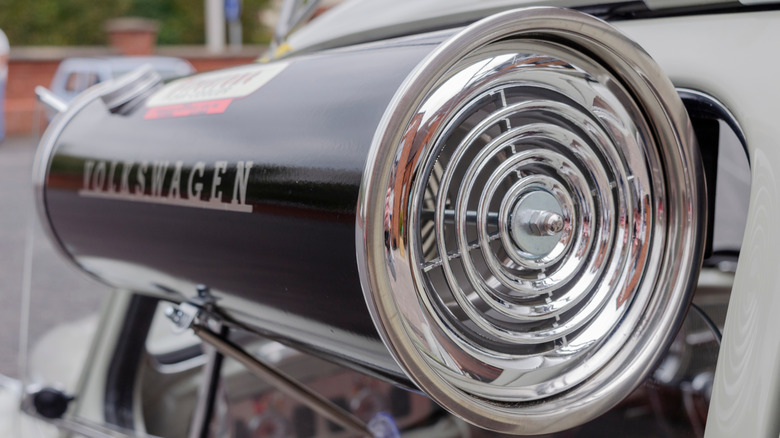
A solution started appearing in the 1930s when some drivers in arid climates began attaching evaporative swamp coolers to their cars. These car cooler kits were typically just a canister that was mounted to the passenger window. Inside the canister was some water and a porous pad or balsa wood shavings. As the car traveled down the road, wind would pass through the canister, forcing air through a tube, over the water, and through the pad, cooling the air in the process. Swamp coolers were especially popular with VW Beetle owners. Sometimes these coolers had electric fans to push air through even when the car was stopped. This kind of cooler doesn't work well in wet climates, but it was fairly popular with motorists in the American Southwest. Of course, these coolers became unnecessary toward the end of the 1960s after automakers finally started putting air conditioning in their cars, fixing all that was wrong with the world. Well, the sweating in cars part, anyway.
There have been tons of car accessories that have come and gone over the years. We haven't even talked about beaded seat covers and those little swaying hula girls people used to put on their dashboards. It makes you wonder which accessories we use today that will soon become forgotten. We hope our pine tree air fresheners stick around, though. We're kind of attached to them.