

How To Stop Static Shock From Zapping You Every Time You Exit Your Car

One of life's little ongoing annoyances, getting zapped with static electricity, can happen in a variety of places. You'll get jolted when touching something metal, like a doorknob, a handle, or often your vehicle as you're getting out. Commercial airliners even have to deal with it; that's what those skinny metal rods sticking off of a plane are for – discharging static. Low humidity is one of the main factors behind static buildup, so not everyone across the country gets shocked to the same degree. Those along America's coasts and the South may not encounter this phenomenon often, but those in the West are all too familiar with it.
If you want to skip the zap when getting out of your car, you'll need to avoid certain fabrics, such as wool, which can be especially problematic during the winter months when static is at its worst. Material made from natural animal fibers contains trace amounts of moisture within the follicles, which allows static to travel. If you have a habit of running your hands through your hair (especially if its long), you should avoid doing so, as you are priming yourself for a jolt when exiting the car. Finally, you can periodically help minimize static on your car's seats by wiping them down with dryer sheets, or by using an anti-static spray designed for interior detailing, which also helps keep dust from clinging to your car's dashboard.
A few habits to take up when exiting your vehicle
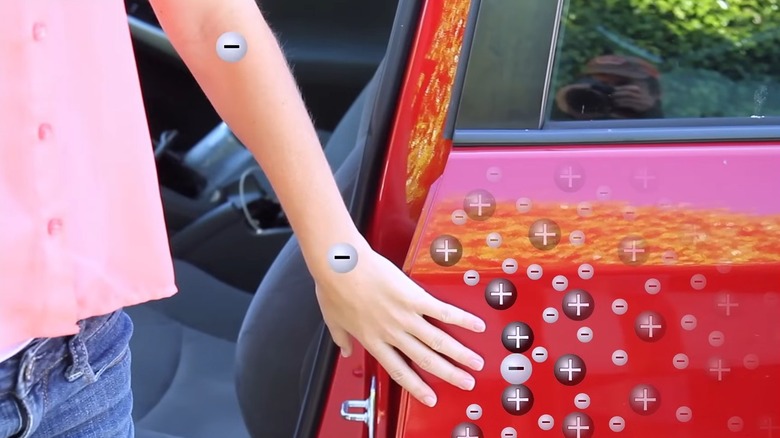
Beyond prevention, you can also employ a few techniques that should help reduce or eliminate that pesky shock when stepping out of your car. When you open your door and slide across the seat to exit, the friction causes your body and the car's seat to become charged. In order to dissipate this charge and avoid a shock, place your hand on the metal of the vehicle's frame while you're moving to exit. This will allow a continuous flow of charged particles away from your body, denying them the opportunity to build up and zap you.
If you're unsure whether you've properly discharged the static electricity, you can opt for less uncomfortable ways to test it. For example, you can touch the end of your ignition key to the cars metal, or press a piece of metal jewelry — like a ring – against the surface of the vehicle. Doing this will help disperse the charge away from you.
How static electricity works
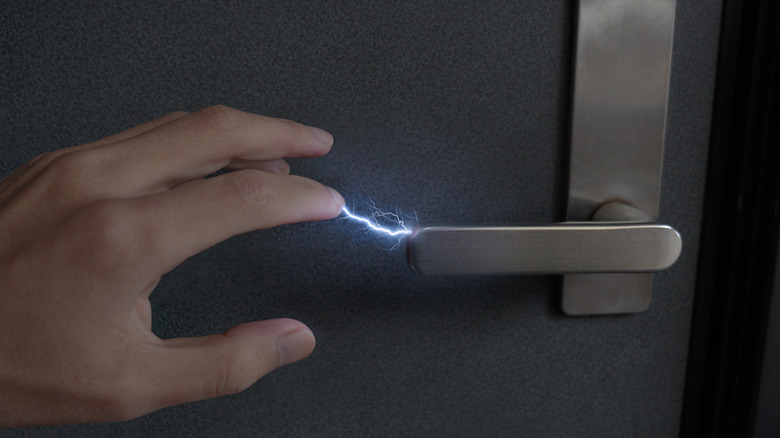
Essentially, static electricity is the result of an imbalance between positively and negatively charged particles. This occurs due to friction, such as when your hand pushes through your hair or your jeans slide on the fabric seats of your car. At the microscopic level, opposing surfaces — even ones that appear smooth to the naked eye — have protrusions that bend when rubbed together, creating voltage.
Regardless of how the friction is generated, it results in an excess of charge that waits for you to touch a grounded object, completing a circuit and releasing a flood of electrons through a single point. With so many charged particles rushing through a single point of contact, you get that familiar and uncomfortable shock.
As mentioned earlier, static electricity is more pronounced in dry climates, particularly when it's cold, as humidity allows these charged particles to escape your body through the moisture in the air before they build up. If you live somewhere like Arizona, New Mexico, or Nevada, you may consider picking up a portable vehicle humidifier, which is powered by a USB cable and typically fits in a cup holder – assuming it's not one of those bizarre Lexus TX cup holders.