

Why Detroit Diesel's 2-Stroke Engine Was Called Screaming Jimmy
One of the most significant contributions in the history of propulsion technology came from a 19th-century engineer named Rudolf Diesel. While his idea was patented in the 1890s, it wouldn't be until the 1930s that the first automobile equipped with a diesel engine would make an inaugural trek from Indianapolis to New York City.
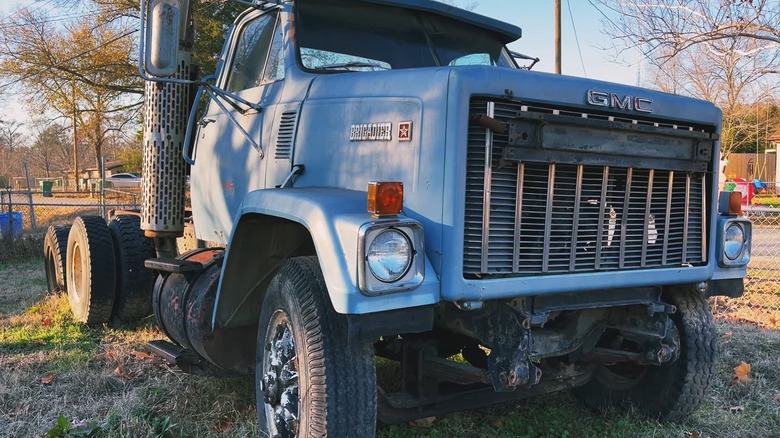
Today, modern diesel engines still outsell gas in heavy-duty trucks due to their advantages in towing and fuel economy. However, this wouldn't be the case without the events of the 1930s, which were a pivotal time in the U.S. Automakers like GM launched diesel-focused divisions, refining and experimenting with this new alternative power plant. One of the achievements of GM's Detroit Diesel Corporation would be a two-stroke engine, fondly and accurately nicknamed the "Screaming Jimmy."
Due to its two-stroke configuration (where the engine fires once for every crankshaft rotation) versus a four-stroke (which fires once for every other crankshaft rotation), the Screaming Jimmy sounded like it was hitting twice the rpm it actually was, producing a higher-pitched tone. In fact, according to some accounts, industry professionals who worked around these engines grew tired of the continuous high-speed whine emanating from the machines. The signature scream was also compounded by the Roots blower, which was used to move exhaust gas away from the cylinder.
Detroit Diesel's two-stroke design proved itself under the hood of the 1938 GM 719 Coach, which was a bus that output 165 horsepower. The following year, the Screaming Jimmy was offered in several variations and available in multiple GMC trucks, with horsepower ratings between 65 and 165.
How does a two-stroke engine work and what are its advantages?
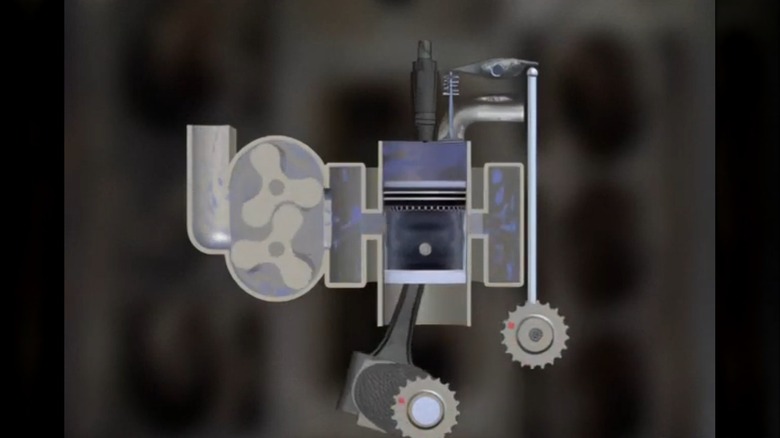
While a four-stroke engine separates the actions of intake, compression, combustion, and exhaust, the two-stroke combines them. So, as the piston in a two-stroke engine is rising, it's completing both the compression and ignition phase. As the piston drops, the engine performs combustion, intake, and exhaust all at once.
This two-stroke design offers some advantages over the four-stroke configuration. Theoretically, the two-stroke could produce twice the output, due to the power stroke occurring more frequently (every crankshaft rotation). It also offers the benefit of less moving parts, which means fewer points of failure and less weight. In addition, the two-stroke manages heat better than the four-stroke.
Because of these advantages, while you won't find two-stroke diesels in many automobiles anymore, you will find them in industrial applications like massive generators or large ships. Just look at the mammoth vessel The Ever Given, which is powered by a 79,500-horsepower diesel engine bigger than most houses. And, you guessed it, it's a two-stroke.
What happened to the Screaming Jimmy?
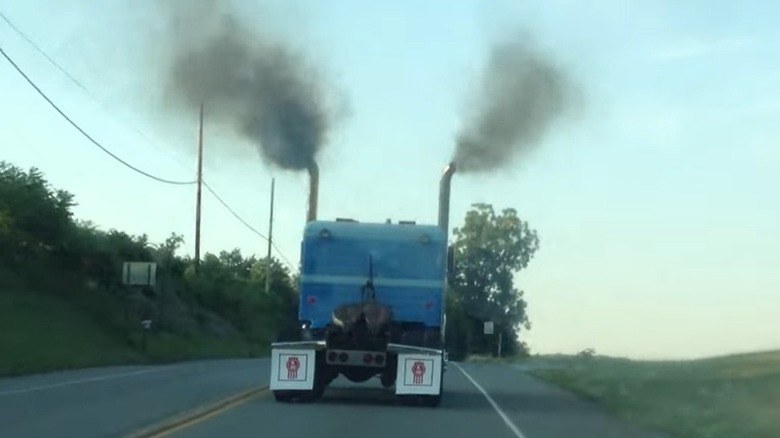
While the two-stroke does provide some advantages, making it a popular choice for large vehicles for decades, it wasn't perfect. The last of Detroit Diesel's Series 71 engines (of Screaming Jimmy fame) were made in 1995 because of tightening emission standards. In fact, it wasn't just the Screaming Jimmy that suffered this fate, but many other two-stroke engines as well. Due to how they worked, they weren't the cleanest-burning power plants.
One of the main issues is that the design utilizes a mixture of oil and fuel for combustion. This results in quite a bit of dirty black smoke being produced. A two-stroke engine could use up a gallon of oil every 1,000 miles, and it would all be released into the air as that smoke.
Today, outside of some specialized vehicles, most cars and trucks feature four-stroke designs since they can run without releasing as many harmful emissions into the air. In addition, they run more efficiently, which enhances fuel economy and transportation overhead costs. Unfortunately for fans of the iconic Screaming Jimmy, these modern four-stroke diesels lack that unique sonic signature. At least two-strokes have managed to live on elsewhere, becoming the dominant performance engines in motorcycle racing.