

Why US Traffic Lights Don't Have Countdown Timers
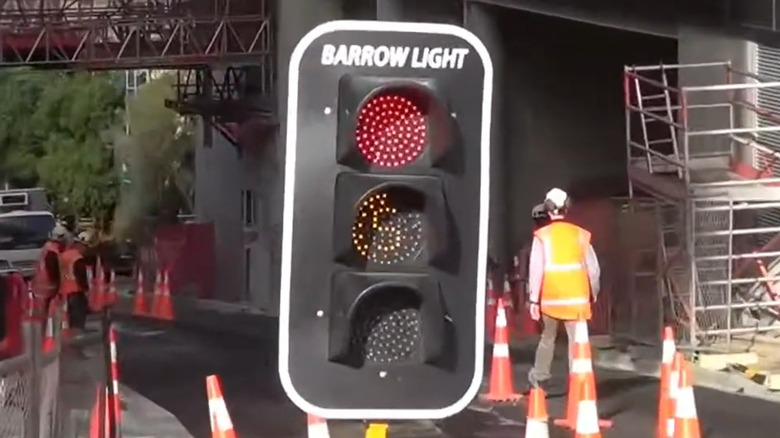
Traffic lights are an integral part of maintaining order among vehicles, cyclists, and pedestrians. And while an agreement has been in place since the late 1960s standardizing intersection lights across many places in the world, some differences remain. For example, in over 20 countries, instead of the solid yellow light used in the U.S., there is a countdown timer.
A yellow light is an indication that a red one is coming, but some say that numbers counting down to red would be better than a solid light. When drivers approach an intersection with a yellow light, there is a moment when they must either commit to going forward or prepare to stop. Researchers at Oregon State University refer to this as the "dilemma zone," and suggest that a countdown timer for American intersections would prevent misjudgments behind the wheel, averting potential incidents.
However, while a countdown timer for crosswalks is permitted in the United States, the U.S. Department of Transportation doesn't allow traffic lights to be modified in this way. The concern is that introducing more data for drivers at each intersection could become too much for motorists to process, leading to crashes. Just look at how these pedestrian traffic signals are confusing drivers, leading to situations where they go when they should stop and visa-versa. In addition, the lack of countdown timers on traffic lights could also have to do with the type of signal technology being used, and the cost of implementing a timer on every light.
Timers wouldn't work well with actuated signals, and installation would be expensive
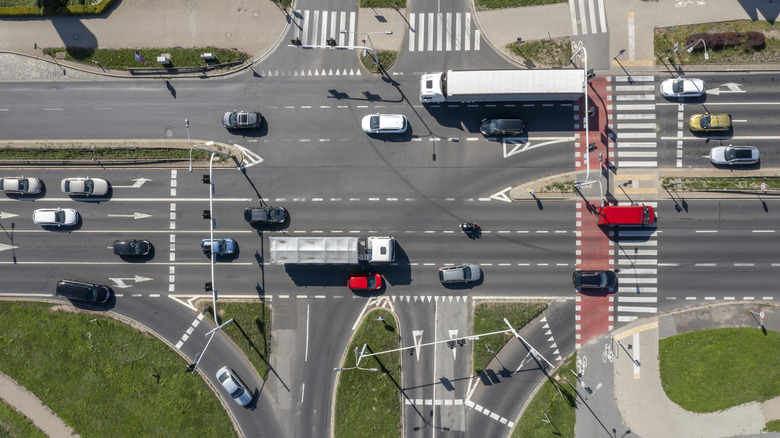
According to Oregon State engineering researcher David Hurwitz, "Traffic signal countdown timers work well at fixed-time signals, but may not be practical for actuated signals." Actuated signals include one component for monitoring traffic and another to make changes in the light cycle to prioritize efficient traffic flow. The issue with a countdown timer in actuated systems is that these lights may change from yellow to red in a few seconds, leaving little opportunity for a countdown to be useful.
In fact, if a timer were to appear for a few seconds, not only would it be pointless, it might disorient drivers trying to quickly process the information. Simply adding the countdown to timed lights would also create inconsistency across intersections, with some traffic signals including it and some not, potentially leading to confusion.
Of course, adding these timers to all traffic lights would also be costly. According to the University of Michigan, the U.S. has about 320,000 traffic signals. While the cost of traffic light timers is unclear, adding countdown timer modules to pedestrian signals costs $190 to $1,930 each, according to the Federal Highway Administration (via PedBikeSafe.org). Why such a huge price range? It's unclear, but there are examples across the country of egregious sums being spent for seemingly straightforward projects. Fresno spent $2.4 million to activate a single traffic signal, with challenges behind the scenes regarding land rights, tree clearing, and equipment costs.