

5 Engines With The Longest Production Runs
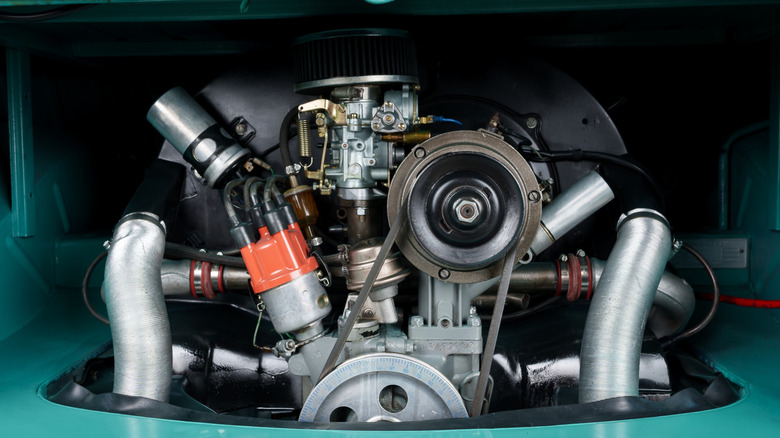
Many vehicles have enjoyed impressive market longevity over the years. However, the engine under the hood might carry on even longer, powering generations of vehicles, or even models from rival automakers. As you'll see in the list below, there was a time when engines remained in production for decades without major changes. However, more aggressive emissions regulations and fuel economy requirements have presented tougher challenges for engines to maintain compliance. Several states have now adopted more stringent California Air Resources Board standards. With the advent of smaller-displacement engines, hybrids, and EVs, technology is changing at a rapid pace.
Identifying the longest-in-production engines is not without some caveats. An engine will often receive significant modifications over its lifetime, depending on the requirements. This can include displacement (bore and stroke), cylinder head design, and intake or fuel delivery system, among other things. On this list you'll see engines no longer in production where the fundamental architecture remained the same. This includes major specifications like the angle between cylinder banks and the valve train configuration (overhead valve or overhead cam). Similar dimensions and specifications may also allow for interchangeable parts.
Ford 300 inline-6 engine (31 years)
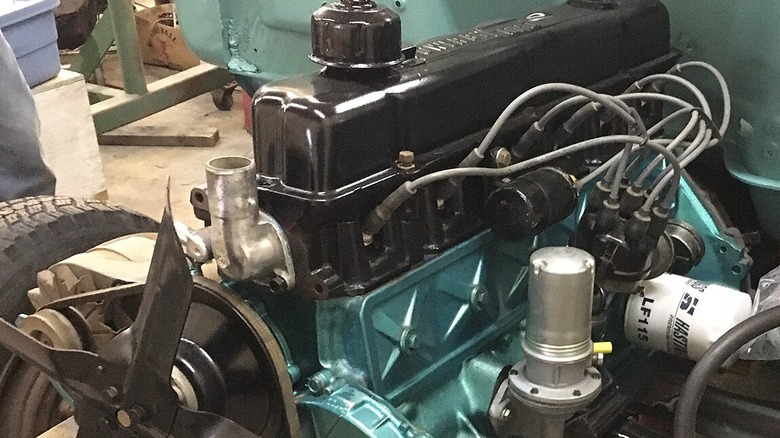
This lineage of Ford inline-6 engines can be traced back to 1941, and a notable version of this engine family debuted as a new fourth-generation design in 1965. This generation of Ford's inline-6 was initially available in both 240- and 300-cubic-inch displacements. The 240-cubic-inch engine would briefly power Ford cars from 1965 to 1974, while the 300-cubic-inch engine was first available in Ford F-Series trucks for 1965. A lot of attention was given to V8 engines over the same time period, but the Ford 300 inline-6 engine proved to be a reliable workhorse.
While the Ford inline-6 engine topped out at 150 horsepower in its last years, the torque spec was always impressive. Early versions of the Ford 300 delivered peak torque of 223 pound-feet at just 2,000 rpm, later increased to 260 lb-ft by the 1990s. Not limited to just Ford trucks, the engine would additionally see duty in other applications, such as generators, irrigation pumps, and UPS delivery trucks. With minor improvements, such as an engine control unit and fuel injection, the Ford 300 (later referred to as a metric 4.9 liter) would continue to power Ford F-Series pickups all the way until 1996.
AMC straight-6 engine (42 years)
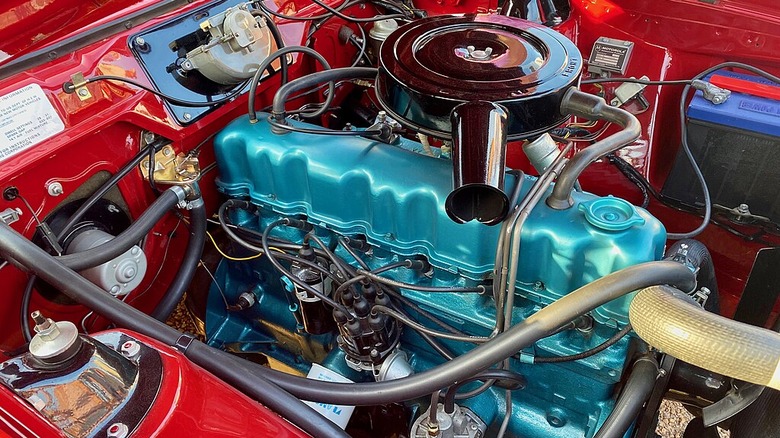
The American Motors Corporation (AMC) straight-6 engine debuted in 1964 and would survive for over four decades. AMC commemorated the release of this new engine with a special-edition "Typhoon" Rambler Classic. After AMC acquired the Jeep brand from Kaiser in 1970, the AMC straight-6 would replace the V6 engine purchased from Buick a few years earlier. . AMC initially installed its straight-6 in the full-size Jeep vehicles. However, the front clip on the 1972 Jeep CJ5 would have to be extended 3 inches to accommodate the extra length of this engine. This engine would later power many AMC passenger-car models, including Gremlin, Hornet, Concord, and Eagle.
Saddled with increasingly complicated emissions controls, the AMC straight-6 struggled through the mid-1980s, until the engine was extensively reengineered through AMC's joint venture with Renault of France. For 1987, the now 242-cubic-inch straight-6 was given the 4.0-liter metric designation, and featured new port fuel injection.
That same year, Chrysler completed its purchase of American Motors, but would retain the proven 4.0-liter engine for nearly two more decades. During that time, the engine would receive a host of upgrades and improvements, but it was becoming harder for it to meet emissions requirements. As a result, it would be slightly detuned for 2002, then finally discontinued altogether in 2006.
Buick 3.8-liter V6 engine (47 years)
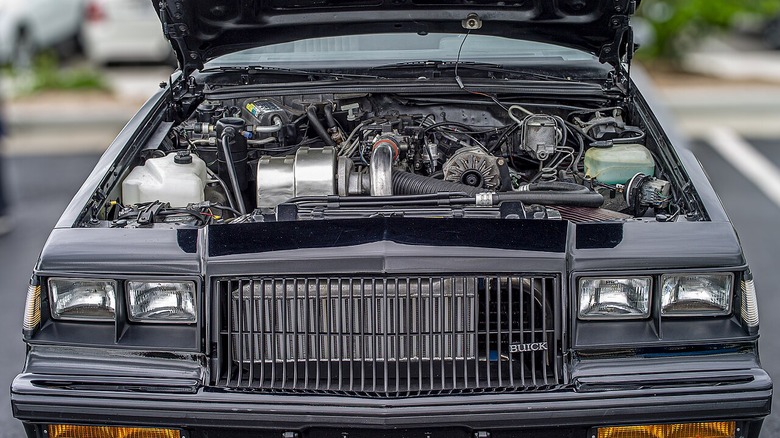
Introduced in 1962, the Buick 90-degree V6 was a staple of many General Motors vehicles for decades, rivaled in longevity only by Chevrolet's small-block V8. This V6 engine was basically designed by removing two-cylinders from a Buick V8, sharing many parts and reducing costs. However, having two less cylinders than the V8 gave the engine an odd firing pattern that resulted in rough running characteristics.
Meanwhile, Kaiser-Jeep made an arrangement to use the Buick V6 in its CJ5 for 1966. Buick, unpleased with the outcome of its V6 engine, then made the decision to sell the tooling outright to Kaiser-Jeep in 1967. Fast forward to the OPEC oil crisis and new EPA regulations, and suddenly a V6 engine offering was looking paramount for GM. In a strange turn of events, Buick would buy back all of its V6 tooling from then AMC in 1974. Starting in 1975, a 231-cubic-inch version of the Buick V6 would proliferate across the GM lineup to stay on target with federal fuel-economy and emissions requirements.
By 1978, Buick was releasing T-Type versions of most two-door models, equipped with a turbocharged version of the 231 (now with the 3.8-liter metric designation) V6. This culminated with the iconic Grand National and GNX models in the late 1980s. GM also adapted the 3.8-liter V6 to front-wheel-drive duty in some of its new platforms during the 1980s.
Later rebranded the 3800, the engine soldiered on for another two decades as a mainstay in many front-wheel-drive GM vehicles. The Series II 3800 engine arrived in 1995, with a host of improvements, including a supercharged variant. The Series III debuted in 2004 with further enhancements, until the 3800 V6 was finally retired in 2008.
Rolls-Royce-Bentley L-series engine (61 years)
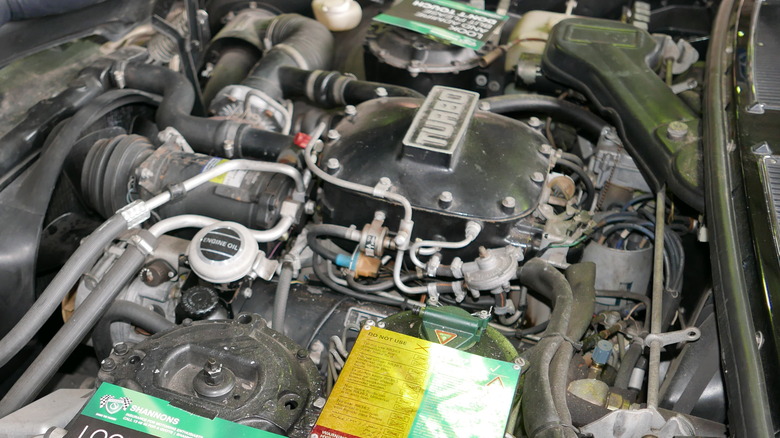
The 90-degree L-series V8 engine premiered n 1959, when Rolls-Royce and Bentley were under the same ownership. The Rolls-Royce Silver Cloud II and Bentley S2 were the first models powered by the new 6.25-liter V8 engine. Fast-forward to 1971, when a slight increase in stroke would bump the engine's displacement up to its familiar 6.75 liter designation. The next major upgrade to the L-Series V8 came in 1980, with the addition of fuel injection. Another milestone was 1982, when the engine was first turbocharged for the Bentley Mulsanne Turbo model.
In 1998, a complex sale split up Rolls-Royce and Bentley and sent them on different trajectories. BMW purchased the rights to the Rolls-Royce name and logo, producing a new Phantom model equipped with a BMW V12 engine by 2003. Meanwhile, Volkswagen acquired the rights to Bentley, including the Rolls-Royce-Bentley factory in Crewe, Cheshire, England. The 2002 Corniche was the last Rolls-Royce model equipped with the storied 6.75-liter V8. It also was the last Rolls-Royce built at the Crewe factory.
The L-series V8, though, carried on with substantial improvements, including variable valve timing and cylinder deactivation in 2010. The Mulsanne was the last Bentley model powered by the L-Series V8, until both were retired in 2020.
VW flat-4 engine (70 years)
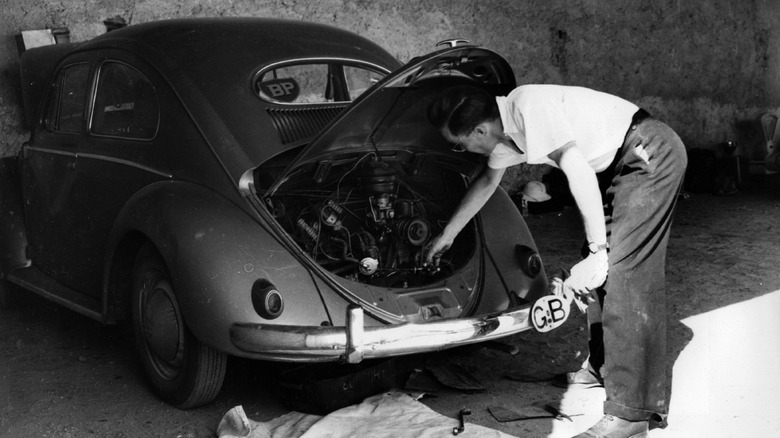
The iconic air-cooled Volkswagen flat-4 engine was engineered by Ferdinand Porsche during the 1930s. The power plant would become synonymous with the VW Beetle, both designed around a set of requirements set forth for the vehicle dubbed the "People's Car." An early predecessor to the Beetle, dubbed the KdF-Wagen, entered limited production in 1939. After the dark chapter of World War II, the air-cooled Beetle returned to consumer mass production in 1945. Designated the Type 1, the Beetle engine saw gradual increases in displacement over the car's life, ranging from 1,100 to 1,600 cubic centimeters (1.1 to 1.6 liters).
VW later introduced a variety of air-cooled flat-4 models. The Type 1 Beetle would eventually be joined by Type 2, Type 3, and Type 4 models and unique engine configurations. Type 2 included the Transporter/Bus. The Type 3 represented the VW Squareback, Notchback, and Fastback models. Lastly, the Type 4 Volkswagens included the VW 411/412, Porsche 914, and late-model VW Buses. Type 4 offered the largest-displacement air-cooled VW engines, with displacements ranging from 1,700 to 2,000 cubic centimeters (1.7 to 2.0 liters).
VW officially ended production of its air-cooled models in Germany when the last Beetle rolled off the assembly line at its Emden plant in 1978. However, this was far from the end of the seminal VW air-cooled engine. VW had also been manufacturing Beetles, Kombis, and other air-cooled models at its Puebla, Mexico plant since 1967. Beetle production continued all the way until 2003, when the final "Última Edición" models rolled off the assembly line. Assembly of the Type 2 Kombi still continued in Brazil, though, with the last air-cooled version ending production in 2005. This finally marked the end of a 70-year run for the flat-4 air-cooled VW engine.