

2026 Dodge Charger Sixpack's Muscle Car Silliness Will Help You Forgive Its Woke Engine
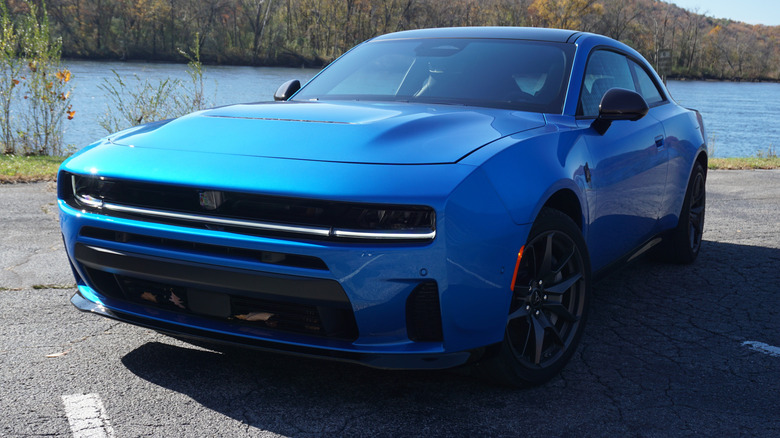
Dodge doesn't do "woke." It doesn't do blue hair or pronouns or genderfluidity or Zohran Mamdani, yet when it came time to put an internal combustion engine in the eighth-generation Charger, it ditched the Hemi V8 (which has seen a resurgence in the Ram pickup, Durango SUV and Jeep Wrangler) for Stellantis' twin-turbocharged 3.0-liter inline-six Hurricane motor. Despite the fact that woke is dead, Dodge has soldiered on with the 2026 Charger Sixpack, and you can call me a crazy lib all you want, but I think the Charger Scat Pack is all the better for it.
Sure, this straight-six is more of a genderfluid-six if you ask people on X (the everything app), but its relatively small package brings with it a huge muscle car–like punch that even the most ardent Fox News viewer will appreciate. What the Charger Scat Pack is missing in Hemi V8 noise, it more than makes up for with classic muscle car silliness, genuinely fine handling and a level of comfort that's hard to beat at any price. On top of all that, there are enough gimmicks packed in to keep even the most iPad-pilled Boomer entertained for days on end.
Full Disclosure: Dodge flew me down to Knoxville, Tennessee, put me up in a lovely hotel and fed me all so I could drive the 2026 Charger Scat Pack on the Tail of the Dragon.
From broke to woke
The electric Charger Daytona is, frankly, not selling well. Dodge moved just 2,776 Daytonas through the first three quarters of 2025. The lackluster reaction has forced the company to drop the lower-priced Daytona R/T model for 2026 and nixed plans for a halo SRT Daytona Banshee. It also cut Daytona Scat Pack prices and actually moved up the Sixpack's release date to help get the money flowing again. All of this is to say, the Charger Sixpack is incredibly important for Dodge.
 Andy Kalmowitz / Jalopnik
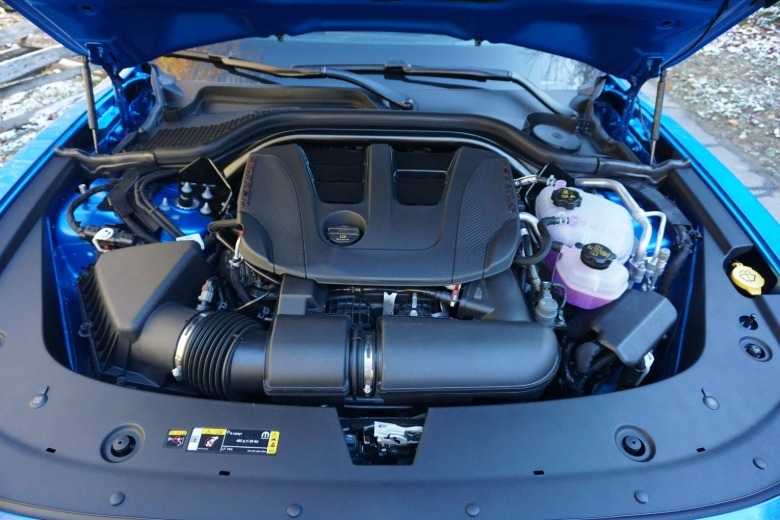
Like in other Hurricane-equipped vehicles, there are two output levels to choose from: Standard and High. Since I only drove the High-Output Scat Pack, I won't concern myself with the 420-horsepower R/T. While some of you Real American Patriots will point out that there's no replacement for displacement, I'd like to point out that the 3.0-liter Hurricane makes more power than the 5.7- and 6.4-liter Hemis that were under the hood of the previous Charger and Challenger. In High-Output Scat Pack guise, the inline-six puts out a strong 550 hp and 531 lb-ft of torque with the help of 30 psi of boost. That's an improvement of 65 horses and 56 torques over the old car.
All of that power is routed through a quick-shifting ZF eight-speed automatic transmission and a mechanical limited-slip differential. And I know, the Sixpack's all-wheel drive is sacrilege in the world of muscle cars, but I promise that there's no need to worry. In Sport mode, the Charger can completely disconnect its front wheels and turn into a true rear-wheel-drive monster that can transform rubber into a fine, inhalable mist.
 Andy Kalmowitz / Jalopnik
There's no getting away from the fact that the Scat Pack's engine doesn't sound nearly as good as the Hemis of days gone by, but it certainly makes an interesting noise. Since you're reading this and cannot hear the written word, I'll say that from inside the car, it sounds sort of like a Nissan VQ engine when you rev it out, but there's also a lot of very welcome turbo noises coming from under the hood. Oddly, on the outside, there's a completely different sound profile that's much more similar to a modern BMW inline-six. I know what you're thinking: So, it sounds like import crap, not American muscle. Well, the whole dual-mode exhaust system carried a deeper baritone lower in the rev range than you might expect from an I6. At idle, it honestly sounds a bit V8-ish.
And don't you worry about gas mileage. You can still own the libs with your fuel consumption. Over about 110 miles of driving the Charger, I averaged a Patriot Approved 9.6 miles per gallon. Right now, neither Dodge nor the EPA has given fuel economy estimates for the Sixpack Scat Pack.
Tackling the tail
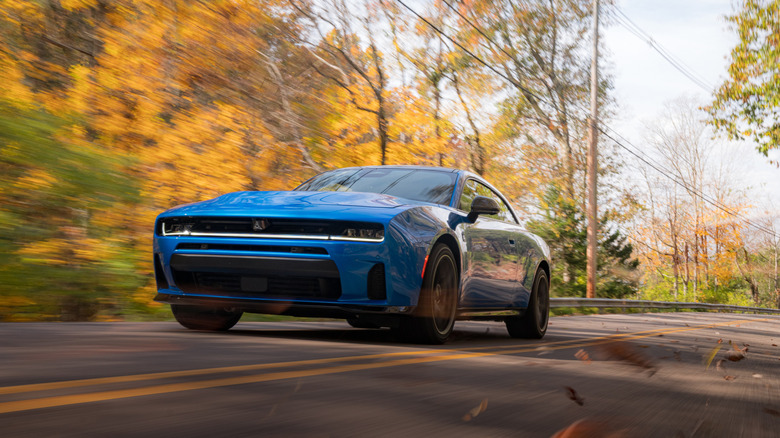
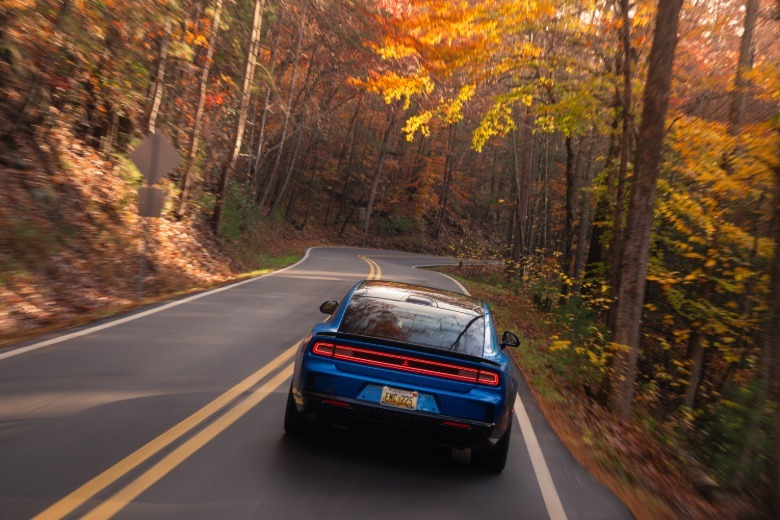
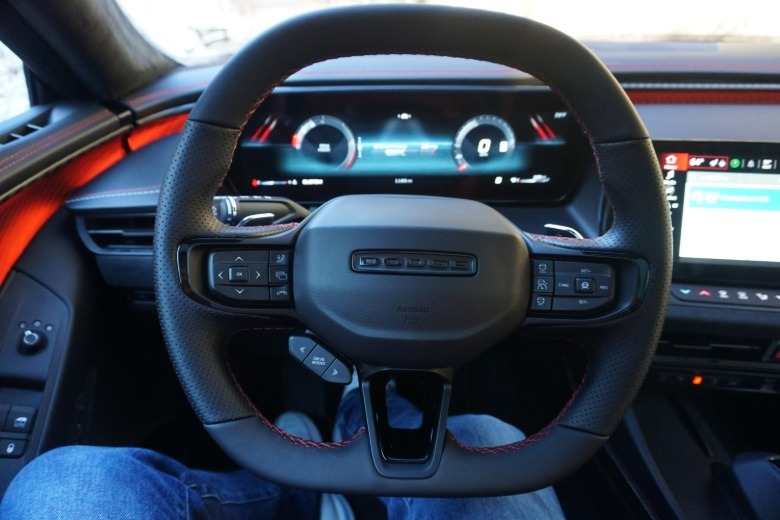
The Charger Sixpack Scat Pack is not a sports car, but it's also not as dogshit as a traditional muscle car should be on a road like the Tail of the Dragon. Don't get me wrong, if you overcook it, the thing will still understeer like a pig. But if you learn to go easy into a corner, be deliberate with your turns of the very vague-feeling and very square steering wheel, and plant your foot on exit, you can have a genuinely fun time in this car.
If being a hooligan is the goal, the Charger excels at that, too. Dodge set up a drift course for us, and I was shocked at how controllable it is. There's no clutch kicking or Scandi flicking involved. This is old school. Come up to a corner, start to turn, and mash the throttle. It'll go sideways really quickly, but the car's magic is in how easy it is to hold those drifts.
 Dodge
Dodge
There are five drive modes to choose from: Auto (woke), Eco (woke), Wet/Snow (Wo/ke), Sport and Custom. When you've got it in Sport or Custom, the Charger really comes alive. The steering never gets more communicative or anything like that, but you can disable the front wheels and go RWD only, which makes everything very silly. Turn traction control off, and boy, nightmares can happen very quickly. AWD is for winning races, and RWD is for looking like you're having a great time while losing races.
 Andy Kalmowitz / Jalopnik
Because of the AWD and that eight-speed auto, the Charger Sixpack hooks up like you wouldn't believe. Dodge says its 0-60-mph time is 3.9 seconds, and it'll dispatch the quarter-mile in 12.2 seconds. Put the hammer down, and it'll hit 177 mph. Not bad for a coupe that weighs over 4,800 pounds.
I brought the car to an 1/8th-mile drag strip, and after warming up the rear tires using line-lock, I laid down a 7.924-second time at 90.84 mph, and that was with about 450 pounds worth of people in the car. While it might sound like some import crap from the outside, on the inside, you'll be grinning like Laura Loomer at a MAGA rally.
Styling made great again
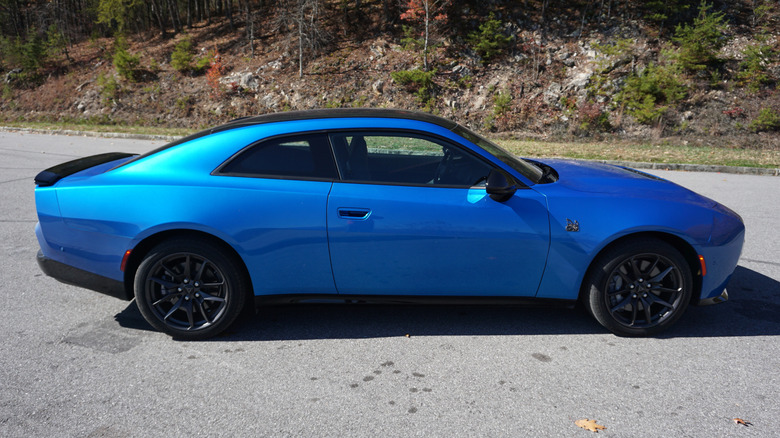
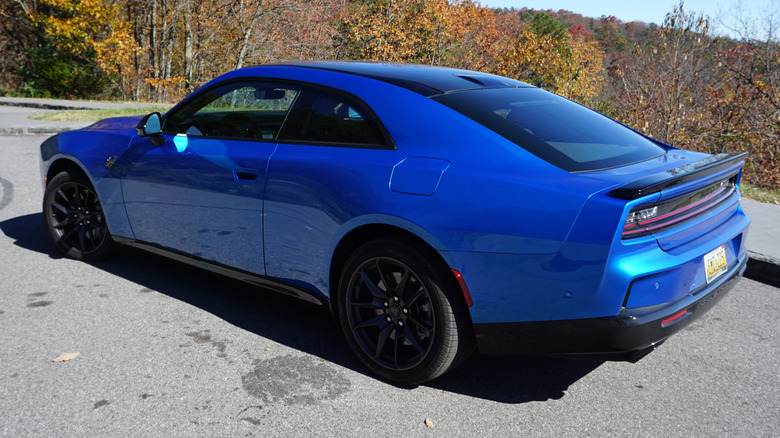
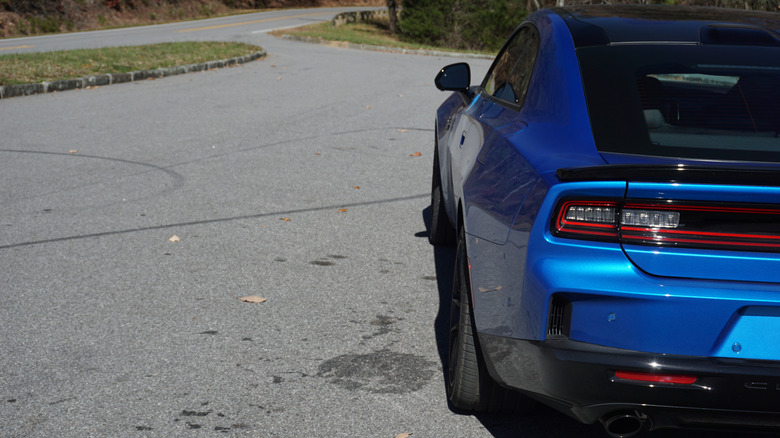
At first glance, it's pretty damn hard to tell the Charger Sixpack apart from the all-electric Charger Daytona. Dodge did this on purpose, and it built the car with a common body structure to allow for flexibility when it came to the powertrains. Of course, the easiest tell is out back. The Scat Pack has dual exhaust pipes, and while I'm sure Dodge designers played around with the idea, the Daytona doesn't. The rear bumper now reads "CHARGER" rather than "DAYTONA," but I wouldn't expect many to notice that since reading is for squares, just like turbochargers.
 Andy Kalmowitz / Jalopnik
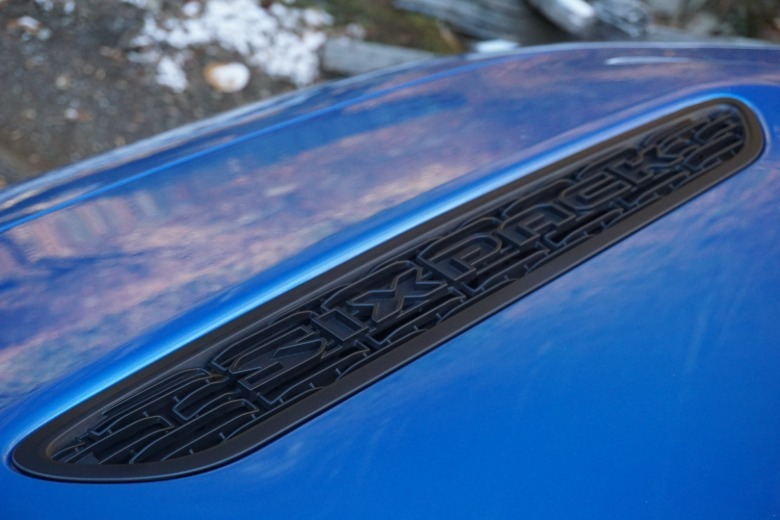
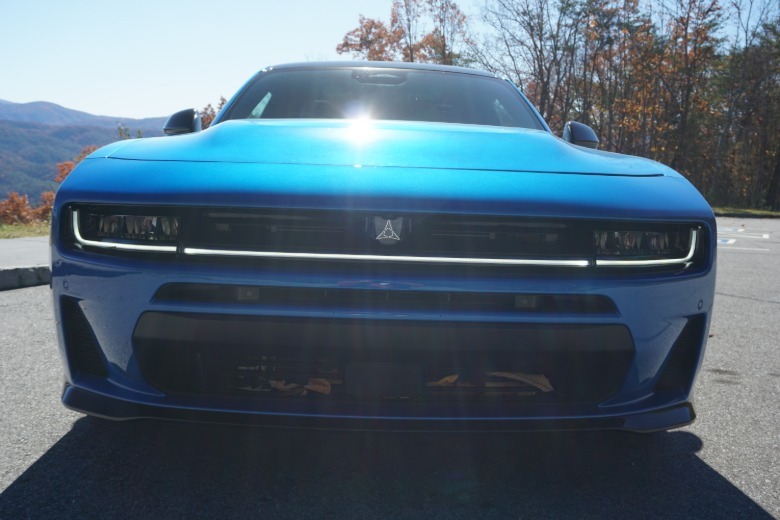
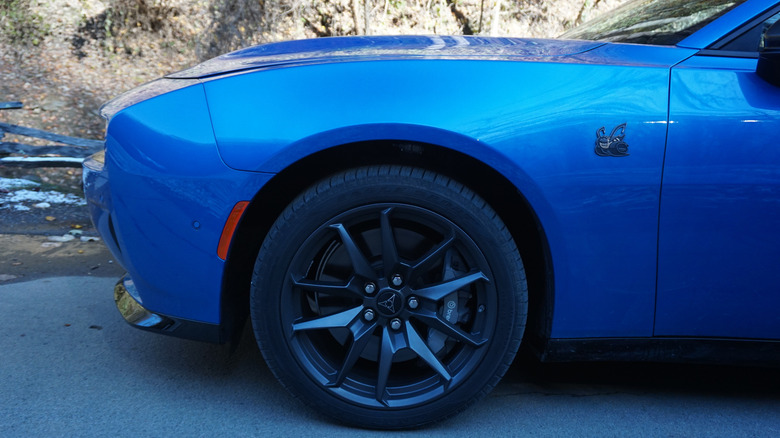
There are plenty of design changes up front, too, including a new front bumper and hood. The R-Wing pass-through in the hood is a defining design element of the Daytona, but Dodge dropped it from the Sixpack for obvious reasons. It didn't need those aero gains, and it would have taken up valuable space where the engine needed to go. That means the Sixpack gets a taller hood with a bit of a power bulge in it, on the backside of which is a false vent with "SIXPACK" written on it.
Dodge went to work with a Sawzall on the front bumper to get more air into the engine bay and other parts of the car. Engineers opened up the lower fascia and grille, and cut a mail slot between the two to ram as much air into that engine as possible. It also added brake duct cooling lanes along the right and left sides of the bumper to keep brake temperatures under control.
 Andy Kalmowitz / Jalopnik
Other than that, the two cars are exactly the same on the outside. It still looks great from some angles and not so good from others. The front and rear head-on views are still my personal favorites, and they draw the most inspiration from the Dodges of Nixon's America. The coupe still deals with the awkward rear three-quarter angle that makes the rear wheels look too small, no matter what you do. There's just so much bodywork. Luckily, this is fixed by going for the four-door Charger sedan, which is $2,000 more expensive than the two-door for both the Sixpack and Daytona. While coupes are cool, the sedan is probably the one I'd buy for just that angle alone. No matter which you choose, you still get that wonderful liftback tailgate, and the exterior dimensions are exactly the same. Of course, styling is subjective, so your results may vary.
If it ain't too badly broke
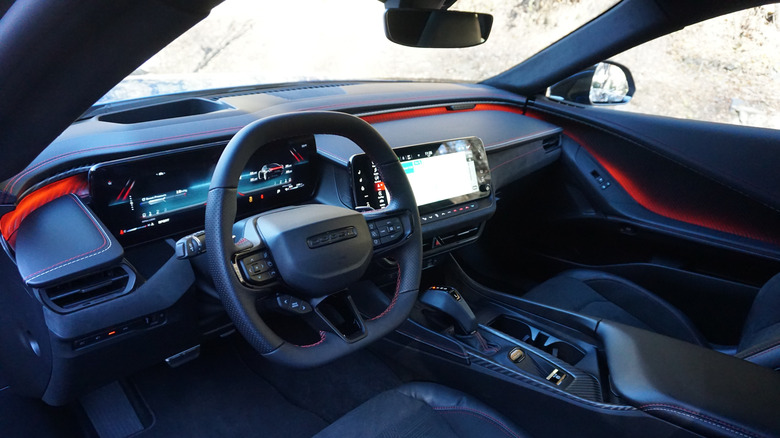
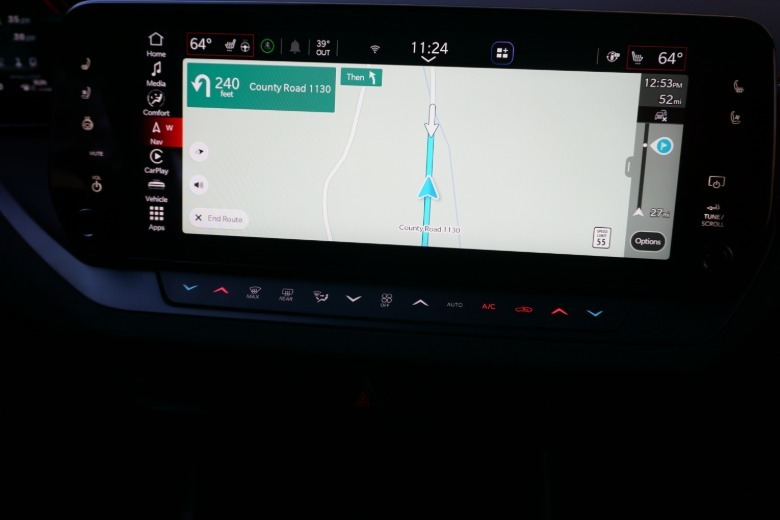
Much like the exterior, the Charger Sixpack's interior is very similar to the Daytona's. That is to say that it's no luxury car, but it's certainly a step up from the old Charger and Challenger, and it feels a bit better screwed together than those piles were. The only giveaways that this is a gas car are the "L" button on the shifter and the tachometer in the massive 16-inch digital gauge cluster. (A 10.25-inch screen is standard.) To the right of the gauge cluster is the 12.3-inch infotainment display running Stellantis' Uconnect 5, and above it is a head-up display. Overall, the trio of screens are fine. They're easy enough to navigate and customize, but there's a bit more lag in the systems than anyone would really like. On each side of the center screen, there are capacitive touch buttons for heated/cooled seat controls, and they gave me such a hard goddamn time. I don't know if it was because of the cold temperatures, but it took a lot of attempts to get them to register my touches. At least there are physical volume and tuning knobs, and a slew of buttons below the screen for your other climate controls.
 Andy Kalmowitz / Jalopnik
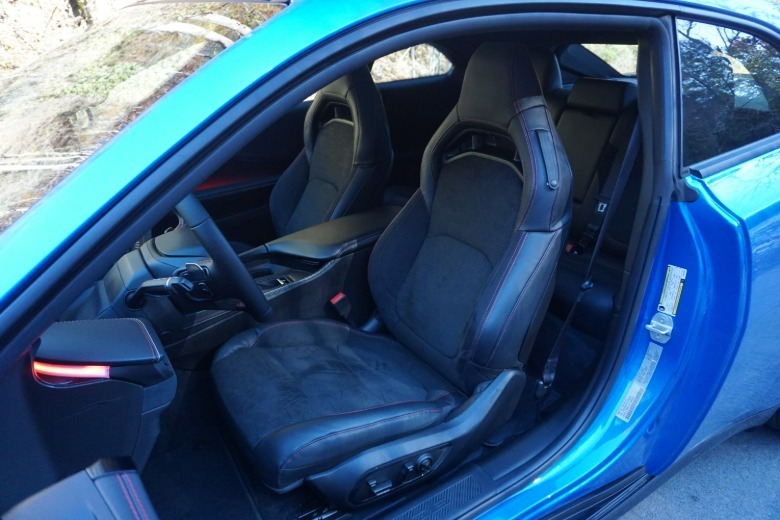
The Sixpack also gets the lovely suite of safety tech found in the Daytona, including stuff like a surround-view camera, adaptive cruise control, blind-spot intervention and lane-keeping assist. All of the systems actually work really well together, and Stellantis actually has one of the better Level 2 driver-assistance systems in the industry. It does a great job of keeping you in your lane and out of the car in front of your bumper. Factor in the extremely adjustable and supportive bucket seats of the Scat Pack (pulled right from the Daytona), and you've got a delightfully comfortable long-distance cruiser. You're going to have to stop for gas pretty often, but at least it'll be comfy. I know comfort is for babies, but I won't tell anyone if you don't.
 Andy Kalmowitz / Jalopnik
The rear seats, while rather spartan, are cavernous. There are oodles of space back there, including 37.2 inches of legroom, which is a 4.1-inch improvement over the Challenger. Adding in the 36.9 inches of headroom means that, despite the fact this thing only has two doors, I can fit comfortably in the rear seats behind my driving position, and I'm 6-foot-1. While there isn't much going on back there, at least passengers will be able to look through the optional fixed glass roof or at the 64 selectable ambient lighting colors that bounce oh-so-nicely off the carbon fiber on the door panels.
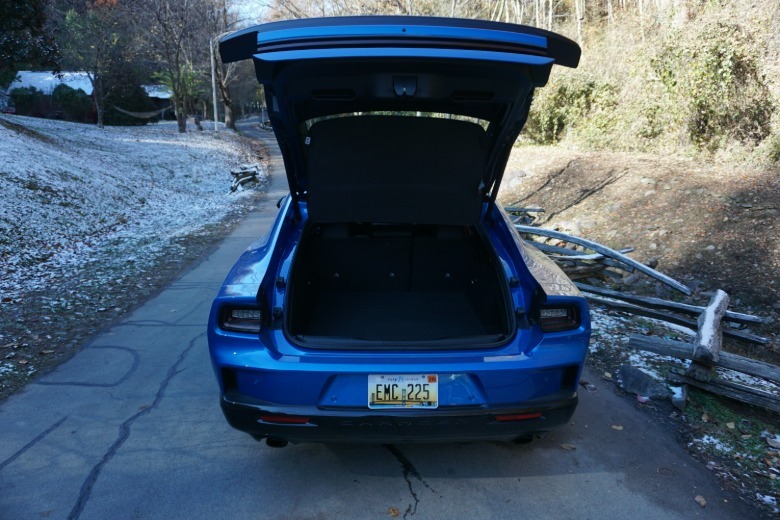
Behind those seats and under the brilliant liftback, Dodge says you can put 22.8 cubic feet of your bugout supplies in the trunk. If you plan on being off-grid for a bit longer, drop those rear seats and it expands to 37.4 cubic feet. You won't find a coupe with more trunk room than that.
Pay pigs
If I'm speaking your language, and you want to get the muscle car with the woke motor (you should, it's quite good), I've got excellent news. Dodge says it's going to start shipping the Charger Sixpack Scat Pack very soon. Prices start at $56,990, including destination. That might sound like a lot, but Dodge says it's the cheapest 550-plus-horsepower car you can buy right now, and I'm fairly certain that's correct. Regular Sixpack R/Ts are slated to start at $51,990, so you might as well spend the extra five grand for all that power.
Of course, you won't get all of the goodies on my test car for $56,990. You'll have to pay the piper. Right off the bat, my car's Bludicrious will set you back $695. Then, there's the $4,995 Customer Preferred Package 22B. It has nothing to do with Subaru, but it does come with ventilated front seats, heated rear seats, performance pages in the infotainment system, the 16-inch gauge cluster, a wireless charging pad, the surround-view camera, the head-up display, that ambient lighting, and about a million other things. Get this package. You need it.
 Andy Kalmowitz / Jalopnik
Next, add on the $1,095 Blacktop package, which gives the Scat Pack black exhaust tips and dark exterior badging. Then, you're going to want to click on the box for the $1,995 Carbon and Suede Package, which gets you exactly what you'd think: heated and power-adjustable mirrors with a carbon-fiber cover and exterior puddle lights with logos.
We're not done yet, friend. You'll need to spend $1,095 on 20-inch wheels and $995 for the full glass roof. Last but not least, fork out another $1,495 for the 18-speaker Alpine stereo system. All of this comes out to a grand total of $69,355.
Charger V8 2028
You're paying a lot of money, but this is supposed to be a lot of car, after all. Dodge wants the Charger Sixpack to be your do-everything vehicle, and in a lot of ways it can be, but it doesn't always take the most orthodox approach, so you get things like the inline-six rather than a V8 and the liftback rather than a trunk. For a company that is mostly averse to taking risks, the new Charger is a massive one in general, so Dodge does deserve some credit for that.
There's little doubt in my mind that Tim Kuniskis and his merry band of engineers will eventually shove a Hemi V8 back under the hood of a Charger with a Symbol of Protest badge slapped on the fender, but I think that'll be a mistake. I worry that one day we'll look back on the Charger Sixpack Scat Pack as a weird interlude in the Charger/Challenger lineup — a vehicle sandwiched between two V8 offerings when the Hemi inevitably returns. I hope that isn't the case, because the Hurricane Charger is good enough to stand on its own two legs, but I don't know if it can outrun the world its automaker created for it.
The Hurricane inline-six suits the Charger, and the Charger suits the Hurricane. Of course, the old adage is "go woke, go broke," but hey, at least it's not electric.