

The Future Of Aviation Might Be As Boring And Brilliant As A Toyota Prius
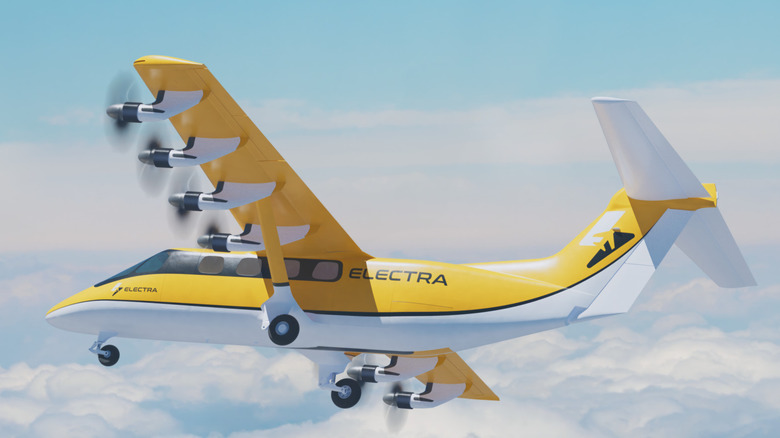
The future of aviation usually promises ridiculous vaporware that looks cool but hasn't yet flown, which is part of the reason why it's too soon to let supersonic flights rip across the country. However, there's an aircraft that's racked up over two thousand orders and it doesn't look like some AI-generated slop. It looks, well, like a plane. Oh, and it works similarly to the car your Uber driver may pick you up in.
The company, Electra, is pushing a hybrid-electric ultra-STOL (short takeoff and landing) aircraft that claims it can operate out of a space as tight as 150 feet. That's like landing a plane within a New York City block without even enough room to spare to grab a hot dog from a cart. This short runway specialist owes its success, in part, to a clever blown flap design, which is not unique to this plane but certainly helps its purpose. Electra's goal is to deliver people or cargo much nearer to the intended destinations.
What makes a $4 million price tag with thousands of orders viable isn't warp drive, rocket boosters, or quantum science breakthroughs. Rather, it's hybrid technology. Just like the humble hatchback that changed roads forever, the future of aviation might just be a flying Toyota Prius.
Batteries can fly in hybrid skies

The biggest problem with an all-electric plane is the same one that electric cars realize the hard way – batteries are expensive and heavy. In fact, the Ford F-150 Lightning's battery alone weighs as much as a Volkswagen. The solution? Just bring the charging station along for the ride (kind of). The automotive space has been doing this for a while now with range extending hybrids, and Electra is applying that same logic to the skies.
A gas-powered turbogenerator sits in the fuselage, humming along to generate electricity. That powers a battery which leads to eight electric motors distributed across the wings. This is where the magic happens. It utilizes a concept called blown flap. By distributing those eight props across the entire span of the wing, the plane forces air over the flaps at high speed, even when the aircraft itself is moving slowly.
It essentially tricks the wing into thinking that the plane is flying faster than it is, generating massive amounts of lift at parking lot speeds. Couple that with near-instant torque from the electric motors, and it seems to be a recipe for a run(a)way success, and you have a plane that can take off in wildly short spaces without stalling.
The combat Prius
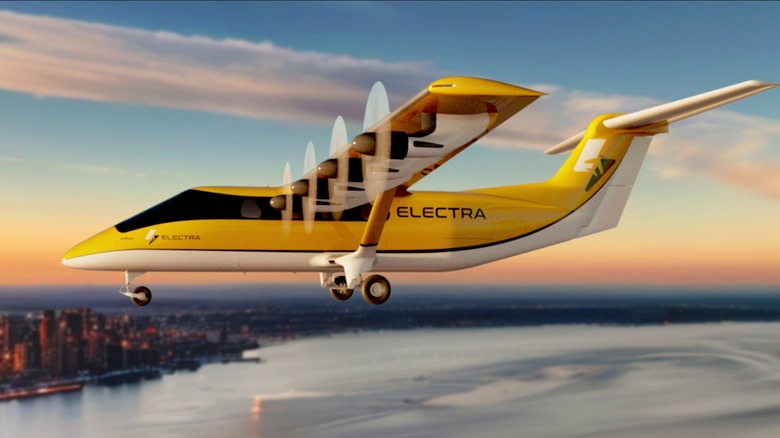
You know an idea is brutally practical when the U.S. government starts asking about it. Obviously, the U.S. Army has taken an interest in Electra's design, recently awarding the company a $1.9 million contract to explore the technology for logistics and contested logistics.
The military has a long-standing obsession with getting aircraft into and out of tiny, rough spaces without getting shot down. Helicopters are great, but they are loud, slow, and mechanically complex nightmares. A fixed-wing aircraft that can drop supplies onto a soccer field — or a forward operating base with no runway — without needing specialized fuel trucks is a logistician's dream. The ability to move things to once limited posts without needing a traditional or long concrete runway is certainly helping the idea gain traction.
It's the Combat Prius — not built for glamour, but for unadulterated practicality. While the rest of the aviation world dreams of supersonic jets that shatter windows, Electra's smaller proof-of-concept, the EL-2 Goldfinch, is adding an exclamation point to the boring hybrid tech, and it may actually get us to the future.