

5 Of The World's Longest Bridges You Can Drive Across
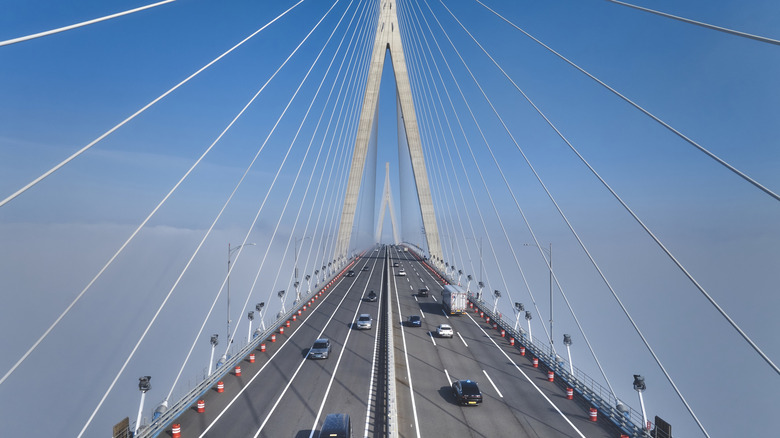
Trigger warning: If you suffer from gephyrophobia — a fear of bridges — you may want to stop reading right now. We're going to be talking about driving on some of the longest bridges in the world, and, as experts point out, the phobia is serious. The fear can be so intense that some places with large bridges have escort programs where you can arrange to have police personnel drive you over their bridges. The Delaware River and Bay Authority Police Department says that about 450 drivers take advantage of the service each year to navigate the Delaware Memorial Bridge. On the other hand, watching big trucks try to go under low bridges is kind of satisfying, and they can create some of the best bridge wreck videos of all time.
As for the bridges themselves, the absolute longest ones in the world are designed for trains, not cars, so you won't see them here. But don't worry, we won't leave you hanging — there are five train bridges that are longer than the longest road bridge, with the Danyang-Kunshan Grand Bridge in China leading the way at more than 102 miles. It's more than three times longer than the longest drivable bridge in the world.
Manchac Swamp Bridge
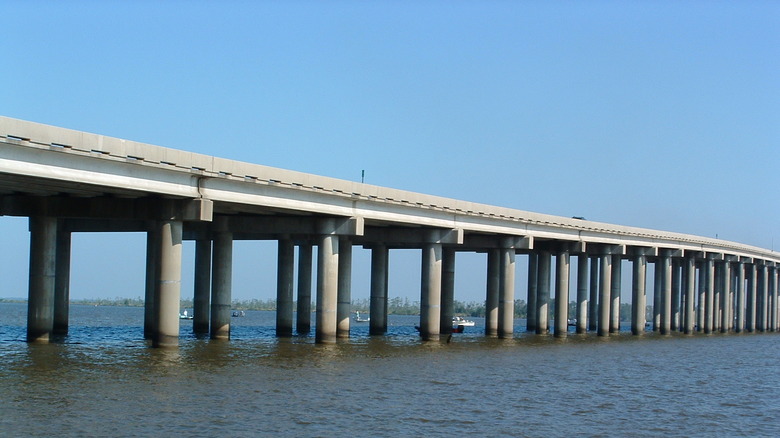
Now, among the drivable bridges, let's start in the United States with the Manchac Swamp Bridge in Louisiana. It opened in 1979 to help drivers get over a swampy area on the northeastern end of Lake Maurepas where it flows into the Pass Manchac — which, in turn, leads to Lake Pontchartrain, home to an even longer bridge we'll discuss later. And to be clear, the Manchac is no ordinary swamp. Legend has it that the Cajun werewolf, the Rougarou, prowls the area.
The Manchac Swamp Bridge is actually two parallel roadways covering some 22.8 miles of Louisiana's Interstate 55 and U.S. Route 1. Due to the marshy nature of the ground, it's supported by robust pillars that start 250 feet below the surface. An expensive proposition, this helped push costs up to the equivalent of nearly $770 million today. There was a good reason for going overboard, however. It turns out that the current bridge is the second span over the swamp — the first collapsed in 1976 after one of its supports was hit by a barge.
Lake Pontchartrain Causeway
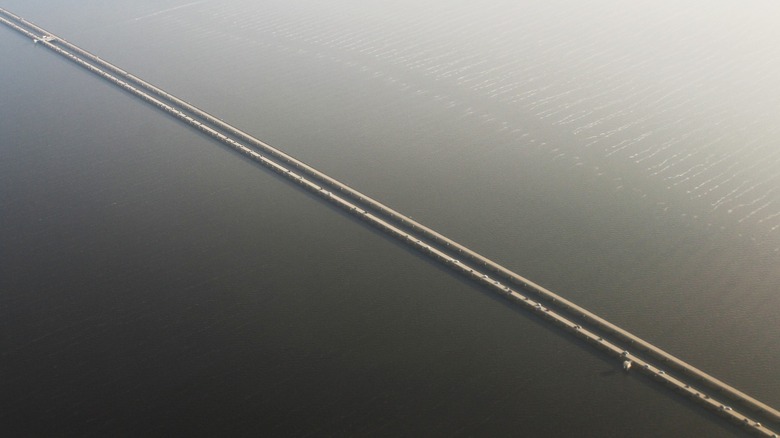
The world's longest continuous bridge over water, the Lake Pontchartrain Causeway, can take you to the end of the world. That said, it was designed to take you from New Orleans to Mandeville by going right across the lake for a distance of 23.9 miles. The bridge started life in 1956, but a second span had to be added in the 1960s to help ease traffic congestion. The new setup opened in 1969 with three elevated sections to help ships pass beneath. While most of the causeway is about 10 feet above the water, there are three 25-foot sections, one section with a 50-foot clearance, and even a drawbridge (with a 45-foot clearance when closed).
According to the American Society of Civil Engineers (ASCE), the original causeway marked an innovative new approach to bridge building. Per the ASCE, it was the first time a bridge was built following "assembly-line, mass-production methods," and the Causeway further marked a major advance for the use of pre-stressed concrete. Without going too far into the details, the ASCE reports that it was called "cenviro" and "used centrifugal force to generate a drier, more compact concrete."
Metro Manila Skyway
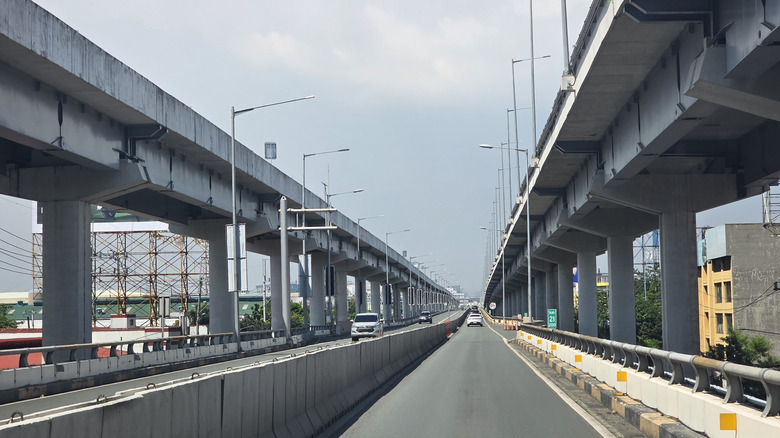
From the lakes and swamps of the Southeastern United States, we go to one of the most densely populated cities in Southeast Asia for our next stop. The Metro Manila Skyway provides some 24.4 miles of elevated road through the Philippines National Capital Area — including the city of Manila itself, which is home to roughly 189,750 people per square mile. Unsurprisingly, Manila is well-known for having some of the world's worst traffic as well — and the bridges have to stand up to barge slams from typhoon storm surges.
The Skyway was developed to help matters, rolling out in three phases that lasted from 1995 to 2021. To put the size of the project into context, the foundations for the third phase alone required 255,160 cubic meters (over 9 million cubic feet) of cement reinforced by 44.3 million kilograms (97.7 million pounds) of steel. The whole thing was successful enough that a fourth phase is being planned. Expected to cost $1 billion when complete, Skyway 4 will connect Bicutan in the Taguig district to Batasan in Quezon City with a six-lane freeway and 28 exit/entry ramps. However, while it will connect to the original Skyway and is called its shorter sibling, it will feature some non-elevated parts.
Dhaka Elevated Expressway, Dhaka, Bangladesh
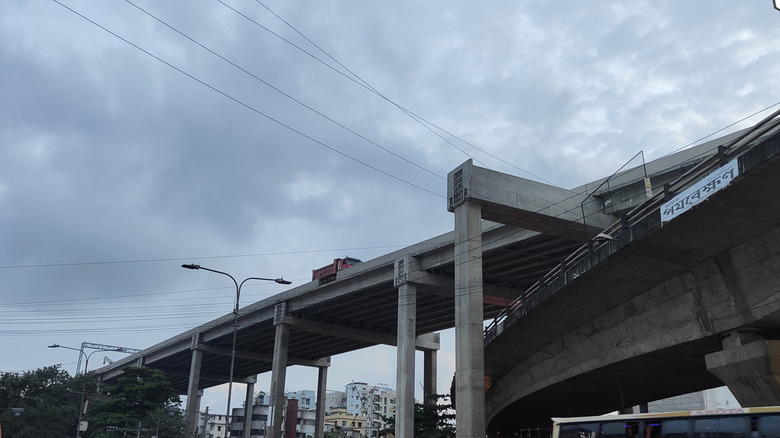
There aren't any hard and fast rules for determining the longest road bridges in the world, so we'll slot the Dhaka Elevated Expressway, located in the capital city of Bangladesh, at number two on the list with a total length of approximately 29 miles. On the other hand, that technically includes not only the main route, but also a short link road and more than 30 on/off ramps accounting for about 15 miles on their own. Also, it's not quite done yet. Work began in 2011 but stopped in 2024 after a dispute among the contractors. The final stages of construction began in August 2025 under the direction of the China Shandong International Economic & Technical Cooperation Group Limited (CSI) and Sinohydro Corporation Limited.
The work can't be finished too soon, either, since congestion is so bad. Yes, studies show other locations as being the worst traffic cities in the world, but Dhaka is no slouch. It has the seventh-worst traffic in the world and was rated number three for time spent commuting, according to crowd-based Numbeo. Furthermore, Time magazine has called it the slowest city in the world.
Bang Na Expressway, Bangkok, Thailand
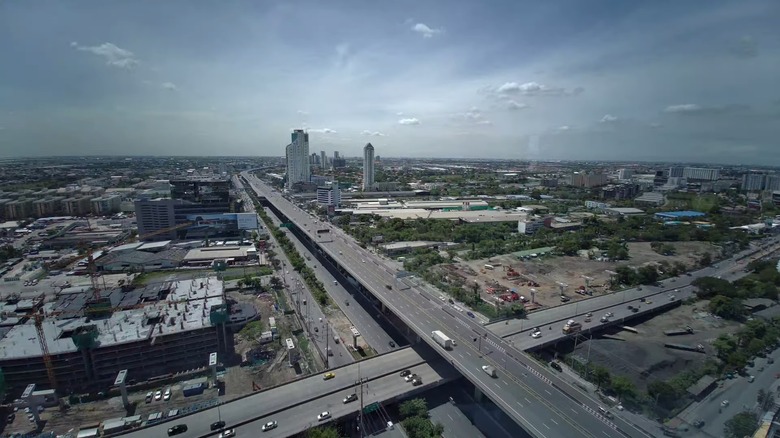
For a long time the longest bridge of any kind in the world, the Bang Na Expressway remains the world's longest elevated highway with a span of 33.6 miles that took 1.8 million cubic meters (roughly 63.5 million cubic feet) of concrete, 3.5 years of work, and $1 billion to complete. Of course, Thailand seems to have a thing for costly automotive projects — the country's $1.2 billion F1 race will be the most expensive ever.
The expressway is yet another project aimed at reducing traffic in a crowded urban area. Bangkok, the capital of Thailand, claims nearly 11.4 million residents who face their own share of notoriously bad traffic. Indeed, the elevated expressway was built right over another grade-level road for its whole distance, essentially doubling the cars that can be carried.
That said, the structure is meant to be more than merely functional. According to the team at Rethinking the Future, the roadway adds "to the aesthetic appeal of Bangkok. The soaring flyovers and meticulous urban planning create a distinctive skyline, showcasing the symbiosis between functionality and beauty in architectural design."