

Portable Tire Inflators Can Save You In A Pinch: These Are The Features To Look Out For
We may receive a commission on purchases made from links.
Imagine this. You are on a road trip on a remote highway, like Nevada's Highway 50. It's a deserted highway, but you should be fine, as your SUV has a full tank of gas. However, your car's TPMS displays a low tire pressure warning. You stop and check the tire, and it seems to have a slow leak. To make matters worse, you're driving a new car that didn't include a spare tire.
While it helps to know everything about fixing a flat tire, without pressurized air or a spare tire, you are stuck in the middle of nowhere with no gas stations for hundreds of miles and patchy cell reception. That is why you need a portable tire inflator, and not just for trips like these, but for daily use as well. If you had a portable tire inflator, you could at least fill up your tire and nurse your car to the nearest gas station or somewhere with cell service.
A portable tire inflator can save you in situations like this. It is also useful to have one lying around for regular tire maintenance or for deflating and reinflating your off-road tires for the trails. But before you rush out and buy a portable tire inflator, let's check out the features you should look for when making a purchase.
Decide on a power source
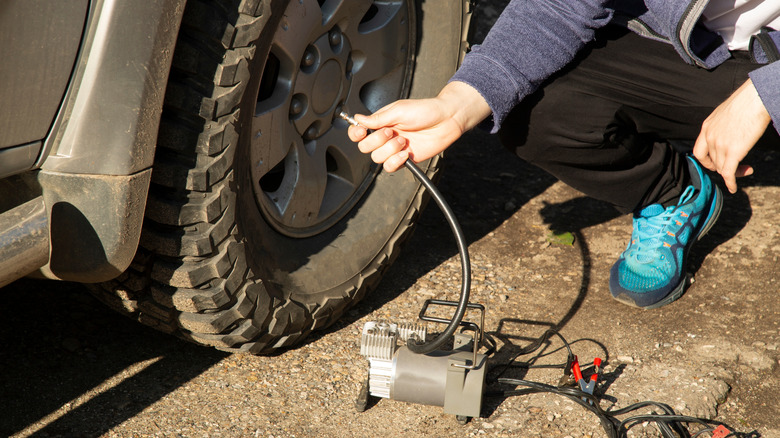
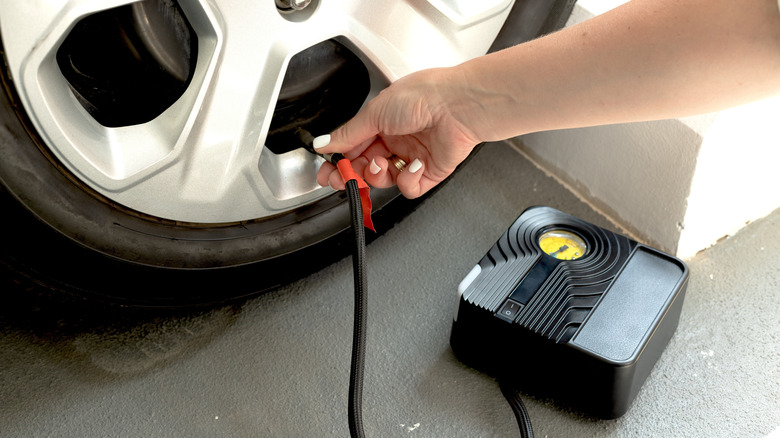
Even a $35 portable air compressor can save you from the tyranny of gas station air pumps. A portable tire inflator uses an electric motor, which powers a piston. This piston forces ambient air inside a nozzle, which connects to your tire via a non-return valve. Compared to air compressors, portable tire inflators do have limitations. They take a lot more time to inflate tires and are often prone to overheating. However, they can get the job done when you are in a pinch.
There are mechanical tire inflators (foot pumps) available, but let's skip them, as they are cumbersome to use. Electric portable tire inflators generally come in three types, classified by their power source. You have the 110-volt AC tire inflator. These tend fill the tires more quickly than the other two types, but that speed comes at the cost of portability. These need a 110-volt AC connection or a wall outlet. So, they won't work remotely unless you have a 110-volt AC power source in your vehicle. While many modern cars do come with 110-volt outlets, you may not be able to use one of these inflators with an older vehicle, unless it's been modified.
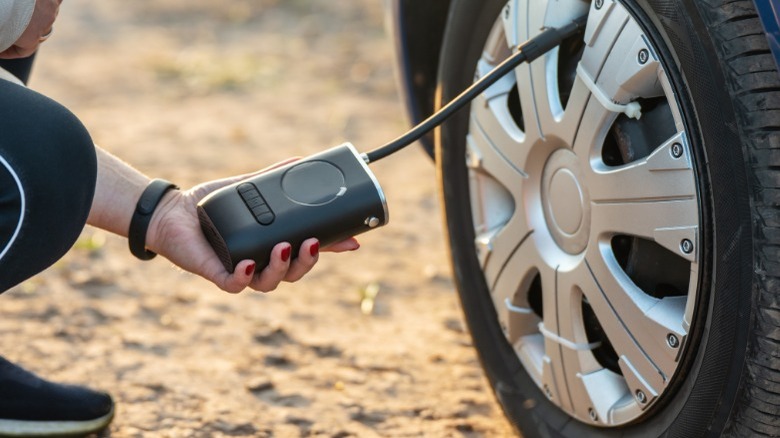
The second type of portable tire inflator uses a power source as well, but it needs just 12-volts, meaning you can use the power outlet located in the center console of your car. The lower voltage means it draws less power and will take more time to inflate a tire. The third type is cordless with a rechargeable battery. These can be used anywhere and, in terms of efficiency, are similar to the 12-volt corded units. Additionally, you can find some portable tire inflators that use multiple power sources, offering enhanced versatility.
Ease of use is critical
A portable tire inflator needs to be easy to operate, allowing anyone to use it in a pinch. Many portable tire inflators come with a tire pressure gauge, either in the form of a mechanical dial or a digital screen. It makes sense to go with the latter, as they are easier to read. Some modern tire inflators feature a digital screen along with a pressure sensor that cuts off the motor once the desired tire pressure is reached, helping to ensure that you don't overinflate your tires.
Many of these modern portable tire inflators also have buttons that allow you to manually set the desired tire pressure, as well as different presets, which allow you to inflate other stuff like sports balls, bicycles, motorcycles, and even inflatable air mattresses. Some inflators also come bundled with adapters for the above applications. Other aspects to consider include the valve stem connector style and the length of the power cable if the device is corded.
Power and portability
A typical car tire needs 30 to 35 psi of air pressure, so it helps to get an inflator with a pressure rating above that. Many portable tire inflators come with a pressure rating of 120 psi, which is enough for most applications. However, you may need a larger 150-psi unit if you have a big vehicle like an RV. Also, a tire inflator with a higher pressure rating will fill your car's tire quickly. Keep in mind that a portable tire inflator will take a lot more time than an air compressor to fill up the tire. Inflating a tire from 0 to 35 PSI can take up to 16 minutes or more, depending on the inflator used.
Another factor to consider is the inflator's build. It needs to be lightweight enough to carry around and compact enough to take up minimal space in your car. Ideally, a regular box or rectangular shape is easier to store than an unconventional design. Some tire inflators have special grooves to accommodate the built-in air nozzle, saving space. The inflator needs to have a rugged build quality in order to handle drops and bumps without falling apart. A waterproof design also helps.
The right juice
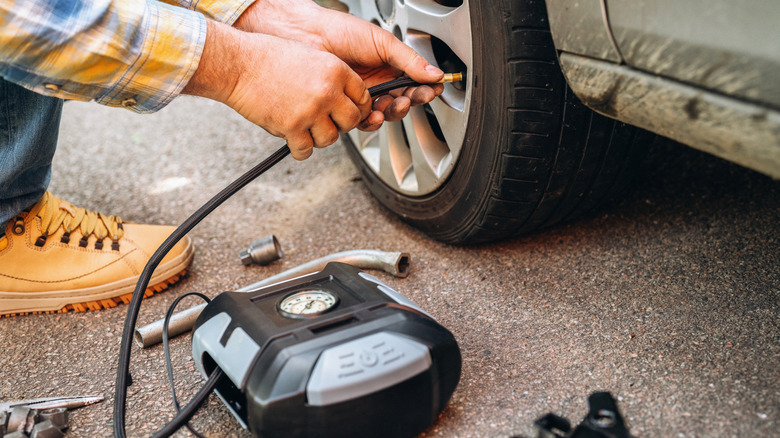
Portable tire inflators need power, too. For corded units, the power source can be 110-volt or 12-volt outlets, but remember to make sure the power cord is long enough for the inflator to reach all four tires when connected. For cordless versions, having a large battery helps, but a larger battery can also be heavy and take up space. A good compromise is to have a battery large enough to top off four tires. In particular, look for an inflator that you can charge using port in your car's center console.
Some cordless tire inflators also come with built-in jump-starter kits. The extra battery and associated battery clamps add weight and take away some of the portability factor, but that's a small price to pay for the ability to jump start your dead car in the middle of nowhere. Other portable tire inflators also come with additional features such as a built-in LED flashlight and USB ports, allowing them to function as large power banks.
What are some of the options?
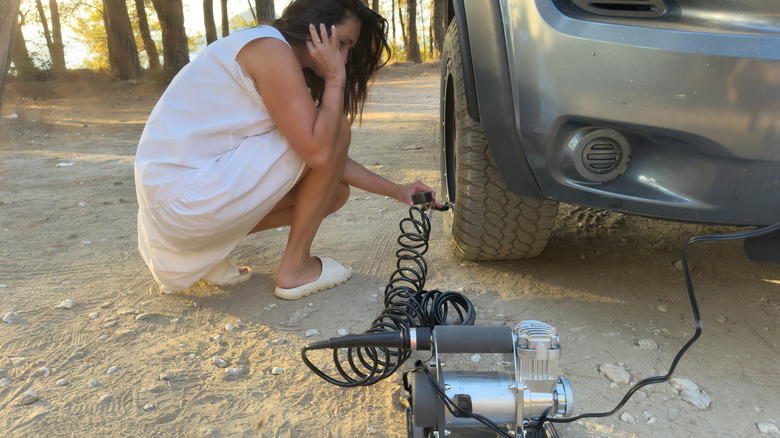
Now that we have covered the features you should look for in a portable tire inflator, let's check out some worthwhile options. The Viair 88P Tire Inflator is a corded model that makes sense if you drive a large truck or SUV. Its main selling points are its ultra-fast inflation speed and rugged build quality. On the flip side, you need to connect it to a power source, which, in this case, is your car's battery terminals via alligator clamps. Starting at around $90, this is an expensive but reliable way to fill your larger vehicle's tires.
If you are looking for a compact tire inflator, the Craftsman Tire Inflator makes sense. It weighs just 1.28 pounds and comes with a 6000mAh rechargeable battery. If the battery dies, you can power the inflator using your car's 12-volt outlet and the included 10-foot cigarette lighter cord. Other features include four pressure presets, four pressure measuring units, an auto pressure cut-off function, a built-in LED light, and a USB-C charging port for your smartphone. The Craftsman inflator normally costs $40.15 at Amazon, but you can often find it selling for a discounted price.
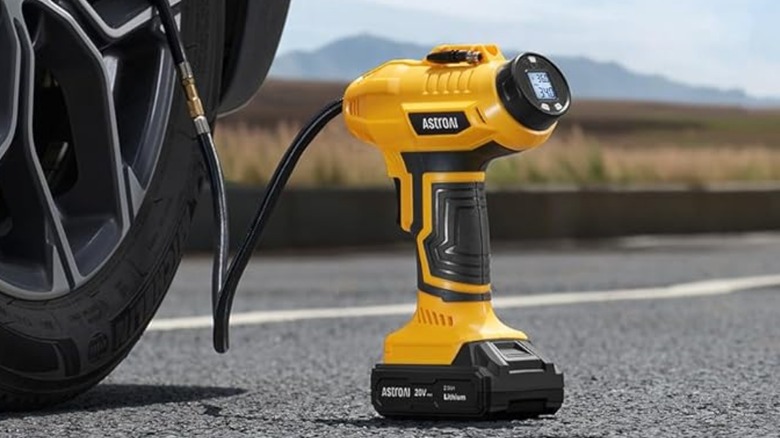
Another good option is the AstroAI Cordless Tire Inflator. It looks like a cordless drill and offers some neat features. Like the Craftsman, this one runs on battery power or a 12-volt connection, making it highly versatile. With a maximum air pressure limit of 160 psi, the AstroAi inflator should cover most tire needs, and the auto cut-off feature ensures you don't overfill your tires. It is slightly expensive, with prices starting at $65.99.