

Here's What Makes Laser Iridium Spark Plugs Different From Standard Iridium Plugs
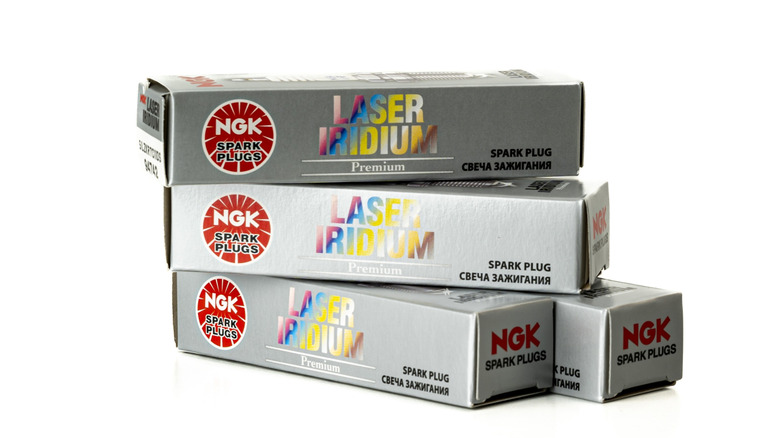
The engine in your car, truck, or SUV can run on either copper, platinum, or iridium spark plugs. You probably heard the hype around iridium plugs and how they manage to deliver solid sparks while lasting up to five times longer than a copper plug. But there are many types of iridium plugs, and their capability depends on the manufacturer. One of the best-known iridium spark plugs is from the Japanese company NGK (now known as Niterra North America Inc.), which makes two types of iridium plugs: Laser Iridium and Iridium IX.
These both have iridium cores that are stronger than both copper and platinum. They also have a higher melting point, making them extremely resistant to wear and corrosion. However, NGK wouldn't file a trademark for Laser Iridium if it weren't any different from Iridium IX. NGK says all Laser Series of iridium plugs are strictly for Original Equipment Manufacturer (OEM) applications, which means that some cars leave the factory with those Laser plugs already in their engines. Despite this, you can get a Laser Iridium spark plug yourself for as little as $10.
Meanwhile, NGK refers to Iridium IX as an "aftermarket performance plug," making it suitable for tuned motors or as an OEM replacement in some stock engines. The difference goes deeper than OEM or aftermarket, since one is capable of lasting even longer than the other.
NGK Laser Iridium has dual precious metals
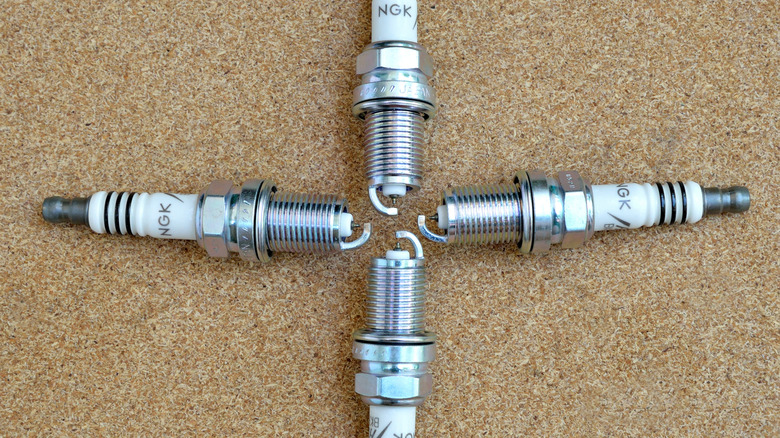
It's not that NGK's Iridium IX plugs are a bad buy; you can even find them for around $1.50 cheaper than the Laser plugs. But Laser Iridium has an edge thanks to construction using dual precious metals. Laser Iridium not only has an iridium center electrode, but it also has platinum on the ground electrode, making it a longer-wearing spark plug that can last 80,000 to 100,000 miles.
Moreover, some Laser Iridium plugs have multiple ground electrodes or custom resistors as per OEM requirements. It's all done in the name of retaining solid, reliable sparks for the longest possible service life. NGK didn't mention which specific makes, models, or brands of cars have Laser Iridium plugs in their engines, but a quick way to find out is to consult the owner's manual — or, if you're in a DIY mood, lift the hood and unscrew one of the plugs from the engine.
Unlike Laser Iridium, Iridium IX doesn't have platinum in its ground electrode, but it still has a fine-tip iridium core that lasts longer and resists wear better than copper or platinum plugs. But with no fortifying precious metal on the ground electrode, it only has around half the service life of Laser Iridium, with NGK claiming a lifespan of 40,000 to 50,000 miles. Admittedly, this gave us second thoughts on whether Iridium IX is worth the extra penny over platinum spark plugs that are nearly half the cost at $4.49 and can reputedly last up to 100,000 miles in some applications. It's still not a bad choice, coming available in different sizes and heat ranges (yes, spark plugs come in hot or cold varieties) to fit most cars, trucks, motorcycles, and other non-automotive ICE engines.
Other brands offer iridium plugs, too
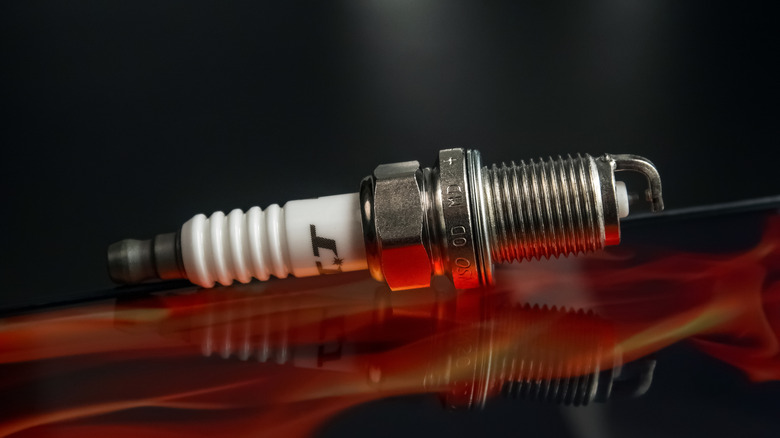
Outside of NGK, other brands like Denso and Bosch have iridium plugs with their own set of advanced features. Denso has a slew of them, including its own equivalent of NGK's Laser plugs: the Iridium Long Life spark plug. It shares similar iridium and platinum electrodes made to handle over 100,000 miles. The company also has a fancier option called the Iridium TT. The "TT" stands for twin-tips because it literally has two tips; one with iridium and one with titanium-enhanced platinum. Denso says that the design "create[s] the largest spark concentration and explosion," enabling the motor to deliver optimal horsepower while improving fuel economy.
Meanwhile, German parts maker Bosch has many iridium plugs in its lineup, but there are a few that stand out. Its Double Iridium plugs are for gasoline direct-injected (GDI) engines. As described by Bosch, they use iridium for both the center and ground electrodes, letting them last up to four times longer than standard copper plugs. Meanwhile, the Bosch EVO – a plug for modern turbocharged GDI engines — has a laser-welded iridium center electrode, a platinum ground electrode, and a new insulator design to withstand what Bosch calls "mega knocking" and "irregular combustion."
Bosch also has an iridium plug with a twin-tip design, similarly to Denso. The Double Iridium Pin-to-Pin has iridium tips for both the firing pin and ground electrode, also making it suitable for modern cars with GDI propulsion. NGK has twin-tip plugs as well; while certain high-cost Laser plugs come with those tips, you can find them on its Ruthenium HX plugs for half the price. Those don't use iridium at all, instead coming with a ruthenium center electrode and a platinum ground electrode.