

Here's How Much A 2020 Toyota RAV4 Has Depreciated After 5 Years
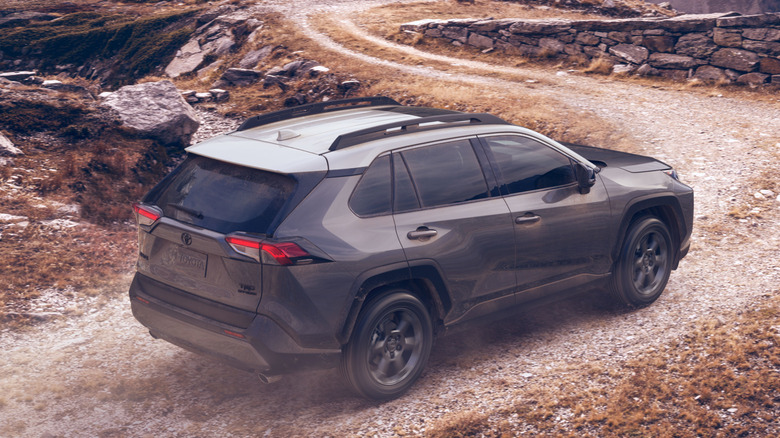
There's a reason you see Toyota RAV4s everywhere; the world's top-producing automaker sells a lot of them. In 2024, that added up to over 475,000 units in the U.S. alone, threatening to dethrone the Ford F-150's reign as the best-selling vehicle. What's surprising is that the non-hybrid RAV4 earns middling grades in the highly competitive compact SUV segment, ranking 13th out of 29 models in a 2025 comparison by Consumer Reports.
But how well does the 2020 Toyota RAV4 hold onto its price? To determine five-year depreciation rates for the 2020 RAV4, we explored data from iSeeCars and CarEdge. The RAV4 shines in this department, with iSeeCars estimating that a 2020 model loses only about 30% of its original selling price over five years. That's stronger than some key rivals, and significantly better than the average 45.5% five-year depreciation rate across all vehicles.
The five-year benchmark is critical in the used-car market, as vehicles of this age are more affordable than new but haven't aged to the point of being outdated. Lower depreciation is excellent if you're selling or trading in a car, but it turns into higher prices for shoppers. Given the popularity of compact crossovers, we analyzed how the RAV4 depreciation compares to the Honda CR-V, Mazda CX-5, Hyundai Tucson, and others.
Five-year depreciation for the 2020 Toyota RAV4
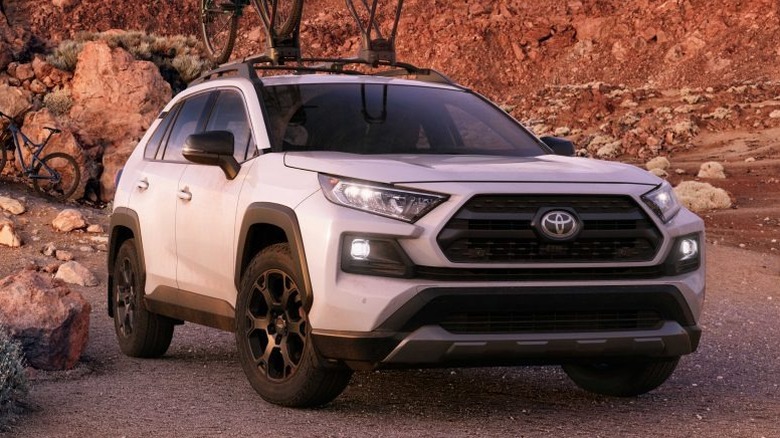
Based on an original sticker price of $29,250, the 2020 Toyota RAV4 would have a resale value of $20,398 after five years, according to iSeeCars. The 2020 RAV4's modest depreciation forecast remains when looking at other terms: three years (16.8%), seven years (43.3%), and ten years (57.2%). There's no estimate yet for the residual value of the sixth-generation RAV4 that will debut for the 2026 model, but we do know the upcoming RAV4 GR Sport is fun to drive.
From CarEdge's perspective, the numbers are even better, with the 2020 RAV4 losing only 27.5% of its original value after five years. The calculation is based on a good-condition vehicle driven an average of 13,500 miles per year (iSeeCars doesn't reveal its value formulation). Looking at different terms, CarEdge's estimated depreciation rates vary somewhat from iSeeCars' projections: three years (18.9%), seven years (42.5%), and ten years (51.0%). The outfit even adds a note of praise for Toyota, stating that "RAV4s are exceptional values whether purchased new or used."
How RAV4 depreciation compares to rivals
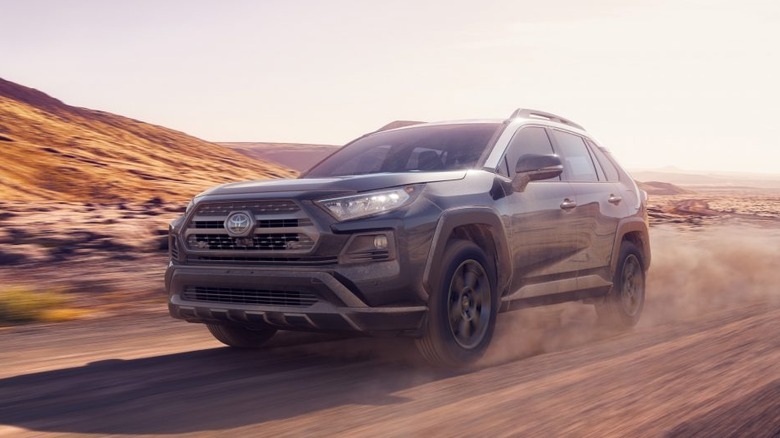
Using iSeeCars' more conservative calculations, the RAV4's five-year reduction in resale value (30.3%) is lower than that of the Honda CR-V, with a depreciation rate of 34.5%. Meanwhile, the Mazda CX-5's five-year depreciation rate of 42.4% is mid-tier in a crowded field, followed by the Hyundai Tucson at 45.9%. Resale value takes a bigger five-year hit with the Nissan Rogue (48.6%), Chevrolet Equinox (49.6%), and Ford Escape (51.3%).
Crunching the numbers shows that the RAV4's value loss over this period works out to an $8,852 hit to the wallet, against $10,673 for the CR-V and $12,199 for the CX-5. The five-year depreciation is worse for the Tucson ($13,182), Rogue ($13,900), Equinox ($14,194), and Escape ($15,155).
CarEdge's estimates show a closer match-up between the RAV4 (27.5%) and the CR-V (29.0%), but the Toyota remains king of the low-depreciation hill. At 39.0%, the CX-5's value drop is somewhat better than iSeeCars' projections, but the Tucson is worse off with a 47% decline in value over five years. Otherwise, the pecking order stays the same, albeit with higher depreciation rates: Rogue (49.8%), Equinox (52.1%), and Escape (54.9%).