

Why You Should Skip The Parking Brake If You're Going On Vacation
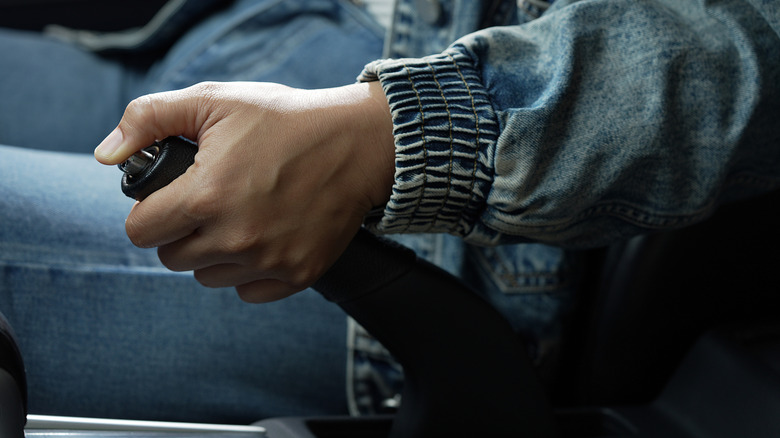
So you finally have an opportunity to take a well-deserved and lengthy vacation, but what about your vehicle? The good news is that there are plenty of ways to safely stow your trusted automobile and keep it secure. However, there is one thing you probably shouldn't do if you're planning to store your ride for a bit, and that's engaging the parking brake.
Whether it comes in the form of a pedal, a center console lever, or a more modern push button, the parking brake is an essential mechanism meant to prevent your car from inadvertently rolling. The parking brake is typically incorporated into the rear wheels, and it's sometimes referred to as the "emergency brake." Some drivers have the misconception it's only useful when parking on hilly streets, but automakers like Infiniti recommend it be engaged every time you've reached your destination, hill or not. Beyond keeping the car stationary, a parking brake also minimizes strain on the transmission and other critical components.
So, if it's so important to use the parking brake, why wouldn't you use it when storing your vehicle? Well, if left engaged for too long, corrosion and rust can occur, potentially leading to things becoming locked or stuck. Unfortunately, this isn't typically a case where a little elbow grease in the driveway will get you moving again — it's more likely you'll need a tow truck ride to the mechanic.
How long does it take for a parking brake to seize?
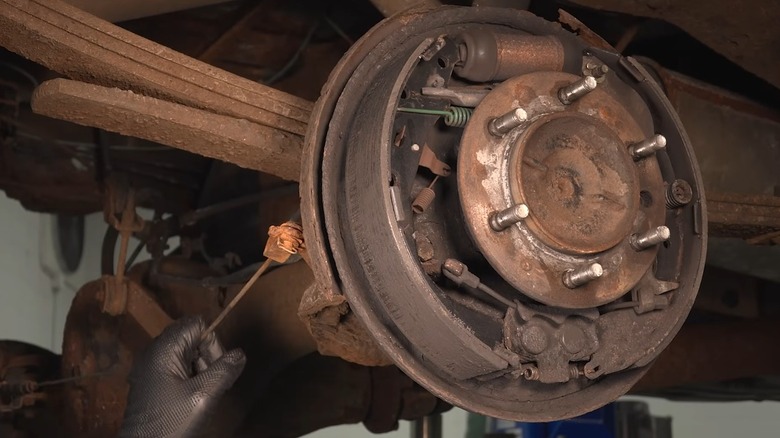
It's impossible to provide a definitive timeline for a parking brake deteriorating and becoming stuck, at least not one that would apply in every situation. However, this isn't a scenario you're likely to face after being out of town for a few days, but rather much more of a concern if you were to store your vehicle for more than a month.
There are also some additional factors that could exacerbate the brake jamming in place. One of these is a commonly used substance to help clear roads of wintery accumulation, rock salt. This unpurified salt effectively reduces the point at which water freezes, which is why some areas of the United States send out trucks to coat the roadways prior to a storm. Rock salt also attacks metal surfaces under your car, intensifying rust, particularly when there is additional moisture present. And while salt is certainly bad for your car, some of the alternatives being proposed — such as using toxic wastewater — would be even worse.
It's always a good idea to get your car washed (especially the undercarriage) before storing it if you've been driving on salted roads. This, in conjunction with ensuring your parking brake isn't engaged, should help prevent sticking and excessive corrosion while your vehicle patiently waits for your return.