

These Are The Only Highways In The World With No Speed Limit

The U.S. has been limiting vehicle speeds since 1901, when the state of Connecticut became the first to set laws regarding automotive speed. The new law set the limit at 12 mph in cities and 15 mph in rural areas. Fast forward to today, and things have changed drastically, especially in 10 states where drivers can hit the highest speeds in the country, up to 85 mph. However, some thoroughfares in Nevada had no limits for decades, and even as recently as the mid 1990s, Montana had highways with no speed laws for daytime driving.
Outside of the U.S., limiting vehicle speed has been handled differently. Some areas of the world adopted a no limit policy, and a couple of them have stuck to those policies to this day. Whether it be due to public pressure, local identity, or political distinction, places like the German Autobahn and the Isle of Man are the few remaining destinations free of speed restrictions (mostly). These are the last bastions for performance car or superbike enthusiasts eager to open the throttle fully and experience the true potential of their machines outside of a track.
Germany's Autobahn highway system has sections with no speed restrictions

The Autobahn is the national highway system that crisscrosses through the country of Germany. However, it isn't a free-for-all across the entire stretch — there are places where limits are imposed. But the highlight for those with a need for speed has to be the bit between Berlin and Hamburg, which covers 93 miles and is the longest unrestricted section you can find. With no bureaucrats getting in the way, just how fast do things get on the Autobahn? According to CNBC, sections of Germany's highways have seen drivers surpass 250 mph. Given this much freedom, we wanted your picks for the best Autobahn cruisers. While some of your choices like the Aston Martin V12 Vanquish make sense, others were puzzling, to say the least. So, why doesn't the Autobahn have speed limits in certain places?
In order to understand why Germany's highway system is set up like this, a quick dive into the country's history is necessary. When construction of the Autobahn really began to kick off, it was a propaganda project of the Nazi Party, which did implement speed limits at the time. However, following World War II, the landscape of Europe changed. Germany was divided up into zones, with an eastern portion controlled by the Soviet Union, and the western side occupied by Great Britain, France, and the U.S. Wanting to further distance itself from the communists in the East, West Germany removed speed limits across the region in 1952. While initially all limits were lifted, the lack of speed restrictions in cities became problematic, and the limits were reinstated. Fortunately, the Autobahn (or at least parts of it) was left alone.
The Isle of Man features some highways with no speed limit
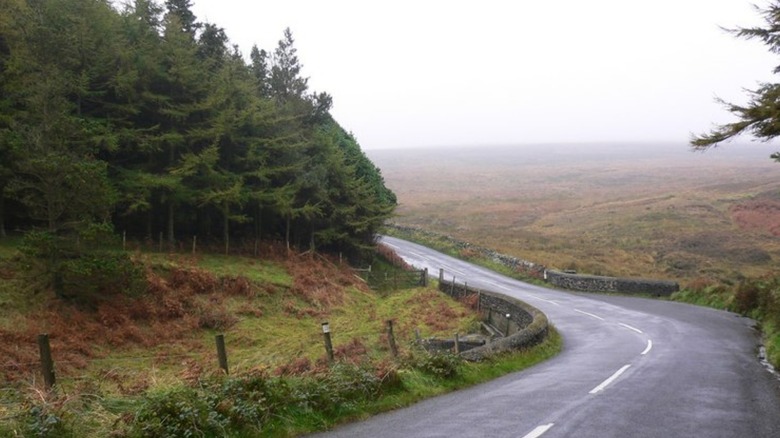
In between Great Britain and Ireland, lies a small island encompassing just under 221 square miles (572 sq km) that's home to some 84,000 residents. While this wind-swept land offers quaint villages, scenic landscapes, and a robust Celtic history, it's also known for one of the most dangerous motorcycle racing events in the world, The Isle of Man TT. While peaceful for nearly the entire year, the anual two-week racing event transforms the island. The race attracts thousands of visitors traveling to see the events, with riders navigating tight two-lane roads lined with stone walls at average speeds greater than 135 mph. However, it isn't just The Isle of Man TT participants that get to careen down its highways at breakneck speeds.
About 30% of the island's highways don't have any restrictions on the books, and this attracts a certain crowd looking for thrills. Considering the island is home to many full-time residents, you may wonder what the locals think of tourists capitalizing on the unrestricted highways. Well, back in 2006, locals voiced their opposition to a plan that would introduce a national speed limit across the island, effectively shutting down the effort, which isn't surprising considering its extreme racing heritage. Speaking with Car and Driver, detective sergeant Allan Thomson with the Manx Constabulary's Road Policing Unit, explained their unique approach to enforcement, saying, "It's all about establishing the idea that if you do wrong we're going to have a word with you, but we want you to come back next year and tell your friends how good it is."
These highways may not offer you the experience you're envisioning
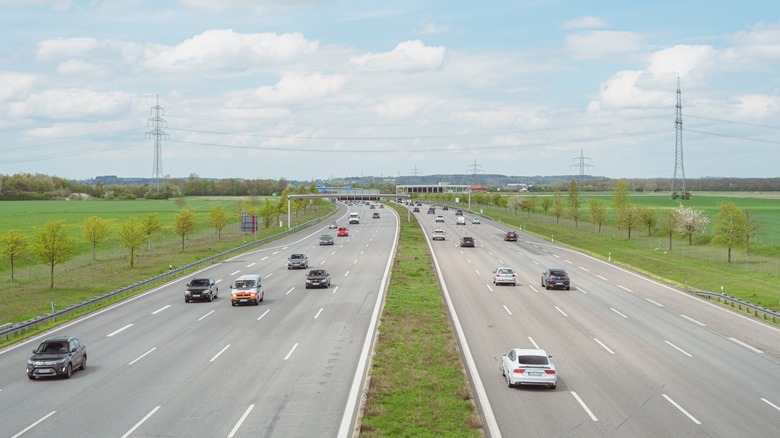
When you picture the Autobahn, for example, the mind may conjure up a wide assortment of exotic sports cars traveling at blistering speeds beyond anything you've ever seen. While this scenario is possible, there's a side of the Autobahn that's seldom shared. For instance, remember that only a portion of Germany's highway system doesn't have a speed limit, which means you'll need to be cognizant of the laws applicable to the section you're driving, otherwise, there will be penalties. One 199 mph Autobahn speeder got a 3-month driving ban and a hefty fine north of $1,000 when law enforcement tagged them on radar.
In addition, despite its mystique and appeal, the Autobahn, like any highway, requires maintenance. So, even if you can theoretically go as fast as your car will take you, road construction will certainly slow things down. Can you imagine hitting a pothole at triple-digit speeds? Speaking of slow-downs, you also won't escape the reality of traffic, some of which — like commercial vehicles — is still bound by a speed limit. A large truck certainly isn't going to set any speed records, and it may hamper your cruising abilities as a result.
Unlike the Autobahn, which has some lengthy straightaways with high-speed potential, the Isle of Man's highway system is known for its high number of curves. Apparently, the best chance you have for maximum throttle is a section called Sulby straight, which doesn't quite last a mile.