

Why Boeing Built The 747SP: The Short 747 With Long-Range Power
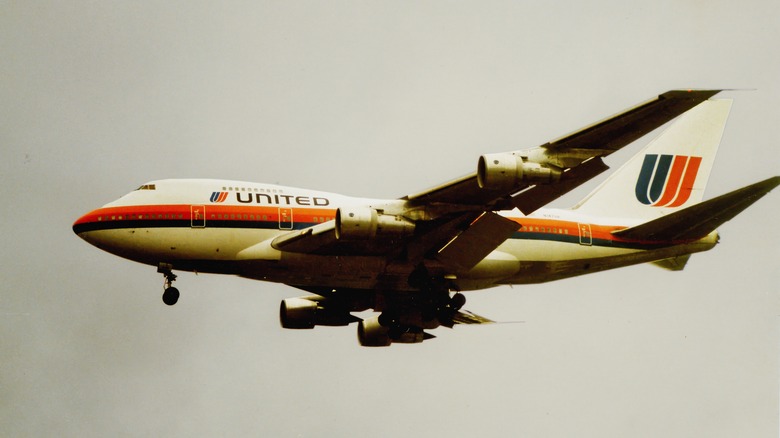
The Boeing 747 ushered in the age of the jumbo jet when it first took flight in 1969, but at least one variant actually had to be cut down to size for continued success. The Boeing 747SP — for Special Performance — was developed for a specific aviation niche: Long-distance routes that the competition of the day couldn't handle but that didn't see enough passengers to require a huge 747. Boeing explored a number of strategies before deciding to simply shrink the regular 747 as a way to save weight. With fewer pounds to lift into the air, the new plane wouldn't need as much fuel, while a smaller passenger cabin wasn't a problem because fewer folks were expected.
Remember, the 747 was a huge machine that certainly lived up to its "jumbo" classification. It was the largest passenger plane in the world from its launch right up until 2007, when the Airbus A380 premiered. Today, 747s are nearly gone from the skies. To give you an idea of what a change the first one represented, its predecessor, the Boeing 707, had seating for 219 passengers. The 747 itself first launched with a 550-passenger cabin that was eventually expanded to seat more than 600 people in later models. The outside is impressively large as well, starting with a wingspan of more than 195 feet, a height of 63 feet, and a length of almost 232 feet.
Differences between the 747 and the 747SP
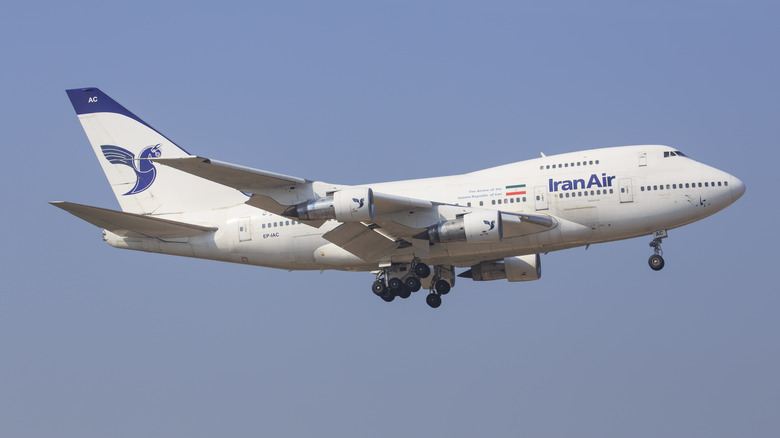
The main changes to the 747 began with removing sections of the fuselage, followed by a redesign of the center section. In the end, the body of the 747SP was more than 48 feet shorter than that of the 747, and its overall length was about 47 feet shorter.
Boeing also redesigned the complex flaps of the 747, further getting rid of their housings. The horizontal and vertical stabilizers, along with the rudder, were also modified. When all the changes, large and small, were added up, the 747SP came out to be about 45,000 pounds lighter — when empty — than a 747-200 of the time. Inside, the plane's passenger capacity shrunk to about 280 people. Yet what didn't change was the 747's four turbofan engines, each capable of 46,500 pounds of thrust. As a result, when Boeing put an early 747SP to the test in 1975, it set a new world record for quickest nonstop flight between New York and Tokyo. The plane took only 13 hours and 33 minutes to carry its 200 passengers over the nearly 7,000-mile distance — and it still had plenty of fuel left over.
True, the demand for the 747SP was never all that great — with only 45 built — but at least two have remained in service in 2025 (perhaps they still use floppy disks for software updates). Pratt & Whitney Canada flies a pair of them to test new engines, which makes sense. Pratt & Whitney was an original engine supplier for the 747SP project, along with Rolls-Royce.
747SP: An airplane for the stars
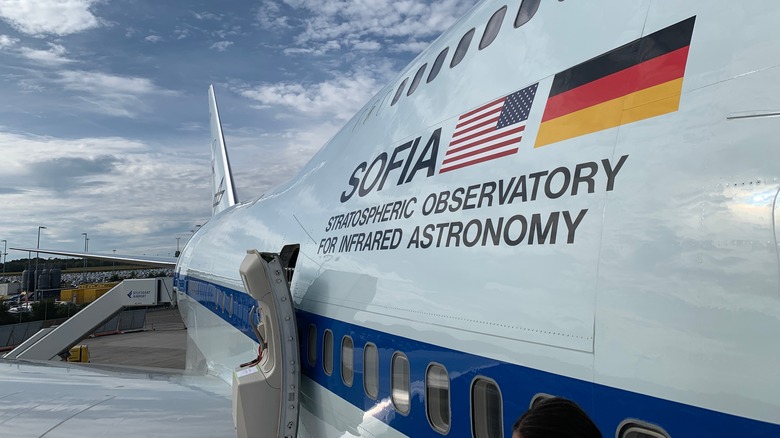
Pratt & Whitney's test planes weren't the only 747 SP aircraft to go beyond passenger routes, however. One of them spent eight years as the platform for the world's biggest flying observatory. Carrying a reflective telescope with an effective diameter of 100 inches, the Stratospheric Observatory for Infrared Astronomy (SOFIA) — developed through a partnership between NASA and the German Space Agency — took advantage of the airplane's ceiling to reach the Earth's stratosphere at a height of between 38,000 and 45,000 feet. There, it could make the kind of infrared observations that were impossible at lower altitudes or on the ground.
SOFIA's mobility was another benefit since the plane could take readings over oceans, for example, or anywhere there wasn't a ground-based telescope. The fact that it landed after each flight worked in SOFIA's favor because that made it easy to upgrade or service its equipment as needed — something not currently possible with space-based observatories.
The 747SP took a star turn of another kind in 2018. That's when it made the news as the aircraft of choice for Kim Kardashian and Kanye West, highlighting its role as an airplane for people who don't mind killing the planet — a 2024 study published in Communications Earth & Environment found that private-plane frequent flyers are responsible for releasing 500 times more CO2 into the atmosphere per year than the average person. The good news? At least one multimillionaire has pledged to use his private jet slightly less.