

Can You Make A Side-By-Side Street Legal?
We may receive a commission on purchases made from links.
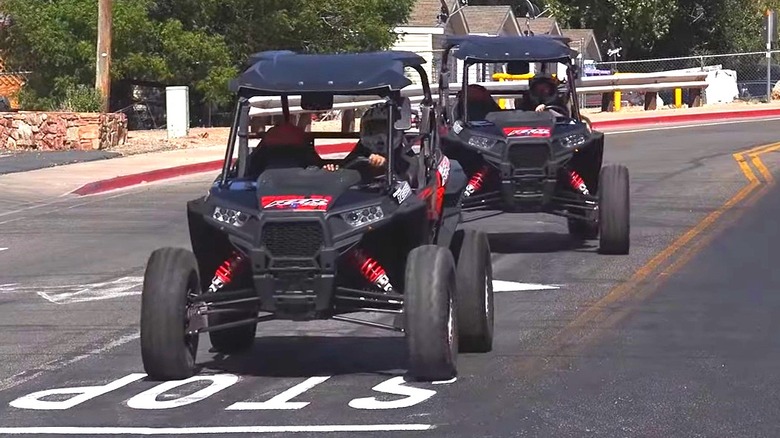
One of the best ways to experience off-road thrills or conveniently traverse large properties is a side-by-side or UTV. These vehicles can accommodate multiple passengers and often feature many of the same components as a car, such as a steering wheel, pedals, and four tires. Considering the similarities, you may wonder if you can travel on the roads as opposed to just off of them. But the answer isn't a simple one, as it largely depends on which state you reside in and the local laws. For example, there are 17 states that flat-out won't allow you to use side-by-sides on the roads. These include places like Colorado, California, Oregon, South Carolina, and Nebraska, to name a few.
Conversely, you can daily a side-by-side UTV in some states, including Arizona, Wyoming, Michigan, and North Carolina, among others. The rest of the country falls somewhere in between with conditional street legality.
So, depending on your location, you may be able to drive a side-by-side on the streets, but it'll take a bit of preparation first. Side-by-sides don't generally come stock with the equipment you'll need for legal road use. You'll have to add parts or modify certain aspects of your ride. You may need to install components like turn signals, tires approved by the Department of Transportation (DOT), seat belts, and a rearview mirror. Furthermore, you may also need to upgrade your headlights, while the final step is to register the vehicle and attach a license plate.
Unfortunately, it can get a bit more complex, as the rules can differ from state to state. For instance, if you live in Michigan, you'll need to pony up for a complete glass windshield, wile some Arizona cities demand that your side-by-side undergo and pass a smog check.
There's a kit or set for that
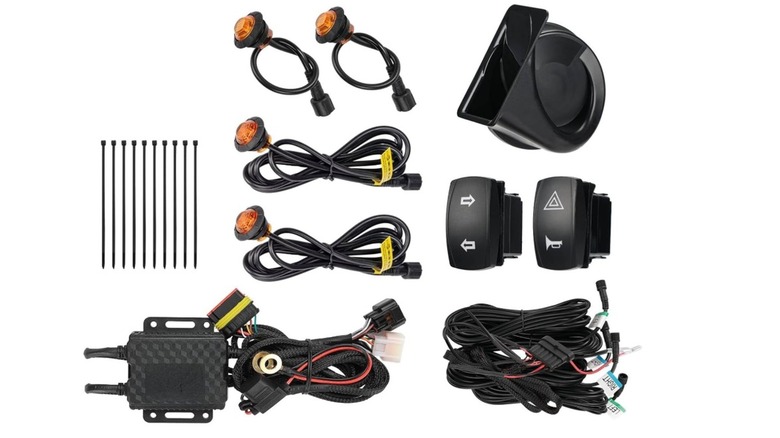
Fortunately, for those wanting to navigate roads legally in their UTVs, there are plenty of aftermarket kits that can help you get going. However, the transition from stock to street legal isn't an inexpensive process. Turn signal kits, which often come bundled with lighting, a wiring harness, and switches, vary from around $50 to over $1,000, depending on the side-by-side model and product features.
Unfortunately, most UTVs don't come stock with DOT-approved tires, which you can verify by looking at the sidewall. The stock tires on a side-by-side are made specifically for rugged off-road use and aren't as safe on paved surfaces. To remedy this, there are products out there like Kanati Mongrel UTV tires, which are all-terrain tires made specifically to handle not only street driving, but to also retain much of the off-road performance as well. However, these specialized side-by-side tires go for $185 each online, making them a bit of an investment. You can also opt for light truck tires (in a matching size) as an alternative.
Other requirements (depending on the state) are thankfully much less expensive, like the available plug-and-play reverse light kits, which can be had for under $40 in many cases. Although, if reverse lights are required in your area, the light must be white.Another straightforward modification is the addition of a rearview mirror, which you can install by simply clipping it to the top structure of the side-by-side. Some of these mirror kits can be found for under $20, making it a painless add-on in the quest to make things street legal.
Be prepared in case law enforcement pulls your over
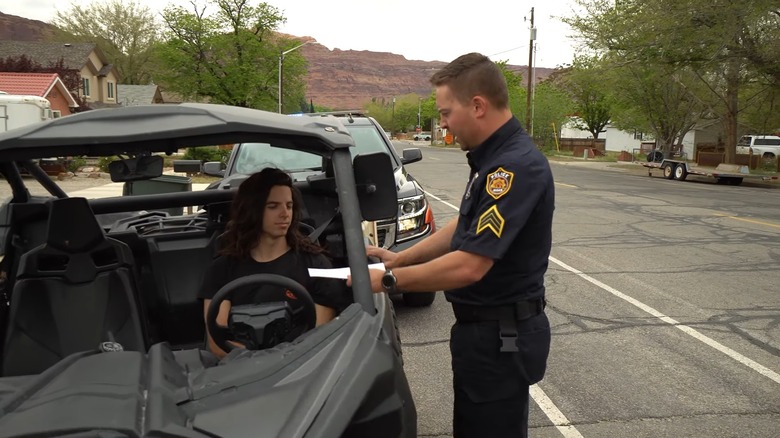
Before you start driving your UTV around town, you need to understand your area's local laws and ensure you've complied with all the requirements. However, even if everything is on the level, you'll not only attract the attention of onlookers — you may also attract the eyes of the police, wanting to verify that the vehicle is street legal. Just like your car, you'll want to have the proper documentation on hand, including your registration and driver's license.
It's also a good idea to be ready to explain your aftermarket modifications should an officer stop you, and it will help if you're able to speak knowledgably about the local laws. This situation may never come up, and if it does, it will likely be a non-issue should if you're prepared. However, it can always depend on the cop, as evidenced by your worst traffic stop stories. In addition, remember that your side-by-side will stand out starkly from other motorists on the road, so be sure to carefully follow all of the applicable traffic laws, as any infractions, even minor ones, may not go unnoticed.