

Then Vs. Now: How The Original FJ Cruiser Compares To The New Model
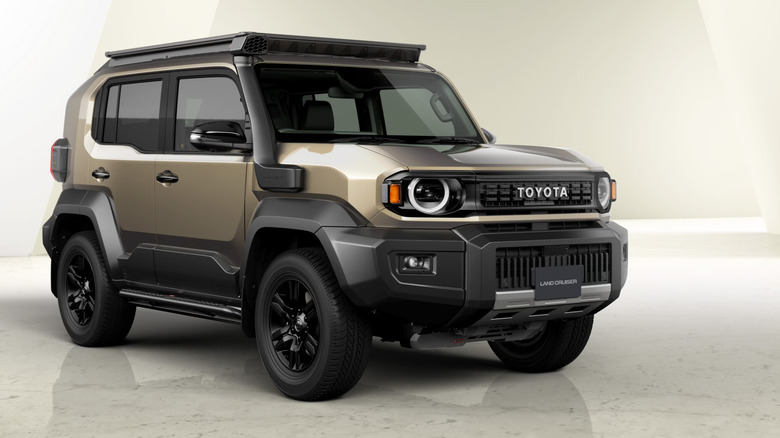
The Toyota FJ Cruiser is something of a cult classic. It debuted almost 20 years ago, first appearing as a 2007 model year, and whilst it was met with harsh criticism by some, it has become loved by so many more. It sports all the same qualities you would expect from a Toyota so closely related to the evergreen Land Cruiser, such as reliable drivetrains, real off-road capability, and a comfortable cabin. However, the style of the FJ Cruiser — and its uniquely interesting name – wasn't for everyone, and certainly could be a little divisive.
Regardless, many people loved it, and many still do. Most models tend to change hands for between $25,000 and $40,000, even as they approach 20 years old with higher mileage and modifications. This demonstrates the lasting popularity of the Cruiser, and with owners happy to exchange such amounts for two-decade-old models, perhaps this is also why Toyota figured launching a new generation can't be a bad idea. Funnily enough, we figured out that a new FJ Cruiser would be a great hit some years ago now, and we're glad to see Toyota clearly shared the same train of thought.
The all-new FJ Cruiser has been confirmed, and it will be based on the Compact Cruiser EV concept, which was revealed prior to Japan's Mobility Show. While there certainly are similarities between the new and old models, there are plenty of differences too. The main changes include a difference in size, details surrounding the powertrain, and what's included from a safety and tech point. While some details are to be confirmed, here's what we know so far and how the new model compares to the original FJ Cruiser.
The different FJ Cruiser powertrains
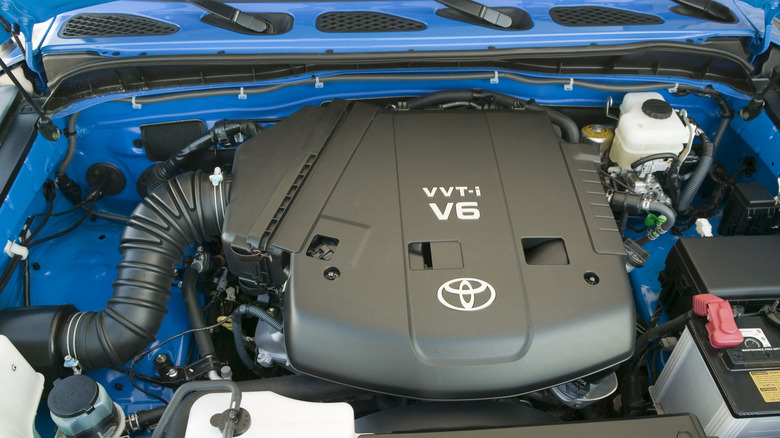
First things first, while the new FJ Cruiser will be based on the Compact Cruiser EV's design, it won't sport an electric powertrain. As cool as it might be to see Toyota develop an all-electric off-roader, the new FJ will instead depend on good ol' fashioned gasoline. Under the hood, owners will find a 2.7-liter naturally aspirated inline-four engine. This hooks up to a six-speed automatic transmission and kicks out 160 horsepower in addition to 181 pound-feet of torque. Power is sent to all four wheels, as is typical for any member of Toyota's storied Cruiser family.
The FJ Cruiser of old takes an entirely different approach. First of all, the old model boasts six cylinders, not four, and they are aligned in a V formation. The capacity of this V6 is set at 4.0 liters, dwarfing the 2.7-liter capacity of the new model. It too is naturally aspirated, but that's about it for the similarities. The old FJ's grunt can also be sent through to each corner of the car through an automatic box, although four-wheel drive was optional alongside a six-speed manual transmission. The standard automatic sports just five speeds instead of six. Power is plentiful with 239 horsepower and 278 pound-feet of torque, so in a numbers game, the old FJ walks all over the new one.
New Cruiser size differences
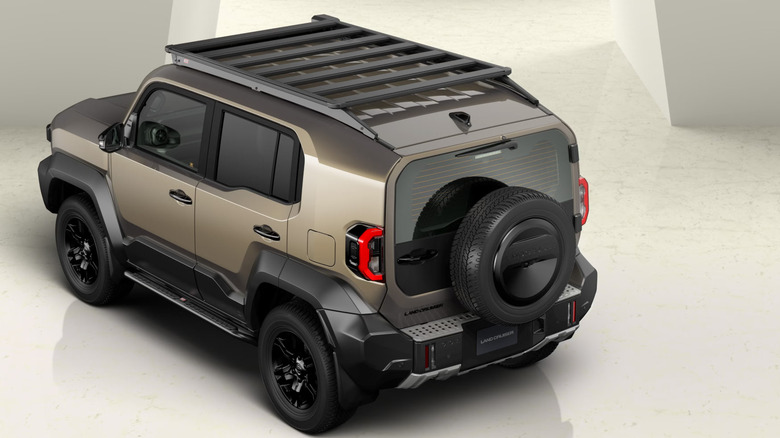
The original FJ Cruiser was far from full-size, but despite the fact that most cars get larger with new generations, Toyota has seemingly put the new model on a diet. Here are some stats: the 2007 FJ stood at 183.9 inches long, 74.6 inches wide, 71.6 inches high, and it sported a 105.9-inch wheelbase. By way of comparison, the new FJ is shorter at 180.1 inches long and with a 101.6-inch wheelbase. It's also narrower, sitting at 73 inches wide. Interestingly, though, it is taller by a full 5.6 inches, which provides the new model with a distinctively different stance.
Toyota has yet to confirm if the two FJ Cruiser generations will have very different weights, but the new dimensions make it likely. While the old model tips the scales at a hefty 4,295 lbs, we will have to wait to see what the new model checks in at. Even so, judging by the less powerful engine and smaller dimensions, we can expect it to be considerably lower.
Hints of the original retro interior
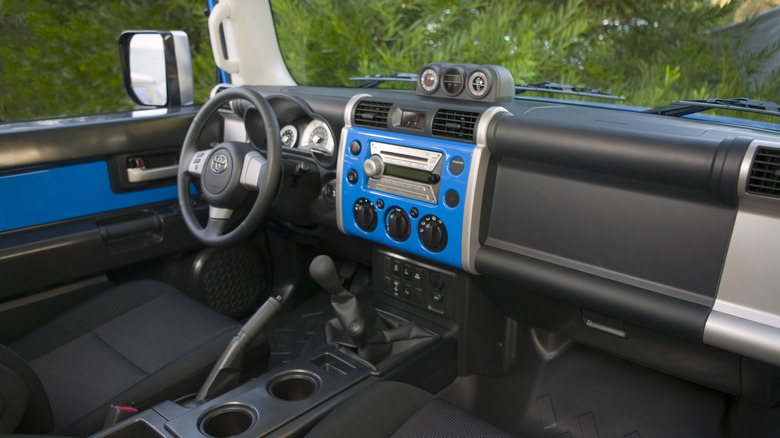
One of the great selling points of the early FJ Cruiser was that it embodied so much cool retro style, borrowed from the original FJ-series Land Cruiser. Not only was the exterior heavily influenced by retro styling, but so was the interior, which boasted big chunky buttons, dash-mounted gauges, and a simplistic dash layout.
Here is where the new model differs so much, as it does away with that retro look and instead embraces a bold and modern aesthetic. Think bright lights, digital gauges, a sizable infotainment screen, and an absolute smattering of fiddlier-looking and touch-sensitive buttons. It's a completely different direction, and yet some lineage can be seen from generation to generation, as the up-and-coming FJ also sports a chunky and slab-sided design to the overall dashboard layout.
While the original model's infotainment originally included highlights such as a CD player and FM radio, the new FJ sports a more comprehensive package. The central screen will host a range of now-expected functions such as navigation and phone connectivity. It's almost guaranteed to sport Apple CarPlay and Android Auto too, matching the capabilities of other models in the current Toyota range. Furthermore, the new model is likely to sport features from Toyota's Safety Sense, which include blind-spot detection systems and adaptive cruise control, although concrete details on exactly what's included aren't available just yet.
Fixing the FJ Cruiser's doors
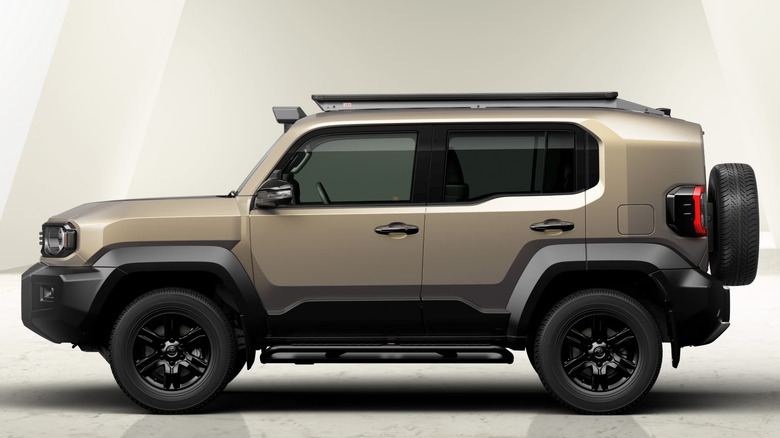
Love it or hate it, the old FJ Cruiser had character. Part of that character was derived from the numerous interesting little quirks it sported, such as rear-hinged rear doors. They served numerous purposes, such as making the FJ look like a stylish two-door, allowing for easy access, and, well, just looking cool themselves. Maybe the second point needs scrapping, actually. Sure, with all doors open, that wide space would make egress and ingress nice and easy, but it also means that rear passengers can't get out until the front door is also opened. Rear passengers also needed the front passenger to get out so that the seat could be moved out of the way. Annoying, but hey, it still looks cool.
Fans of practicality will no doubt be pleased to see that the new FJ does away with the rear-hinged rear doors for a far more conventional set of four doors. Sure, it loses some of its quirkiness and character there, but the new FJ isn't just trying to be a re-hash of the old model. It has to actually work in the modern world, and normal doors will work so much better for families who actually plan on using the rear seats on a daily basis.