

Series Vs Parallel Hybrids: What Are The Differences?
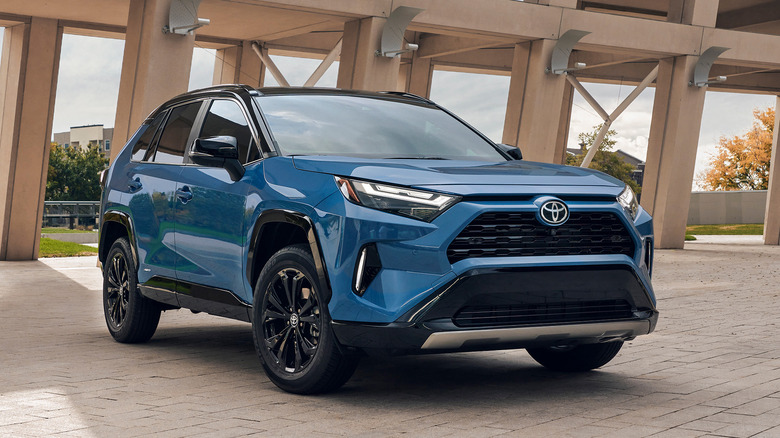
At the end of last year, we reported that Americans can't get enough of hybrid cars, and that hasn't changed much for 2025. For instance, per GreenCars, sales jumped another 36% in the second quarter of the year. Meanwhile, top sellers like Toyota RAV4 are going hybrid-only for 2026, so further increases wouldn't be a surprise — especially when you consider the efficiency and performance benefits of a typical hybrid vehicle.
As a quick reminder, those advantages come from the fact that hybrids can rely on two forms of motivation. The traditional hybrid, remember, adds regenerative braking, a sophisticated battery pack, and one or more electric motors to an internal combustion engine. The vehicle charges the battery through braking, the engine, or plugging in (depending on the exact type of hybrid), and then can use that stored electricity to power the motor(s). The motors can combine efforts with the engine or, for short distances, drive the vehicle by themselves.
It's a technology that most people date back to 1901, when Ferdinand Porsche designed an electrified powertrain for the Lohner-Porsche Mixte. Now, to be clear, this was a series hybrid, which means the gas engine never powered the wheels. It acted as a generator for the electric motors that did that. In other words, the power sources ran in a series. It would take another 80-odd years for the game-changing parallel hybrid — which could use both sources at the same time — to be invented.
Series hybrids: The cure for EV range anxiety
Series hybrids haven't made much of an impact on the auto industry. They tend to work best where there aren't a lot of changes in speed, without constant starting and stopping, like in diesel-electric locomotives. Here, the engine can operate at an optimum speed for generating electricity, not for literally driving a vehicle.
In fact, driving a series hybrid is much like driving a pure EV, right down to the fact that a conventional transmission isn't needed, which helps reduce cost and weight. The technology is less complex as well, since there's no need for hardware and software to manage and merge the two power flows. In addition, if the gas engine stops working, you can still drive (as long as there's electricity in the battery, of course). That said, when the battery of a series-hybrid vehicle is full, it's like driving with a few hundred pounds of unneeded metal in your frunk.
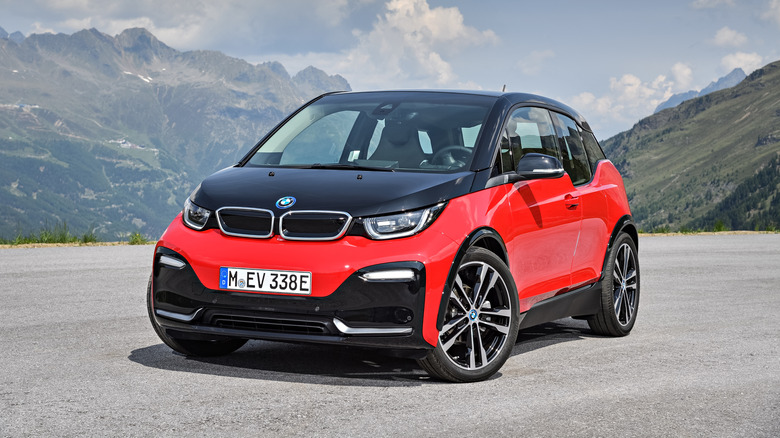
The real-world result is that production vehicles with series-hybrid systems are few and far between. An early 21st century example is the BMW i3. This funky little EV was available with a two-cylinder gas engine that could operate as needed to keep the battery charged. Per BMW, it extended the i3's range from about 97 miles to 180 miles, plus you could stop at a gas station to fill up instead of searching for a working EV charging station. That can be a challenge, though they're being installed at a record pace.
Parallel hybrids: The best of both worlds
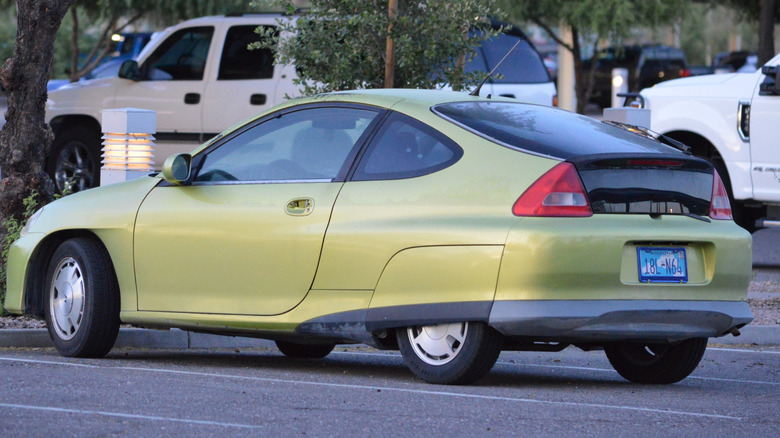
Even though they had to wait for the right kind of computer technology — to handle the complicated process of managing the engine, motor, and battery pack, as we mentioned above — parallel-hybrid systems have dominated the industry ever since the Honda Insight went on sale in the late 1990s; 25 years later, 25% of Honda's sales were hybrid. The idea behind the system, however, goes back to a 1982 partnership between GE and VW that led to an early plug-in hybrid concept car.
Just about every hybrid and plug-in hybrid vehicle on the road today features parallel-hybrid technology — many can sort of mix modes, too, running on only gas, only electricity, or both. A car like the Prius, for instance, may use parallel-hybrid functionality for much of its driving, gaining motivation from both gas and electricity at the same time. But it's also able to disconnect the gas engine from the powertrain and travel on electricity alone for a limited distance. In that case, it's basically operating as a series hybrid, using only electricity developed by the engine (and braking) to drive its electric motors.
You should keep in mind, however, that series and parallel hybrid technology doesn't come into play with mild hybrids, which are seeing some Toyota-inspired controversy over their claims to be hybrids at all. These vehicles use 48-volt starting systems, but their electric motors aren't powerful enough to drive the vehicle on their own.