

Why Modern Hemi Engines Have 16 Spark Plugs Instead Of 8
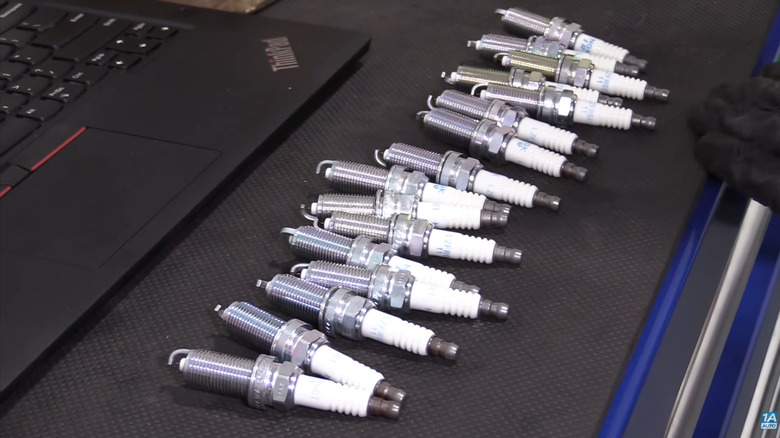
Back in the days of carburetors and cigarette lighters being common in dashboards, a Gen-II Hemi didn't need a lot of spark plugs to prove a point. Eight cylinders, eight spark plugs — simple, loud, and unapologetic. But when Chrysler rolled out the Gen-III Hemi in 2003 in the Dodge Ram, things got a little brighter. Suddenly, each cylinder had two spark plugs, bringing the count to 16 across engines like the 5.7-liter, 6.2-liter, and 6.4-liter Hemi offerings.
The original 1950s Chrysler FirePower (331-cubic-inch V8) was a pioneer Hemi engine. It had big hemispherical combustion domes that let air and fuel mix freely and explode efficiently — which is where the name Hemi came from. But that dome also created a problem: one spark plug couldn't ignite the entire charge evenly. The result was that bit of unburned fuel would be left in some parts of the dome.
After a number of years, Chrysler engineers solved this by adding a second spark plug. Two ignition points mean a faster, more complete burn, better power and performance, fewer emissions, and a tiny bump in fuel efficiency. It wasn't about doubling horsepower — but about cleaning up the ignition. Still, old-school Hemi fans can't help but smirk. The modern Hemi might burn cleaner, but it sure doesn't feel and smell like the old ones.
Twice the maintenance or twice the benefit?
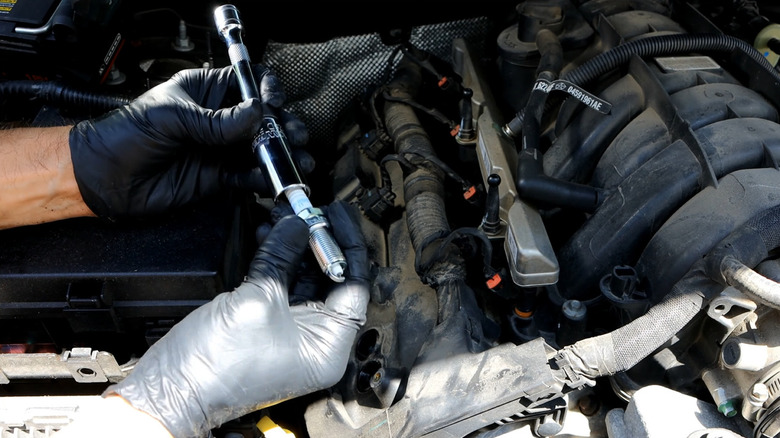
So yes, two plugs per cylinder makes sense — from an engineering standpoint. But from a car owner's wallet? That's another story. Sixteen spark plugs mean double the parts, double the labor, and double the cursing, especially when looking out for a busted one. Also, these engines produce more heat since two plugs are sparking in union. Lastly, the choice of fuel matters. Pricier high octane is suited more to Hemi engines to max its performance.
However, the extra plugs help by improving ignition control, smoothing out combustion timing, and making the engine just a little bit cleaner. By ensuring stable ignition, they also helps in reducing knock and gives drivers a better throttle response. It's smart engineering, just not particularly idealistic. Back in the '60s, when a Hemi coughed raw fuel out the tailpipes, no one cared. Today, you can't even start one without a computer nodding approval. Progress, right?
In fairness, dual plugs make the Hemi surprisingly refined for a 400-horsepower bruiser. They improve cold starts, increase horsepower, reduce engine load, and smoothen out operation. But for purists, it feels like trading whiskey for green tea. Sure, it's better for you, but it doesn't quite have the same kick. So, is it worth it? Technically, yes. Financially, maybe not. Spiritually? Let's just say the classic eight-plug Hemi still wins in the garage of nostalgia, where a little inefficiency was part of the fun.