

These Muscle Cars Had The Best Names
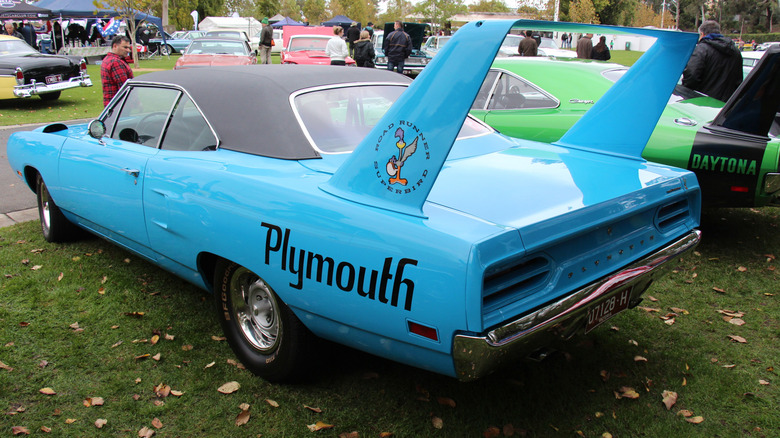
American carmakers were slow to catch on to the power of a great model name to market a car and create a legacy. The Ford Model T changed the world, but it got its name from the fact that Henry Ford named his prototypes after letters. Not very imaginative, Henry. Duesenberg also referred to its most breathtaking car as simply the Model J. Other cars were named after technical specs, such as the twelve-cylinder Packard Twelve of the 1930s.
By the 1950s, however, manufacturers started to catch on. Cars got model names that conjured speed, power, or luxury, such as Corvette, Thunderbird, or El Dorado. By the mid-1960s, car names truly started to come into their own with designations like the Ford Galaxie, the Plymouth Barracuda, and the Pontiac Tempest. The latter car became the basis for the Pontiac GTO, widely considered the car that launched the muscle car era.
Muscle Car Club defines a muscle car as "an intermediate-sized, high-performance oriented model, powered by a large V8 engine, at an affordable price." Although there's plenty of debate over when the American muscle era peaked, most agree that it had ended by the mid-1970s. For roughly a decade, then, we saw some of the most glorious machines that ever came out of Detroit. Along with tire-smoking V8 engines, the muscle car era produced some of the best model names of all time, too.
Plymouth Road Runner
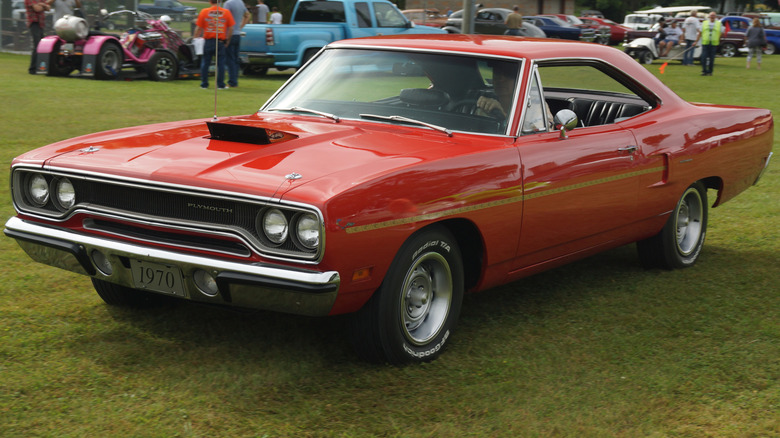
Above all, the muscle car era was about the fun provided by smoking tires and eye-popping zero-to-sixty times. Our first car takes the concept of fun and leans into it with a lighthearted name and one of the coolest badges on any car – the Plymouth Road Runner. Named after the beloved Looney Tunes character who was always one step ahead of his hapless coyote pursuer, the Road Runner debuted in 1968 as a more affordable alternative to pricier muscle cars of its day. And yes, the car actually sported a graphic of the Road Runner.
Plymouth licensed the Road Runner name and image from Warner Brothers. It cost them all of $50,000 to do so. The car's horn also used the cartoon bird's "beep-beep" sound, so Plymouth really got its money's worth from its fifty grand. Heck, even Wile E. Coyote's image made an appearance on Road Runners equipped with the Coyote Duster air filter, although you had to open the hood to see it. Plymouth got a cartoon character two-for-one.
The '68 Road Runner was based on the redesigned intermediate-size Plymouth Belvedere, which rode on Chrysler's B-body platform. Engines for its first year included a 383-cubic-inch V8 and the famed 426 Street Hemi, the latter of which pumped out 425 horsepower and an earth-shaking 490 pound-feet of torque. Partway through the 1969 model year, the 440 Six Barrel engine (also called the 440-6) became available, producing 390 hp and 490 lb-ft of torque. In 1970, Plymouth introduced the ultra-aerodynamic Road Runner Superbird, a car so fast that it was banned by NASCAR.
Pontiac GTO Judge
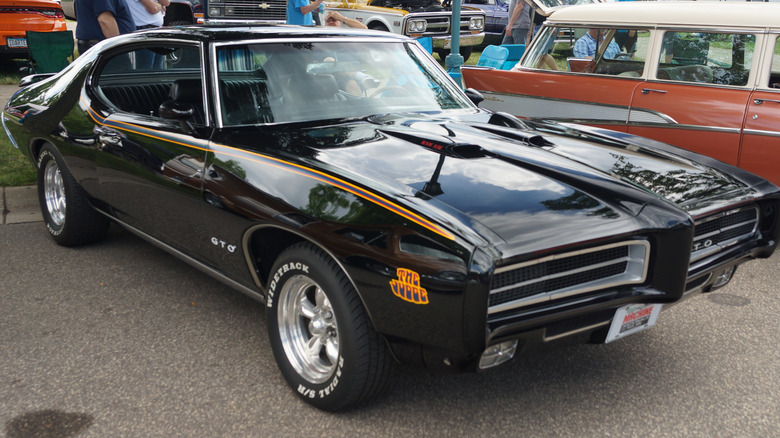
In keeping with the theme of fun, the Pontiac GTO Judge was named after a catchphrase from the classic sketch comedy show, Rowan & Martin's Laugh-In. It sported an emblem spelling out "The Judge" in wavy, trippy black letters outlined in red against a yellow background–perfect for the psychedelic '60s. However, the lighthearted iconography belied the car's super-cool name, because who is more intimidating than a judge? It stood ready to pronounce its sentence on its competition, and no lenience could be expected.
The Judge started as a project to build a competitor to the Road Runner. Like the Plymouth, it was meant to be a lightweight, bare-bones, affordable muscle car. Originally called the E/T — which apparently did not yet connote space aliens — the car's name and mission were changed by John DeLorean, who was then Pontiac's chief engineer. By the time it hit showrooms for the 1969 model year, the Judge sported a 366-horsepower Ram Air III V8, with a 370-hp Ram Air IV as an available option. Wider tires, a rear spoiler, and a Hurst shifter completed the package.
Up through 1969, GM prohibited its divisions from installing engines larger than 400 cubic inches, but this ban was lifted in 1970. Pontiac took advantage of this and equipped the Judge with a monster 455-cubic-inch V8 partway through the 1970 model year. Styling was lightly refreshed, too. About 10 percent of all GTOs sold in 1969 and 1970 were Judges, so buyers didn't quite seem to catch on to the unique model. It has since become a classic, with a $1 million Pontiac GTO Judge sold at a Mecum auction in 2023.
Chevy Chevelle Malibu SS
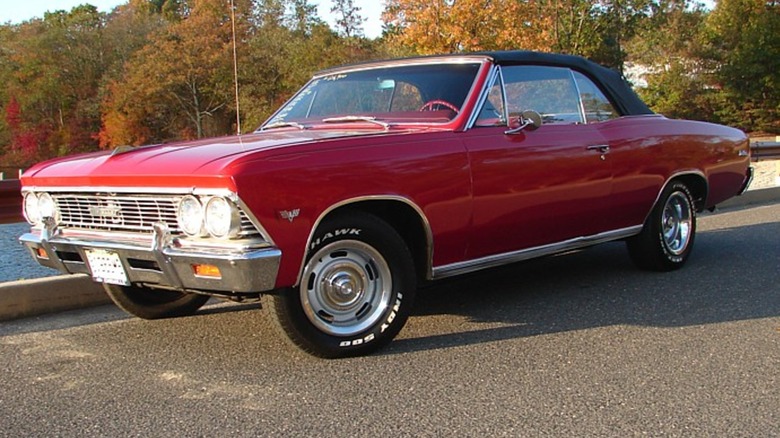
GM's A-body platform birthed several iconic muscle cars, one of which we've already met in the form of the GTO Judge. Several A-bodies have famous, if somewhat anodyne, alphanumeric designations such as the Buick GSX and the Oldsmobile 4-4-2. However, the Chevelle Malibu SS came with a name that stands out. Chevelle obviously conjures the Chevy name, but it also has echoes of horses, since cheval means horse in French. However, it has often been said that Chevelle is a portmanteau of Chevy and gazelle, although perhaps only Chevy's marketing department knew for sure.
Regardless of its origins, Chevelle just sounds cool. Buyers agreed, and the Chevelle became one of the most popular muscle cars of all time. In its debut model year of 1964, it sold more than 338,000 units, rising to a peak of 633,000 in 1970. Not every Chevelle would have qualified as a muscle car, such as six-cylinder models. However, V8 options included a 283 small-block rated at up to 220 hp and a 327 producing 300 hp, both of which were available in the Chevelle Malibu SS.
By 1966, the Chevelle Malibu SS 396 model offered V8s rated for 325, 360, and 375 horsepower. A 1968 redesign included a 402-cubic-inch engine option, although it was still designated as a 396, presumably to skirt GM's prohibition on engines bigger than 400 cubic inches. By 1975, Chevy stopped offering big-block V8s in the Chevelle, and in 1977, the model was discontinued. Oddly, despite the car's popularity and cool name, Chevy has never tried to revive it. However, there have been occasional rumors of Chevrolet bringing the Chevelle back.
Oldsmobile Rallye 350
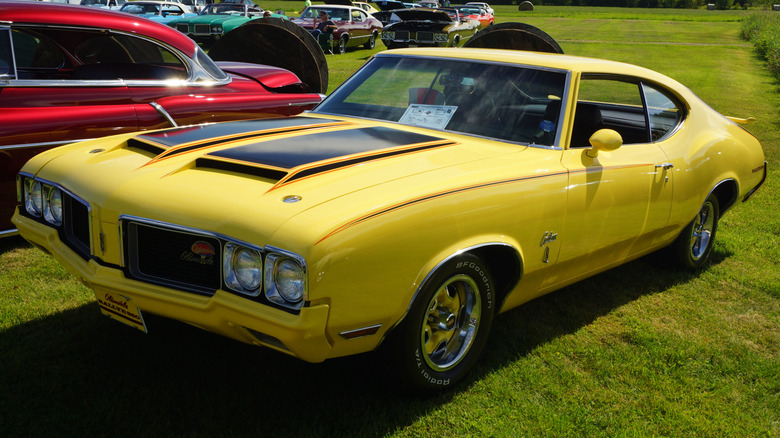
Look past the awkward spelling and pronounce the name out loud: Oldsmobile Rallye 350. It sounds fast before you even lay eyes on its spectacular yellow-ness. Based on a Cutlass Holiday Coupe body, the 1970 Rallye 350 was one of a number of muscle car models that responded to rising insurance premiums by scaling back the performance aspect — but not too much. After all, there was still a 350-cubic-inch, 310-hp, four-barrel V8 under the car's Sebring Yellow hood.
This made the Olds good for a 7.0-second zero-to-sixty run. The quarter-mile clocked in at just over 94 mph. By the standards of 1970, this was more than decent, although short of some top-end muscle cars, which helped to appease insurance companies. However, the Rallye 350 also offered decent handling thanks to a suspension package that offered anti-roll bars (front and rear) and stiffer springs.
We keep mentioning yellow, but it's hard to avoid in regards to this car. The body, bumpers, grille, side mirror housings, spoiler, and wheels were all yellow, a rarity in an era when most cars sported plentiful chrome. In fact, some dealers tried to boost the slow-selling model with stainless steel trim rings on the wheels, and they sometimes even replaced the yellow bumpers with chrome ones. With only 3,547 units sold, this car is rare and doubly unique since Oldsmobile is an extinct brand. Indeed, we're still not over Oldsmobile's death after more than two decades.
Dodge Super Bee
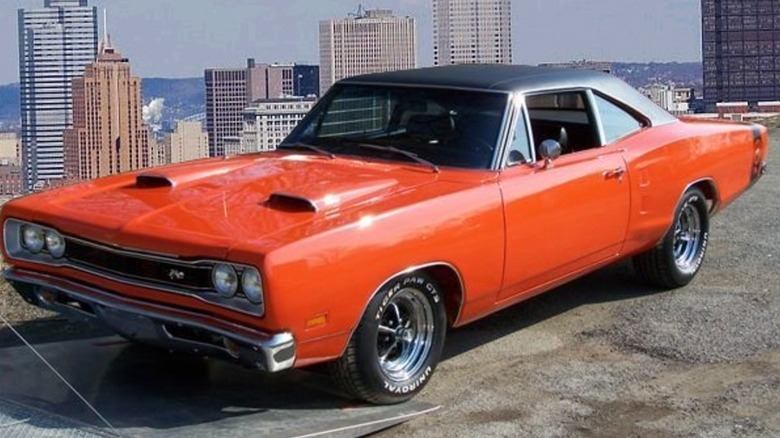
What stings more fiercely than a bee? A Super Bee, Dodge's wild and short-lived affordable muscle car. The name Super Bee most likely derived from the fact that it rode on the B-body platform, but how cool is the image of a car that stings its competition? When Plymouth hit one out of the park with the 1968 Road Runner (also a Mopar B-body car), Dodge quickly responded with the Super Bee as a mid-year 1968 model.
Like its Road Runner cousin, the Super Bee got a fun name and a cool logo – a cartoon bee in a racing helmet and goggles, sporting wheels and side pipes instead of wings. Under its cool graphics and hood scoops, the Super Bee was based on the Dodge Coronet in its pillared-coupe version. Like the Road Runner, the '68 Super Bee offered a choice of the 383 big-block and the 426 Hemi. However, the Super Bee offered extra equipment such as a podded gauge cluster and a Hurst shifter, making it slightly more upscale than its Plymouth counterpart.
For 1969, the Super Bee got the same 390-hp 440-6 engine as the '69 Road Runner. The option package that it came with also included black wheels and a matte-black fiberglass hood, along with a Dana 60 4:10-geared rear end. The model was refreshed in 1970, but in 1971, the Coronet coupe was dropped, leading Dodge to transfer the Super Bee name to a small-block equipped Charger. We believe the Super Bee is a Dodge model that deserves another chance.
Dodge Charger
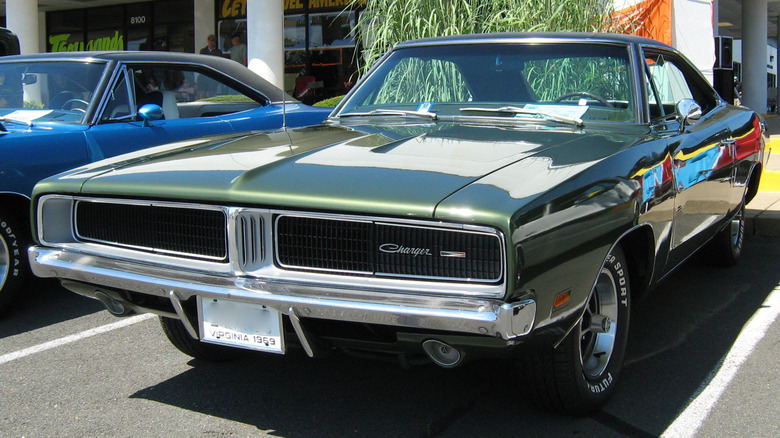
Before the word charger came to refer to a device for slowly powering up EVs, it referred to a medieval warhorse. Much cooler than an EV, huh? Dodge brought its own Charger steed to the muscle car wars of the 1960s. Like the Super Bee and the Road Runner, it was based on Chrysler's B-body platform and shouldn't be confused with the similar-looking but more upscale E-body Challenger. Yet with its muscular design and hidden headlights, the Charger looked like a premium car in its own right.
The 1968-70 version of the Charger, with its iconic Coke bottle styling, has come to define the model. This results partly from its frequent appearances in movies and TV shows, including a certain Friday night staple of Gen X childhoods in which an orange Charger could be seen jumping over creeks in Hazzard County while Wayland Jennings narrated the adventures of "them Duke boys." Just don't remind us that over 300 Chargers were destroyed filming the show's stunts.
First-generation 1966-67 Chargers offered a range of V8s topped by a 425-hp Hemi that cranked out 490 lb-ft of torque. The second generation added an inline-six and the Magnum V8, which made it a part of the group of performance cars known as the Scat Pack. Two homologation specials were offered in 1969 to qualify the Charger for NASCAR races: the Charger 500 and the ultra-aerodynamic Charger Daytona, which joined the Road Runner Superbird in being banned by NASCAR for being too fast.
Mercury Cyclone Cobra Jet
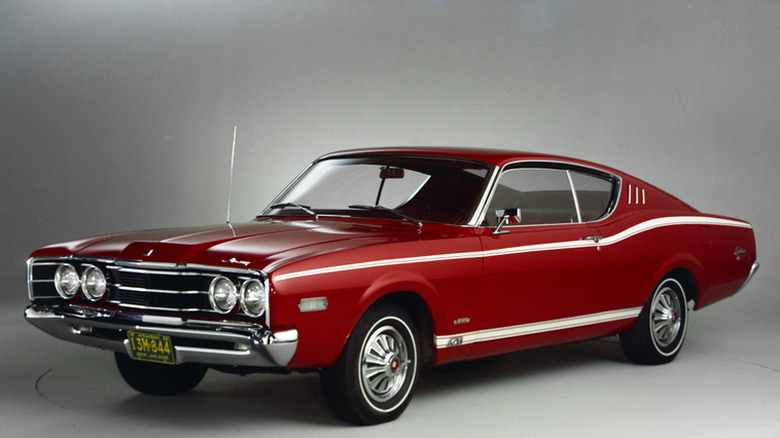
Here's a car name that piles on layer after layer of cool. After all, Mercury was the fleet-footed messenger of the gods, a cyclone is a powerful storm, a cobra is a quick-striking snake, and jets power the fastest vehicles on earth. Put them together in one name, and you have the Mercury Cyclone Cobra Jet. Even the car that it was based on had a pretty cool name in the Mercury Comet, a compact car that grew into a midsize by 1966 to qualify the Cyclone as a true muscle car.
The '66 Mercury Comet Cyclone was a worthy contender and stands out for its rarity, but the model came into its own with the 1969 Mercury Cyclone Cobra Jet. A twin to the Ford Torino Cobra, the Mercury version of this car is exceedingly rare, with only 2,175 ever built. If you see one, get a pic, because you'll quite likely never see one again. Its 428-cubic-inch V8 officially made 335 hp, but it's widely believed that the actual number was quite a bit higher, in the 400 hp range.
This was good for a 14-second quarter-mile time, which would rank the Cyclone Cobra Jet as one of the fastest muscle cars of its era. Yet because of its rarity, or perhaps because of the now-departed Mercury division's reputation as a purveyor of mid-level near-luxury cars, the Cyclone Cobra Jet faded into history, ignored by all but the most die-hard muscle car fans.
Ford Torino Super Cobra Jet
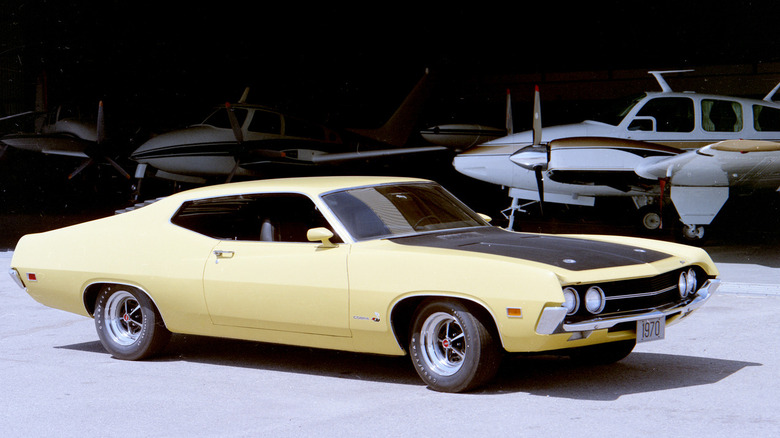
As if the Super Cobra Jet designation in this car's name wasn't cool enough, there's the model name itself, Torino, the Italian name for Turin, a city in northern Italy. Turin is named for the Celtic Taurini tribe, who lived in the area before the Romans conquered it. Their name, in turn, was derived from a word meaning either bull or mountain. Additionally, Turin is often referred to as Italy's Detroit because it's home to carmakers like Fiat, giving Ford's car a frisson of Italian performance heritage.
Of course, that was all marketing. The Torino was a thoroughly American car, and Cobra versions of the Torino used a thoroughly American approach to performance: great, big, stonkin' V8s. Even the regular 1970 Torino Cobra was a formidable muscle car equipped with a 360-horsepower Thunder Jet V8 with a four-barrel carburetor. With a blacked-out hood and Cobra badging on a muscular body that had been redesigned for that model year, the Torino Cobra was an intimidating road presence. Upgrading to the 429 Cobra boosted horsepower to 370.
By checking off the Drag Pack option on the order sheet for just $155, buyers could step up to the Super Cobra Jet. With upgrades like a Holley 4150-series carburetor, header-style exhaust manifolds, and upgrades for durability, such as heavier-duty connecting rods pushing forged aluminum pistons, this was a race-ready engine. Ford officially rated this motor at 375 hp, perhaps to appease the insurance companies, but a 1971 road test achieved a 13.70-second quarter-mile time. Ford must have printed that 375-hp figure with its fingers crossed behind its back.