

Prague Is Betting On These Lamp Posts To Fulfill Its Ambitious EV Charger Plan
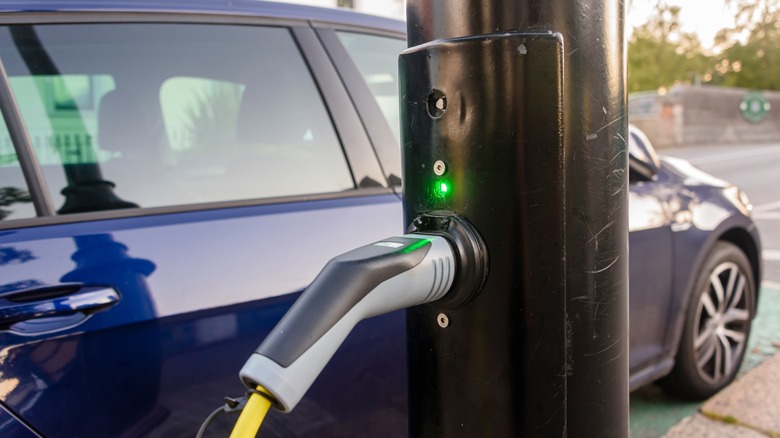
You know those lamps with USB outlets for replenishing your phone battery? Prague wants to do that, but scaled up to street lamps and electric-vehicle charging stations, and it's adopting the breakneck pace that EV chargers are springing up in the U.S. Basically, the Czech Republic's capital city is sidestepping what could have been a major construction project and is instead treating the retrofit like an appliance swapout, so installation speed shouldn't be a problem.
In 2024, the city began in earnest, putting in 143 EV-ready street lamps. By 2026, Prague hopes to have 1,500 such lamps installed, with a goal of 6,000 once 2030 rolls around. Two years ago, there were only 2,400 EV charging points in the entire Czech Republic, but they only had to serve the Czech Republic's 22,000 registered electric cars, a drop in the bucket of the country's 6.13 million registered passenger cars. This endeavor is banking on future EV adoption, and it's not a shot in the dark. In 2020, electric car sales increased by 331%, a trend Prague wants to move from the realm of "early adoption excitement" to "normal occurrence."
All of this infrastructure modification is the reponsibility of Technology of the Capital City of Prague, the company that oversees Prague's public lighting. Its current job is installing the thick new cables that will support the massive charging network. To accommodate these new oversized iPhone-charging desk lamps, Prague has to ensure that its 3,400-plus miles of roads have electric cables up to the task. Ultimately, they will serve at least a fifth of the 500,000 to 700,000 EVs the Czech Republic anticipates will be operating by 2030.
Electrons vs. diesel
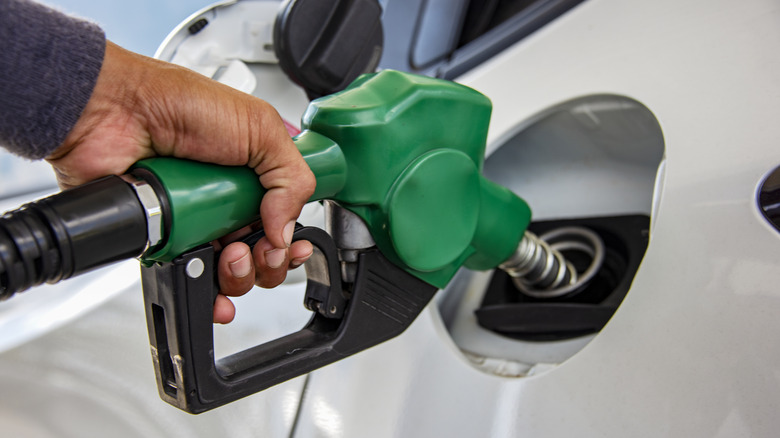
Ever since Volkswagen created cheat software for its diesels, an incident that had to be called "Dieselgate" because the Watergate Hotel will forever lend half its name to scandals, the fuel has waned in popularity. That's especially true in the U.S., where the only diesels you can get in 2025 are large trucks, SUVs, and vans.
In Europe, however, there are still plenty of diesels coming off assembly lines and into showrooms. The purchase percentage of diesel-powered cars has certainly dropped, going from 52% of new cars sold in 2015 to 13.6% in 2023, but that's still nearly double the take rate of plug-in hybrids (7.7%) and just below battery electric vehicles (14.6%). In the Czech Republic's case, a large part of this push toward EV infrastructure is because its people still love diesels, to the point that more diesel cars are sold there than in any other nation in the European Union. The country is trying to reverse that.
The specific environmental issue Prague likely wants to address is smog. While diesel engines generally emit less carbon dioxide than gas engines, diesels release more nitrous oxide unless they have reduction systems such as exhaust-gas recirculation or diesel-exhaust fluid injection. Of course, even if a vehicle has those systems, it still needs care and mindful owners to prevent pollution from increasing over the vehicle's lifespan.
The main issue with nitrous oxide is that it directly leads to smog, which can cause asthma, respiratory problems, cancer, heart attacks, and a slew of other unpleasantness. Considering that Prague's air currently contains 1.2 times the World Health Organization's guidelines for particulate matter, perhaps not every Czech citizen is on top of diesel maintenance.
Street lamp EV chargers are on their way
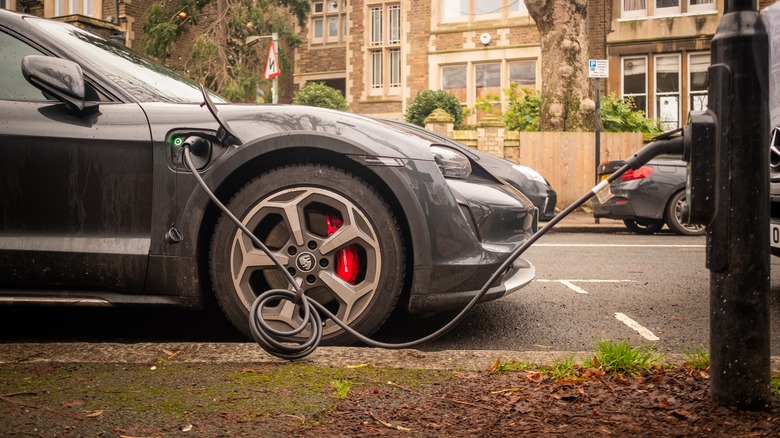
A good idea is a good idea, and Prague isn't alone in its desire to make charging more accessible for electric and plug-in hybrid owners. My childhood hometown of Lancaster, Pennsylvania recently got a $3.1 million grant to install EV chargers in parking lots and public parks, with an emphasis on the lower-income neighborhoods. Detroit is going the Prague route, with AT&T and Voltpost tansforming lampposts into internet-connected EV chargers. That internet connection isn't just to charge your credit card, either — it lets the companies that operate the chargers fix software issues remotely.
Voltpost, by the way, is a company that specializes in turning lampposts into Level 2 EV chargers, and has already brought its tech to other cities in Michigan, as well as California and Illinois, among others. You know what AT&T is, so we'll skip that one.
With this increase in charging infrastructure, the hope is that it will alleviate range fears for potential EV buyers. Zdeněk Hřib, Prague's first deputy mayor for transport, told Prague Morning, "Without accessible charging options, electromobility will remain the privilege of a small group. Prague must ensure that every resident has the opportunity to make the switch."
For driving enthusiasts, all of these new charging stations will have one negative affect: it's the range anxiety governments want to eliminate that's probably keeping used Kia EV6 GTs cheap. The model debuted with 576 hp, and Car and Driver got a 3.2-second 0-60 time, though it only had an EPA estimated range of 206 miles. But what does a 206-mile range matter when chargers are everywhere? Seriously, go buy one of these while they're still around 30 grand!