

Honda Super Cub: All About The History-Making Motorcycle
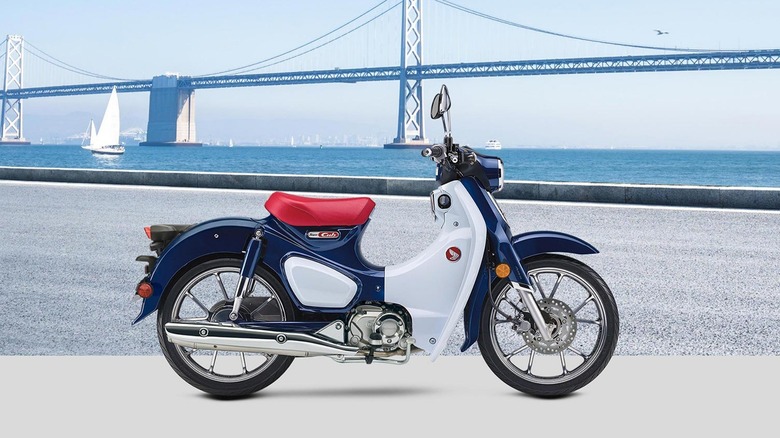
In 1958, Honda announced its plans to release the C100 Super Cub. At the time, few could have predicted that the Super Cub would go on to become the top-selling motor vehicle ever built. Honda has sold over 100 million units, and that was back in 2017, so the numbers are surely higher now. This little step-through has done more than just get people to work, it has firmly redefined what motorcycling means around the world, especially at the entry level.
You may have heard the tagline, "You meet the nicest people on a Honda," which wasn't just marketing fluff. It was a cultural reset that spawned in 1963 specifically for the U.S. market. Before the Cub, motorcycles in America were often linked with outlaws and leather jackets. The Super Cub, with its approachable design and clever engineering, made its two wheels something your mom, your postman, or your college buddy could hop onto without receiving questionable looks.
What made the Super Cub special was its engineering. This little motorcycle was genius in its simplicity, employing a step-through frame supporting a reliable four-stroke engine. The semi-automatic transmission cut out the intimidation factor of operating a clutch lever and changing gears at the same time, giving even beginners the confidence to hop on and hit the road. In the decades since, the Super Cub has become an icon, both in Japan and here in the U.S. The bike is so famous that it even inspired engineering students to build a cardboard replica of the Super Cub. But there's a lot more to the bike's story.
The creation of the Honda Super Cub revolution
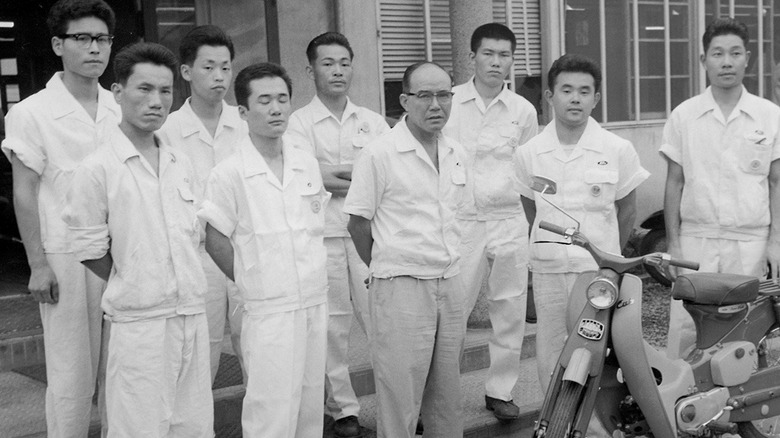
In the mid-1950s, Soichiro Honda and his business partner Takeo Fujisawa were interested in creating a two-wheeler that would be able to carry Japan through its postwar boom. It had to survive the country's battered roads while hauling groceries and looking appealing.
The starting point was the engine. Honda's team managed to create a unique 50cc four-stroke engine that pumped out 4.5 horsepower. They mounted it horizontally to make the bike slimmer and easier to step through. Then, they drilled an airflow passage into the cylinder head and reached out to spark plug makers for custom parts. The bike came with pressed-steel handlebars, 17-inch wheels and tires, and polyethylene resin fenders, which were light, durable, and painted in attractive bright colors.
Development was a bit chaotic — engineers frequently engaged in heated discussions, which Soichiro habitually silenced by grabbing a piece of chalk and sketching ideas on the blackboard. However, the final mockup impressed Fujisawa so much that he didn't just predict success — he anticipated that 30,000 units would be sold every month. That was a hugely optimistic number for the time, considering that the total number of motorcycles sold per month by all manufacturers combined was about 40,000.
In 1958, Honda announced the Super Cub in Japan, while sales started a year later. Today, Honda is an automotive giant and recently launched an experimental reusable rocket, but, back then, the company was just starting to make a name for itself. Little did it know that a tiny 50cc step-through bike was going to rewrite the rules of motorcycle history.
The Super Cub lands in America
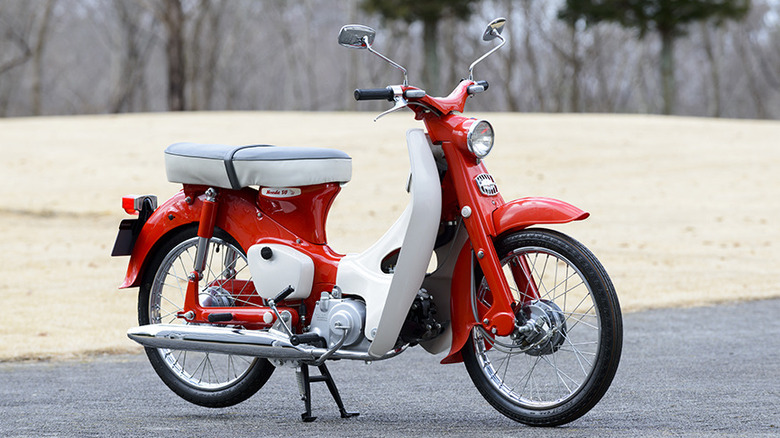
The 2020s saw Honda's coolest new motorcycle come to the U.S., but when the manufacturer brought the Honda 50 (C100 Super Cub) to the U.S. in 1959, it wasn't exactly an obvious sell. Americans were used to big Harley-Davidsons. A tiny 50cc step-through looked like a toy in comparison. But Honda's gamble paid off. The "You meet the nicest people on a Honda" campaign launched in 1963 and flipped the script, so much so that it compelled the Hog manufacturer to produce the only Harley-Davidson scooter ever made, the Topper. In the '60s-era U.S., the Super Cub became the perfect starter bike and a great way for students and suburban families to dip their toes into the joy of motorcycling.
Honda's marketing plan worked. The Super Cub found its first fans in Hollywood. West Coast tastemakers, forever chasing the next cool thing, saw the tiny step-through as a stylish alternative to Detroit iron and oversized American bikes. It was lightweight, modern, and just quirky enough to stand out on L.A. streets. College kids caught on fast. With a $295 sticker price, the Cub was attainable even for students with a part-time job, and the Cub's frugal appetite for gas made it even more appealing. Soon it was the youth mobility badge of the 60s, sometimes gifted as a Christmas present and even immortalized by The Beach Boys in "Little Honda," an international hit in 1964-65.
The Super Cub's dirt-loving cousin is born
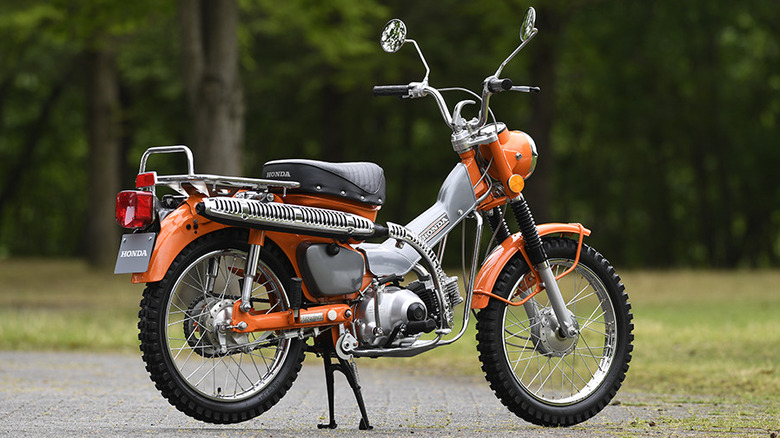
In the early 1960s, riders were bending the Honda Super Cub into something more practical for the dirt trails. The first big transformation came when a Honda America employee yanked off the Super Cub's leg shields and front fender, swapped in knobby block-pattern tires, and added a larger rear sprocket. That backyard experiment became the Trail 50 (CA100T) and sold for $275. Suddenly, hunters, anglers, and campers had a lightweight, 50cc bike they could throw in a pickup bed, haul into the woods, and ride where no car or scooter dared. Honda quickly leaned into the craze, offering optional rifle and fishing rod holders along with a raised muffler.
The Trail family didn't stop there. In 1963, Honda introduced the CA105T, a purpose-built off-road model with a high-mounted exhaust. By 1964, the Trail 90 (CT200) was born, packing an 86.7cc overhead valve engine. Two years later, in 1966, the CT90 replaced it, this time with a new 89.6cc overhead cam motor. The big leap came in 1968, when Honda ditched the old double sprockets for a dual-range sub-transmission that let riders switch between highway and trail gearing with a simple lever flip. A telescopic front fork arrived in 1969, making the bike smoother over rutted roads. By the early '70s, the Trail Cubs had sprouted 90-degree folding handlebars, and auxiliary fuel tanks, turning them into true farm and backwoods workhorses.
The Super Cub' Southeast Asian domination
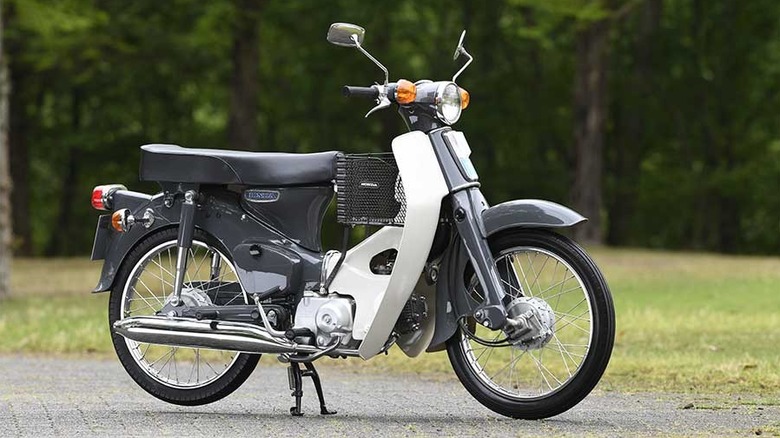
By 1960, Super Cub sales in the U.S. exploded past expectations. The company sold 564,000 Super Cubs, helping Honda become the world's top motorcycle maker the following year. By 1966, cumulative sales topped 5 million, and the little Super Cub went on to enjoy a 15-year U.S. sales run before bowing out in 1974. Meanwhile, it continued its success story in other parts of the world.
Honda expanded into Europe in 1961 with the Super Cub, and the company landed in Southeast Asia with Asian Honda's launch in Thailand in 1964. Just like in Japan, the Super Cub's cheap, rugged, and approachable form made it the face of mobility in regions where roads were rough and cars were out of reach. In Thailand, where just 100,000 motorcycles were on the road, Honda raised that number to 150,000 by 1966. Honda began assembling Super Cubs in Thailand by 1967, backed by a new local version of the "You Meet the Nicest People on a Honda" campaign. From there, the Cub spread to Malaysia, the Philippines, and Indonesia, cementing its place as the region's go-to two-wheeler.
Vietnam's story was more dramatic. In the late 1960s, the U.S. military shipped over 20,000 Super Cubs to South Vietnam, sparking a boom that saw 750,000 Honda bikes arrive between 1967 and 1969. When Saigon fell in 1975, countless Cubs were abandoned and quickly adopted by the locals. During the U.S.-imposed embargo, Vietnamese ingenuity kept the Super Cubs alive with local parts and gray-market imports. The Super Cub wasn't just transportation in Vietnam, it was cultural bedrock, leading to the country's nickname: Super Cub Paradise.
The comeback story: new-age tech meets retro charm
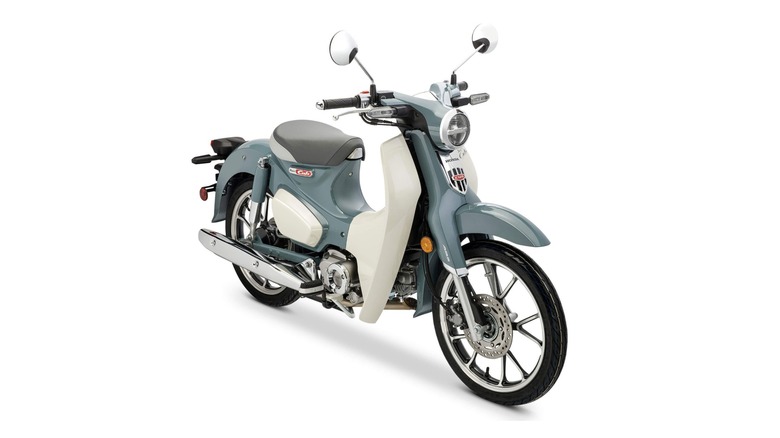
The original Super Cub was all about simplicity, and Honda didn't leave it frozen in time. In 2019, Honda reintroduced the Super Cub C125 in the United States, with styling inspired by the original and modern tech to bring it up-to-date. It kept the step-through style and classic lines but added features like fuel injection, ABS, LED lighting, and a smoother, air-cooled 124cc four-stroke engine. The bike is still approachable, but now it's ready for today's traffic and emissions standards.
The modern Super Cub functions as both a fun piece of nostalgia for older riders and an excellent entry point for new ones. It may not dominate U.S. sales the way it did in the 1960s, but it could carve out a niche among city commuters who want style and substance without breaking the bank. The Super Cub remains true to its core value offering and is as relevant as ever, even spawning its modern-day Hunter cub counterpart, the 2020 CT125 Hunter Cub.