

The Chevy BrightDrop-Based Coachmen RVEX Electric RV Actually Makes Sense In The Real World
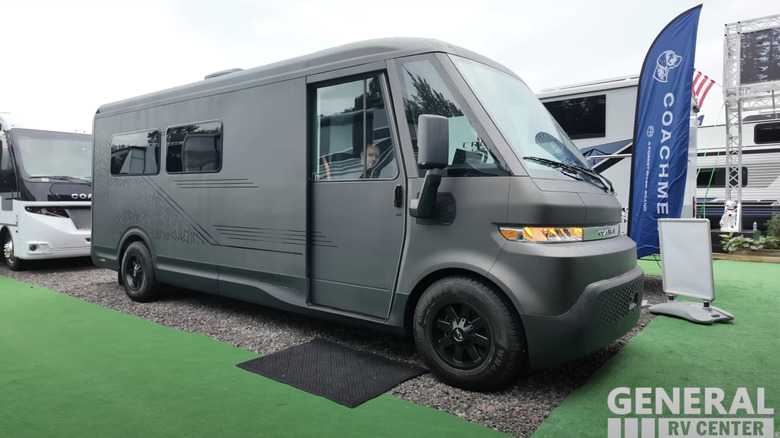
While EVs have gone mainstream, they have yet to penetrate the RV market successfully. Nobody wants to drive 100 miles, then wait hours to recharge before moving on. That may be about to change, as the new Coachmen RVEX addresses the shortcomings of electric RVs better than anything we've seen so far.
It's based on the Chevy BrightDrop delivery van, and while a step van with sliding doors may seem an odd choice for an RV, a large box on wheels is the perfect shape. Even better is the RVEX's claimed range of up to 270 miles, thanks to the BrightDrop's largest available 172-kWh battery pack. It takes one hour, a leisurely lunch stop, to add 160 miles of range. While less than the BrightDrop cargo van's 296-mile range due to the weight of the RV interior, it's far better than the Ford E-Transit's maximum range of 159 miles. A dual-motor setup gives the RVEX 300 horsepower, 390 pound-feet of torque, and all-wheel drive, making it far more difficult to get stuck on soft ground while driving to the ultimate boondocking site. You'll also be able to stay off the grid for a long time, thanks to the 1,000-amp-hour 48-volt house battery and 1,000 watts of solar panels on the roof.
All the comforts of home
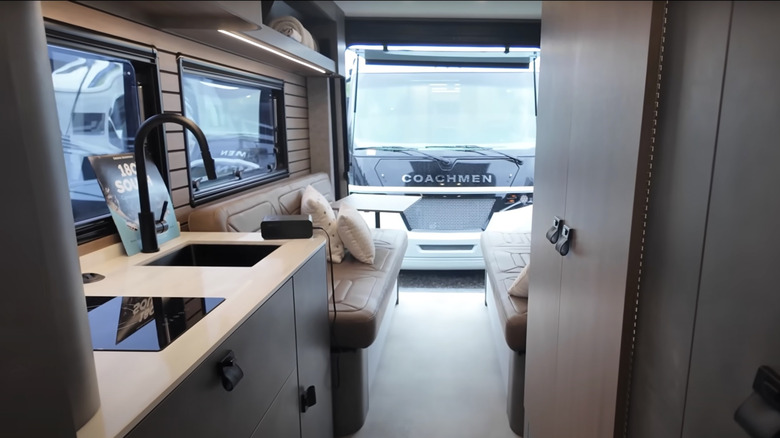
The Coachmen RVEX is a Class B RV, meaning it's built within an existing van's bodywork instead of having a larger custom-built body. Some would call it cramped, while others consider it cozy. Either way, it's a rather standard, if minimalist, arrangement as far as any Class B RVs go. It has a sink, refrigerator, freezer, induction stove, and a combination microwave/convection oven. A wet bathroom takes up a chunk of the interior, combining a shower and sink with a five-gallon cassette toilet. The RVEX holds 18 gallons of fresh water and a storage tank for grey water from the sink and shower. The cabinets and interior build are made of far more lightweight materials than are usually found on RVs, saving 290 pounds over traditional materials.
In the back, a pair of long sofas turns into a bed at night. The only flat space is a single Lagun swivel table, which must be removed to fold the bed flat. A split door replaces the roll-up door of the BrightDrop delivery van. The bottom half swings out to the side, while the top half is a window that opens vertically. That window is electrochromic and instantly turns opaque at the press of a button.
The front is nothing to write home about, and it's where BrightDrop's delivery van roots show most clearly, with large swaths of gray plastic and storage cubbies. The touchscreen displays are a great modern touch, though, and Coachmen added a passenger seat, which the standard delivery van didn't need.
Why this changes the electric RV game
Contrary to what this video says (although it's a great walkthrough if you want to see the details), the Coachmen RVEX is not the first fully electric RV on the market. Winnebago made an electric adventure van concept out of an E-Transit, and Grounded has already made a BrightDrop-based RV. Two main differences between these electric RVs and the RVEX make it practical for the average RVer, not just the EV enthusiast.
The first difference is the price. The original starting price of the Grounded G2 was $195,000. That has come down to $165,000, but it can still go up to $200,000 depending on how you option it out. The RVEX starts at $150,000. While far from chump change, this is about the same as a new gas or diesel-powered Class B RV. You no longer need to pay a premium for the privilege of an electric RV.
The RVEX has multiple charging methods. As expected, it supports Level 1, Level 2, and DC fast charging. The game changer is that plugging into the standard RV 30 or 50-amp outlet for the house electrical system also charges the vehicle battery. This is huge. You can drive to a campground 250 miles away from home without stopping, plug in for the night, and fully recharge the vehicle battery in 12 hours at 50 amps, or 18 hours at 30 amps, according to Matt's RV Reviews. If your overnight stops are close enough to each other, not only do you not need to stop at a gas station, you don't need to stop at a DC fast charger, either.
This is an advantage of an all-electric RV that works in the real world, and can't be duplicated in one that burns fossil fuels. Unless you want to cannonball a lot of non-stop miles, it's even more convenient than a gas or diesel RV. There's just one more feature I'd like to see, and I admit it's a power user thing. If you know you're going somewhere you can plug in, but it's 350 miles away, it would be great to have the option to sacrifice some of your house battery power to charge the vehicle battery, extend your range, and make it on one charge. When you plug in at your destination, you'd have all the power you need to recharge both batteries overnight.