

The Toughest Formula 1 Tracks, Ranked
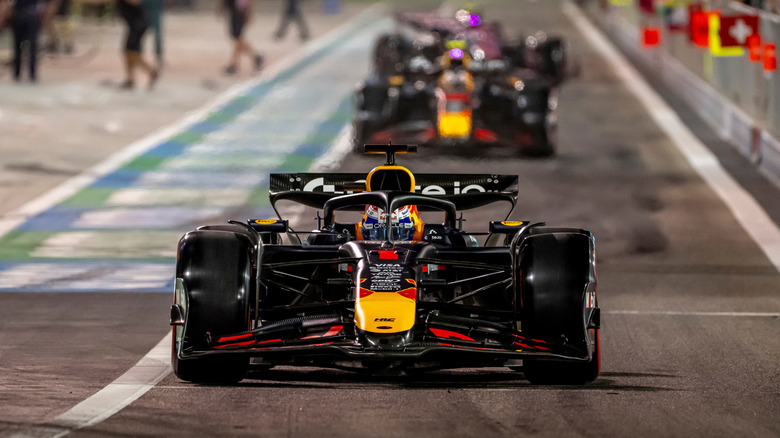
Car racing seems as though it were a natural progression borne from racing horses, and it's something that's evolved right along with the automobile. But the very first official Formula 1 race didn't take place until May 13, 1950, at the United Kingdom's Silverstone Circuit. In that race, Giuseppe Farina took first place driving an Alfa Romeo 158. The event attracted an estimated 120,000 spectators and included dignitaries such as King George VI and Queen Elizabeth. This is actually the only time a reigning monarch has ever attended a motor race.
Since the first F1 race in 1950, many things have changed in the sport. From cars getting faster to tracks getting tougher, F1 racing is an ever-changing sport that's constantly adjusting to current innovations. Safety standards have also become a bigger issue in F1 competitions, forcing car makers and track designers to adopt features that help prevent mishaps. That's not to say F1 courses have gotten easier by any means, though. And you can be sure that races are just as exciting today as they were in the past.
What makes an F1 circuit tough? The answer to that question isn't cut and dry, as many things must be considered. To rank this list starting with the least challenging and working up to the toughest, a variety of factors were used, including the track's overall length, the number of laps drivers must complete, the top speed that drivers reach, braking frequency, difficulty to overtake, and the number of turns and how technical they are. And while the order of this list could be debatable, the fact that these are some of the toughest F1 tracks today definitely isn't.
10. Silverstone Circuit
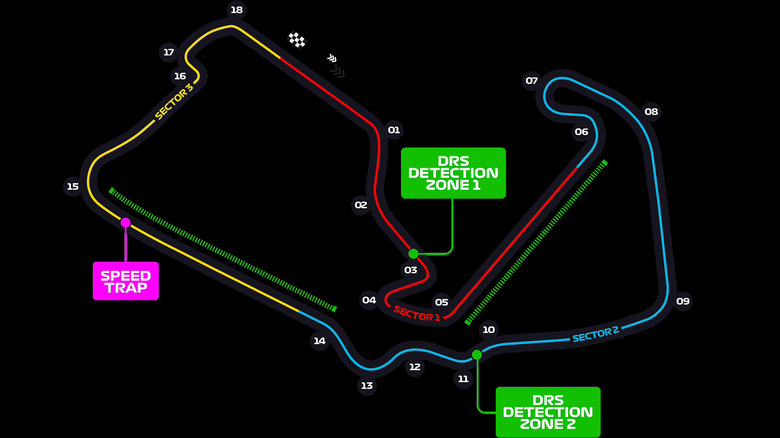
As the birthplace of the F1 Grand Prix, the Silverstone Circuit finds its way to No. 10 on this list because, although it's short, cornering is fast and challenging. It was constructed in 1943 as an airbase where pilots could practice night bombing techniques, but it would see its first car race in 1948. When racers took to the Silverstone track in the first F1 race, the Woodcote curve was the first bend on the course. This would change in 1952, when Woodcote was positioned as the final curve. The track underwent many changes over the years to improve safety, but in 1991, the Silverstone Circuit got a major overhaul that virtually transformed it.
Today, the Silverstone course is 5.891 kilometers long with 18 corners, and drivers must complete 52 laps, making the entire race distance just over 306 km. Several challenging turns and the track's high speeds contribute to its difficulty. The Maggotts curve is the start of a three-curve run that's considered one of the most enjoyable in F1, but drivers can reach a top speed of 190 mph, making it both thrilling and dangerous. A newer addition to Silverstone is The Loop, a hairpin curve that limits drivers to a top speed of just 56 mph.
The fastest lap time recorded at Silverstone Circuit is 1:24.303. This was achieved by Lewis Hamilton in 2020, the same year Max Verstappen set a lap record of 1:27.097 at the same course. Top speed at Silverstone is 202 mph, with cars going full throttle for 70% of the race.
9. Suzuka Circuit
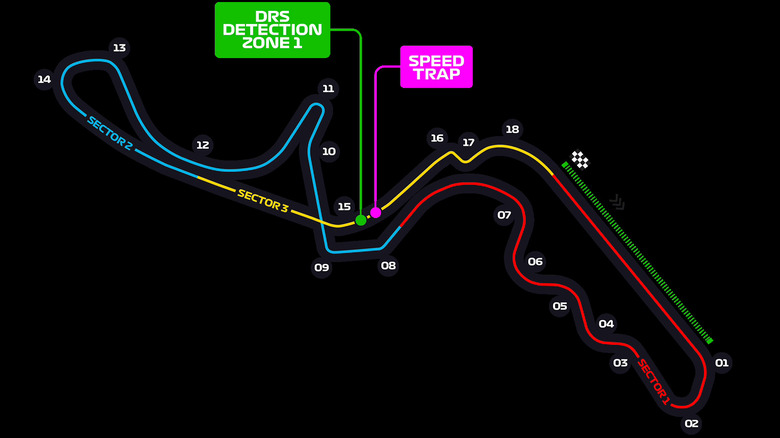
Although the Suzuka Circuit is the oldest racetrack in Japan, having been built in 1962, it didn't join the F1 circuit until 1987. Originally used as a test track for Honda, the Suzuka Circuit is now famous in F1 for its unique crossover layout. Because of the figure-eight design, Suzuka runs both clockwise and counterclockwise, adding to its difficulty level. The course has gone through a few major redesigns intended to increase safety over its lifetime, but it still proves a tough test for F1 drivers.
S-curves and hairpin turns are just part of what earns Suzuka Circuit ninth place on this list. The course takes 53 laps to complete and runs for 5.807 km. Total distance for the circuit comes out to 307.471 km. There are 18 curves of varying degrees of difficulty along the route, with the 130R curve being an exceptionally challenging left-hander that requires maximum speed throughout. Other tough curves include Esses and the Spoon Curve. This track has some significant elevation changes as well, which can add complexity to cornering and braking. Kimi Antonelli holds the lap record of 1:30.965 at Suzuka, which he set in 2025.
Drivers can reach a top speed of 203.8 mph on this tough F1 track, running at full throttle for about 66% of the race. From the S-curves in sector one and hairpin turns in sector two to the long, straight runs throughout the course, Suzuka has been and remains one of the most difficult courses in F1 racing.
8. Hungaroring Circuit
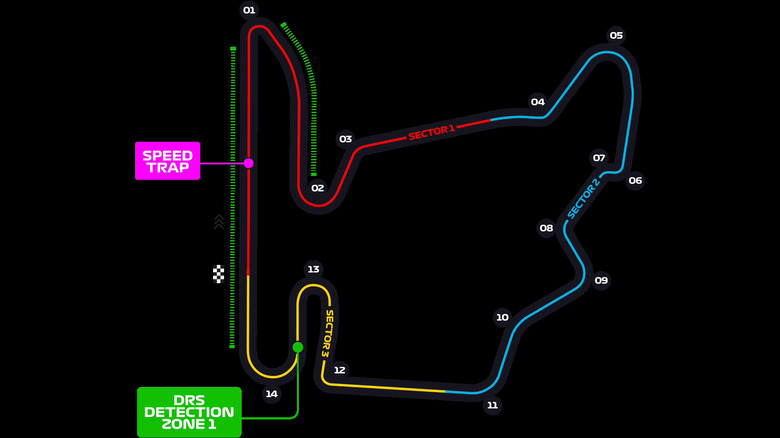
It took just nine months to finish construction of the Hungaroring Circuit in 1985. The track near Budapest, Hungary, saw its first F1 Grand Prix in 1986, making it the second-longest continuously used circuit on the F1 calendar. Since then, it has hosted 40 F1 Grand Prix races and been through only a few minimal changes to its layout. Because this circuit features very few straightaways, drivers liken it to a kart racing track, but that doesn't mean this course is easy by any means.
With a total distance of just 4.381 km, Hungaroring Circuit definitely isn't the longest course, but drivers must do 70 laps for a complete race distance of 306.67 km. And the mere 14 turns may sound less arduous than that of other courses, but these curves are tight and technical, requiring drivers to fully focus on the challenge they present. Overtaking on the tough Hungaroring F1 track is difficult as well, with only two DRS zones near turns one and 14 giving drivers a chance at passing.
Top speed at the Hungaroring Circuit is around 195 mph, but due to the limited straights, cars are usually only at full throttle for 50% of the race. Braking for the course is also considered medium since only four corners are highly demanding. The fastest lap time for the Hungaroring Circuit is 1:16.627, a record held by Lewis Hamilton.
7. Jeddah Corniche Circuit
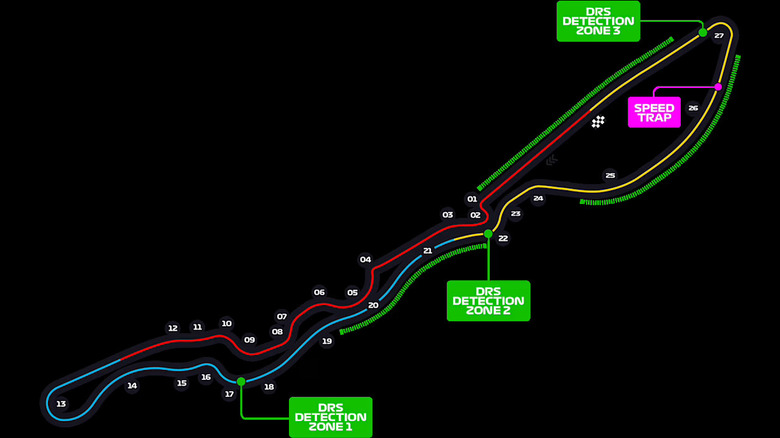
Jeddah, Saudi Arabia, is home to one of the newest track additions in F1 racing. The Jeddah Corniche Circuit is a temporary street circuit built along the Red Sea, and it hosted the first Saudi Arabian Grand Prix in 2021. Despite being such a fresh member of the F1 circuit family, the Jeddah Corniche Circuit has already emerged as one of the toughest tracks on the calendar. After the first F1 Grand Prix there, changes were made to the course based on driver input regarding safety, but it remains challenging for many reasons.
The Jeddah Corniche Circuit is one of the fastest races currently in F1, and it's also the second-longest course drivers must take on. Each lap is 6.175 km long, and drivers complete 50 laps for a total race distance of 308.7 km. With 27 corners to manage and an average speed of 160 mph, this F1 track puts drivers on high alert. Several narrow spots around major turns push cars together and uncomfortably close to the walls, while three consecutive DRS (Drag Reduction System) zones provide the best chance for overtaking. Cars stay at full throttle for close to 80% of the race, which means G-force is present almost constantly.
Max Verstappen currently has the lap record at Jeddah Corniche Circuit with an impressive qualifying time of 1:27.294. He also has the most wins (two) on this track. This course is set to be part of the F1 calendar until at least 2027.
6. Baku City Circuit
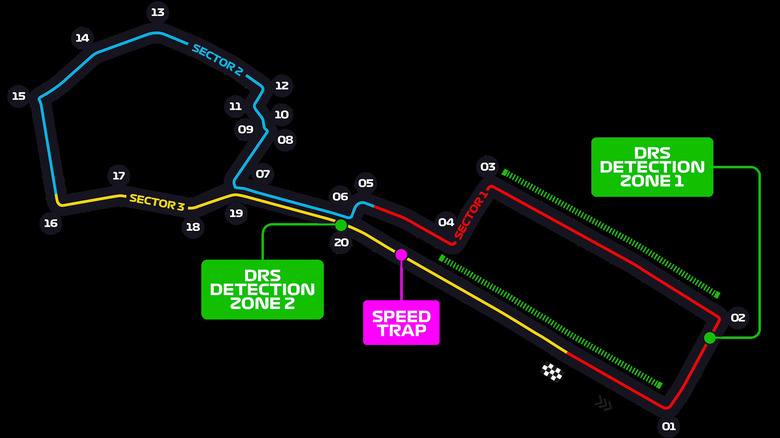
Baku City Circuit in Azerbaijan is a street course that joined the F1 ranks in 2016, and it ranks the sixth toughest F1 track here for its difficult layout and tricky corners. Meandering through the city's old town, along its medieval walls, and past modern architecture, Baku City Circuit is both thrilling and dangerous. Taking drivers through long straights and one of the narrowest curves in the F1 circuit, this is easily one of the toughest courses drivers face. Even the slightest mistakes can have a huge impact on the Baku City Circuit.
Braking is exceptionally challenging for drivers when racing the Baku City course. There are several 90-degree turns and one of the longest straights in F1, which combines the need for precise braking with the ability to reach incredible top speeds. This results in a technically demanding track that challenges even the top F1 drivers (ranked here by facial hair). The total distance of the Baku City Circuit is just over 6 km, but with 51 laps to complete, the total race distance is 306.049 km.
Drivers have plenty of chances for overtaking thanks to some fairly wide sections, especially near turn one, but navigating the narrow curves takes focus and skill. Top speed for the Baku City Circuit is 209.4 mph, and Charles Leclerc holds the outright lap record with a time of 1:40.203 and the race lap time record of 1:43.009.
5. Autodromo José Carlos Pace Circuit
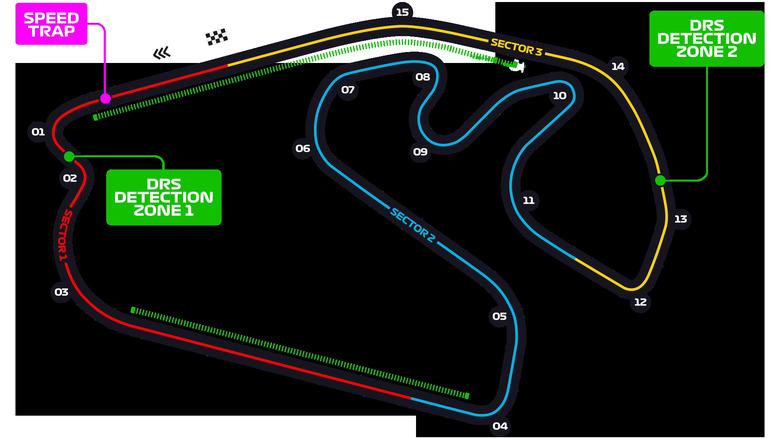
Taking inspiration for its design from the old Brooklands, Roosevelt Raceway, and Montlhery Circuits, the Autodromo José Carlos Pace Circuit is an F1 track in São Paulo, Brazil, that offers challenges galore. Construction on the racetrack began in 1938, but F1 wouldn't hold an official Grand Prix race at the course until 1973. Originally called Interlagos, the circuit was later renamed after Brazilian driver José Carlos Pace, who died in a plane crash just a year after winning the Grand Prix championship. Many people still refer to the São Paulo circuit as Interlagos.
In 1980, safety concerns led to major changes in the layout of the Autodromo José Carlos Pace Circuit, shortening the track from its almost 8 km to its current 4.309 km. This circuit poses drivers with unique challenges because of the area's heat and humidity as well as its high elevation. Drivers have to complete 71 laps to finish the race, which makes the total race distance 305.909 km. Hilly terrain, banked corners, and a counterclockwise direction enhance difficulty at Autodromo José Carlos Pace Circuit. The 15 corners require a mix of medium and low speed, adding a technicality that you won't find at other F1 circuits.
Drivers can reach a top speed of nearly 206 mph on the Brazilian racetrack, and Lewis Hamilton holds the fastest lap record with a time of 1:07.28. The best opportunities for overtaking at Interlagos are on the Senna S curve just off the line, when feeling the g-force in the Curva do Laranjinha turn, and after braking into the end of the back straight at the Descida do Lago bend.
4. Marina Bay Street Circuit
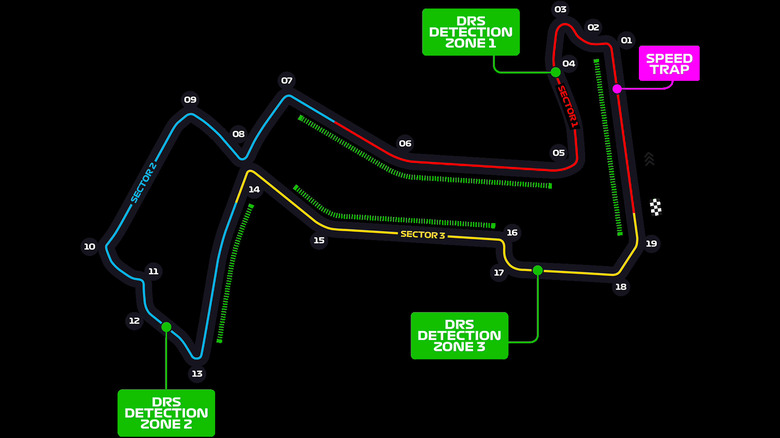
Singapore made history with its Marina Bay Street Circuit when it opened in 2008. It was the first time an F1 race was ever held at night, which required 1,600 artificial lights to help replicate daylight driving visibility. It's a street course littered with bumps that are difficult to traverse at high speed. At one point, the track takes drivers under the grandstand, and it incorporates the 1910 Anderson Bridge for a feel unmatched by other track designs. Intense heat and an average of 70% humidity make driving conditions at Marina Bay Street Circuit risky.
Physical demands for racing this course are extreme, with many drivers actually losing weight during the race due to stress, helping this track make No. 4 on this list. Lap length is currently 4.928 km, and it's vital for drivers to stay completely focused on the road for the duration of the 62 laps it takes to finish the race. The race distance is 305.723 km, making it one of the longer races in the F1 circuit. It also features 19 corners that drivers must navigate, which puts a turn every 260 meters. This corner-to-corner layout means no time to relax, even on the rare straight sections.
The Marina Bay course has a top speed of 200.7 mph, but with only a couple of short straights, cars are only full throttle for 49% of the race. In 2024, Daniel Ricciardo set the lap record at Marina Bay Street Circuit with a time of 1:34.486.
3. Spa-Francorchamps Circuit
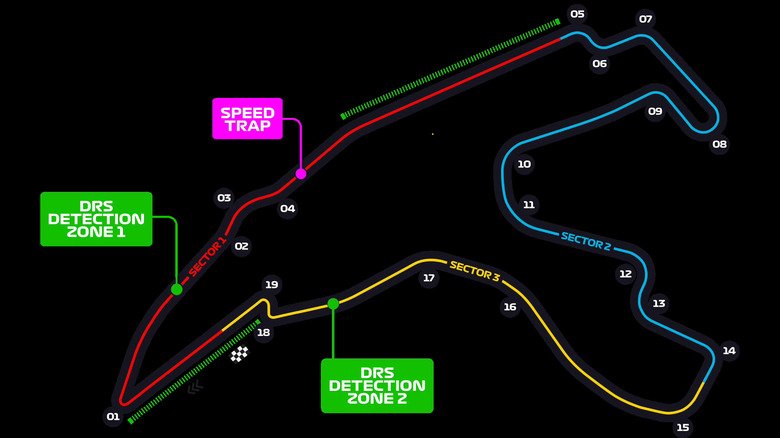
Unsurprisingly, one of the oldest F1 circuits is also the third most challenging. Spa-Francorchamps Circuit in Belgium, fondly referred to as Spa, has a history that predates Formula 1, but it held its first Grand Prix in 1950. Of course, it looks a lot different today than it did in its early days, having undergone a major redesign at one point that kept it off the F1 calendar for more than a decade.
After a driver boycott over safety concerns, the last Grand Prix on the original 14.9 km Spa Circuit was held in 1970. The track was shortened to half its original size before it would hold another F1 championship in 1983, and it has undergone additional changes since to further improve safety. Despite being shortened, Spa remains the longest course on the F1 calendar at 7.004 km. The race is only 44 laps, but the entire race distance is 308.052 km, which means long distances between each lap.
Drivers appreciate the challenges at Spa Circuit, as it offers a good mix of long straights and fast curves that require honed skills and precise timing. The weather can add an element of difficulty as well to this course. It often rains in Belgium, making the already poor visibility around several tight corners even worse. Braking is heavy on this course, too, with 19 corners to navigate. The downhill Eau Rouge bend is immediately followed by an uphill climb to Raidillon, probably the most famous of all the Spa curves. This rapid left-right with a decline and an incline isn't for the faint of heart. Sergio Perez set the race lap record at Spa in 2024 with a time of 1:44.701.
2. Monza Circuit
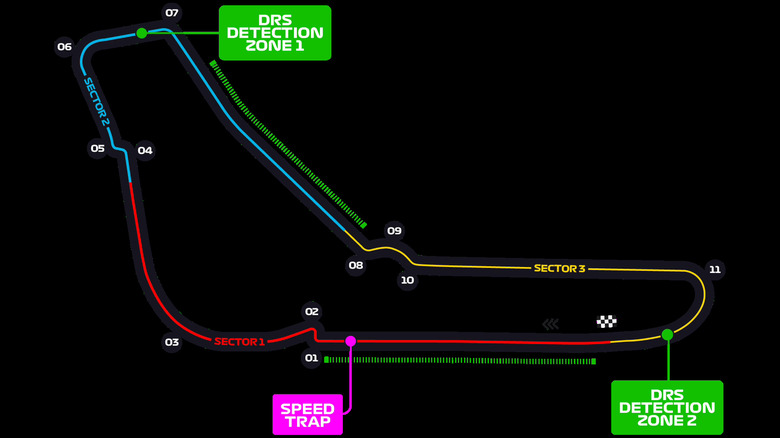
Dating back to 1922, the Monza Circuit in Northern Italy has a long relationship with racing. It was the third purpose-built racetrack in the world and the first built in Europe. Like many older tracks, Monza has gone through changes over the years, but it maintains much of its original feel. It joined the F1 calendar at the organization's inception, holding its first F1 Grand Prix in 1950. The track earns its "Temple of Speed" nickname for several reasons, one being that it's frequently used for setting speed records.
The Monza Circuit is the fastest track in the world, with drivers known to reach a top speed of more than 220 mph. A lap speed record of 1:18.79, held by Max Verstappen, makes quick work of the 53 laps for this 5.793 km course. Engines get a workout at the Monza Circuit, staying at full throttle for more than 80% of the 306.72 km race. There are 11 curves of varying widths, offering a mix of high- and low-speed maneuvers that require drivers to use all their skills.
Maintaining such a high speed at Monza also means staying highly focused for the duration of the race. One small mistake can have massive consequences on this tough F1 track. Two DRS zones allow for overtaking, but they come near some tricky turns, adding a unique challenge to passing. The course's park-like setting could be hard for drivers to enjoy over the roar of the F1 engines flying by.
1. Monaco Circuit
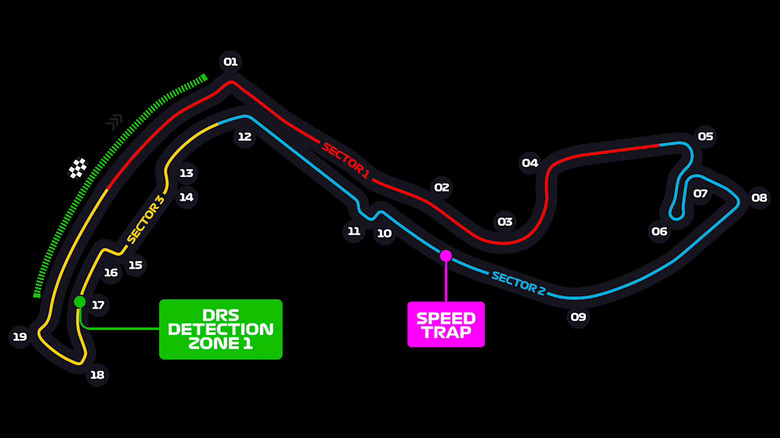
The Monaco Circuit has been a part of the F1 Grand Prix since its inception in 1950, but it hosted its first Grand Prix just after it was constructed in 1929. Few alterations have been made to the track in its lifetime, but the tunnel addition of 1973 is rather historic and quite famous. The street track runs along the principality's marina and through its bustling casinos, lined almost entirely with walls that leave no room for mistakes, which is a huge part of what puts this track in first place for most challenging. Monaco is a small principality, so it's no shock that the Monaco Circuit running through town is tight and narrow.
Opportunities for overtaking at Monaco are scarce, with some races never seeing drivers pass. This makes the qualifying placement here key to having a strong finish. The track's 19 curves and minimal straights mean drivers usually don't see top speeds of much more than 180 mph, and they only maintain full throttle for about 60% of the race. But with a total race distance of 260.286 km, drivers must complete 78 laps at 3.337 km each to finish the race, requiring full attention throughout the championship.
As of 2025, Lando Norris holds the lap record at Monaco Circuit with a time of 1:09.954. This F1 track is a challenge most drivers welcome. However, with the size of F1 cars constantly pushing the limits, F1 racing at Monaco is only getting more difficult and dangerous due to its narrow roads and tight corners.
Ranking methodology
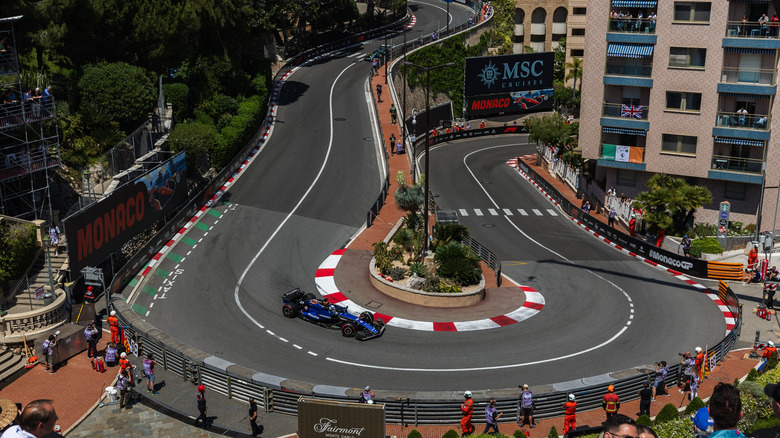
Ranking the toughest Formula 1 tracks isn't easy. Each racetrack on this list poses unique challenges to drivers. There's no single thing that makes a track difficult; rather, it's a combination of factors that tests the skills of F1 drivers. To determine the order of this list, many things were considered.
The top speed drivers can reach was a big consideration because the faster the cars go, the harder they are to control if something goes wrong. But like in the case of the Monaco Circuit, which isn't known for being a high-speed course, narrow roads with little room for run-off also play a part in how challenging the course is. Other factors considered when ranking these courses were the length and number of laps, as this contributes to driver fatigue, and the number and technicality of turns, which take skill to navigate successfully. Because braking takes precision, this was another factor that played a part in deciding what makes an F1 track difficult.