

Why Chevy Switched From Detroit Diesel To Duramax Engines
When General Motors decided to make a diesel engine a permanent part of its light-duty truck lineup in 1982, it partnered with Detroit Diesel for a 6.2-liter V8 rated at 130 horsepower and roughly 240 pound-feet of torque. And while the motor was upgraded in the years that followed, GM thought it could do better when it came time to engineer a fresh generation of trucks at the end of the millennium.
In fact, the market basically forced GM's hand. You see, GM grabbed more than half of the full-size truck market in the early 1990s. However, sales began lagging behind the newer Ford F-150 and Ram 1500 during the second half of the decade, and some folks put the blame on that Detroit Diesel powerplant for its relatively lackluster performance. At its peak, the turbocharged 6.5-liter version of the Detroit Diesel engine maxed out at 215 horsepower and 430 pound-feet of torque. Ford's 7.3-liter Power Stroke V8, in contrast, was pumping out 225 horses and 450 pound-feet of torque at the time.
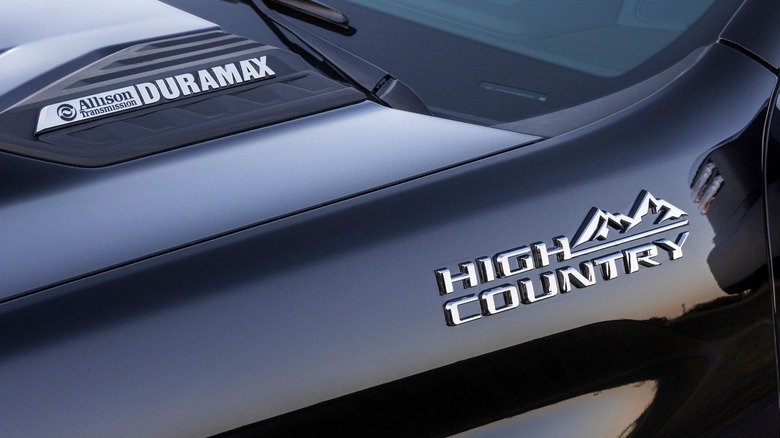
So, GM engineers turned to Isuzu for what would become the Duramax engine. The legendary Duramax 6600, a 6.6-liter turbodiesel V8, went on to first appear in the 2001 Chevrolet Silverado HD and GMC Sierra HD pickups. Today, Duramax engines are still proving themselves in rides like the 2025 Chevrolet Silverado 2500 HD Trail Boss.
The evolution of the Duramax diesel engine
The first Duramax engines (LB7) distinguished themselves from their Detroit Diesel predecessors in a number of key ways. First off, the Detroit Diesel was an old-school unit designed with mechanical fuel injection and cast-iron heads, both of which were ditched in the Duramax motors. Modern electronic fuel injection allowed the Duramax engines to run more efficiently, deliver more power, and require less maintenance. Switching to aluminum heads helped save weight, contributing to gains in performance.
GM continued to update the Duramax family to help keep pace with the competition, adding enhancements like variable geometry turbochargers and exhaust gas recirculation (EGR) systems (2004), diesel particulate filters (2007), and B20 biodiesel capability (2011). Of course, power outputs were increased along the way. The current generation Duramax engine (L5P), which premiered in the 2017 Chevrolet Silverado, can now make 470 horsepower and 975 pound-feet of torque. It's enough for a max tow rating of 36,000 pounds, depending on model options.
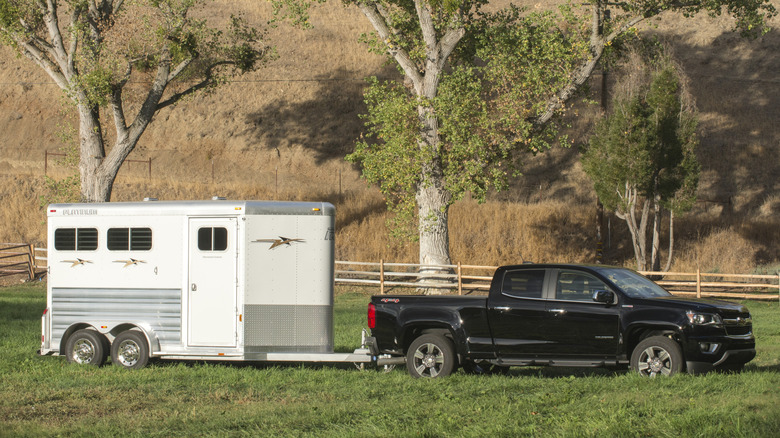
The Duramax family tree grew a couple of new branches when Chevrolet began offering four- and six-cylinder Duramax engines in its light-duty trucks and SUVs. The Colorado was available with a 2.8-liter, four-cylinder turbodiesel from 2016 to 2022, while a 3.0-liter I6 turbodiesel debuted in the Silverado in 2019 and in the Tahoe and Suburban in 2021. However, the engine wasn't without issues, as owners have reported some persistent problems with the 3.0-liter Duramax.
What Chevrolets have Duramax diesels today?
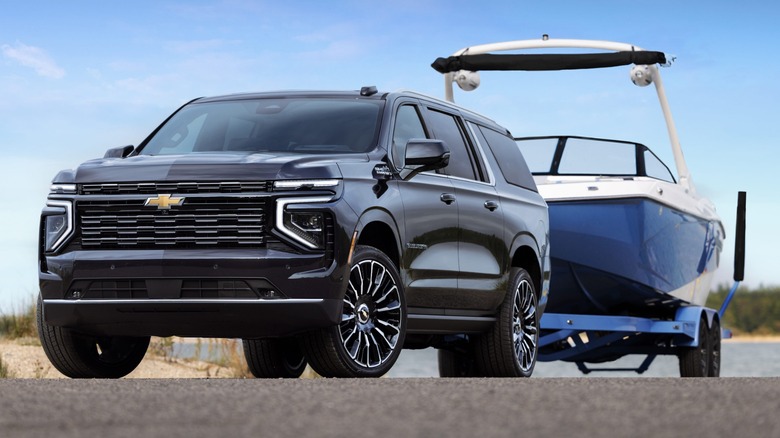
While diesel engines aren't as common in light-duty trucks, Chevrolet and GMC stand out in this regard. The 2025 Chevrolet Silverado, Tahoe, and Suburban can all be ordered with the latest edition of the 3.0-liter Duramax turbodiesel I6, making them (and their GMC counterparts) the only domestic light-duty vehicles to offer diesel engines.
The engine pours out 305 horsepower and 495 pound-feet of torque to help the Silverado showcase a max trailer rating of 13,000 pounds. That's 500 pounds less than the top rating for the Ford F-150, thanks to the Ford's 3.5-liter EcoBoost V6. However, it beats the Ram 1500, which maxes out at 11,610 pounds of pulling power.
On the other hand, Chevrolet does trail its Ford and Ram rivals at the very top end of the heavy-duty towing spectrum. As mentioned, the Silverado 3500 HD can pull up to 36,000 pounds by leveraging its 470 ponies and 975 pound-feet of torque. But Ford and Ram both offer dedicated high-output versions of their big turbodiesel engines, while Chevy does not. The Ram 3500's 6.7-liter Cummins turbodiesel makes 430 horsepower and 1,075 pound-feet of torque, offering a max towing limit of 36,610 pounds. In comparison, Ford's Power Stroke puts out 500 horsepower and 1,200 pound-feet of torque, allowing the Ford Super Duty to tow up to 40,000 pounds.