

The Internet Is Filled With Posts About Stricter Driving Laws For Seniors, But They're All Fake
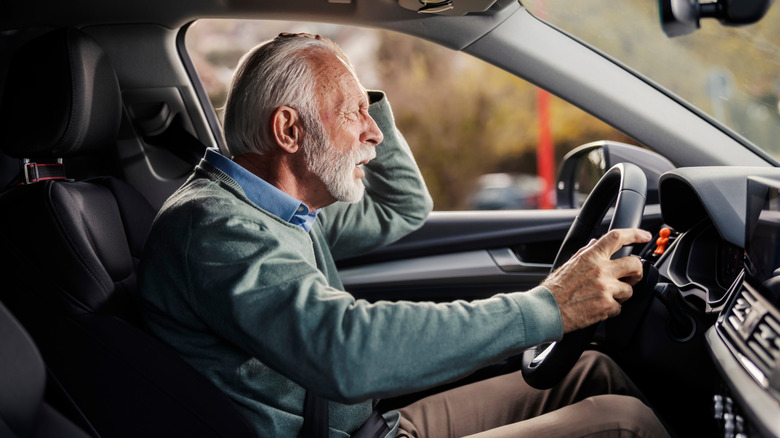
Do seniors need stricter traffic laws? There's certainly a strong case for it: We're all drivers in the great endurance race of life, but no one can outrun Father Time. As folks age, inevitable changes in their brains and bodies can have a serious effect on their driving abilities, especially when it comes to eyesight and reflexes.
The long list of potential issues from the American Academy of Ophthalmology includes worsening night vision, having trouble picking out objects from their backgrounds, and being overly sensitive to sunlight and glare. Meanwhile, scientific studies continue to show that physical changes in older people can leave them slower to react than younger adults.
The result, according to the Centers for Disease Control and Prevention, is that drivers aged 70-plus are involved in more fatal car accidents per mile driven than those aged 35 to 54. In addition, some 25 older adults are killed each day in auto accidents, which leave more than 740 seniors injured each day.
Even some automakers are addressing the issue. GM, for example, recently patented an in-vehicle system that could get old, dangerous drivers off the road. Yet despite all that, state and federal legislators haven't been eager to address the situation. Sure, you may be seeing more and more internet posts about changing driving laws for seniors, but that's almost always pure AI slop.
AI is ruining the Internet
Static Media, Jalopnik's parent company, doesn't allow the use of AI-generated content, period. Other sites, however, and plenty of scammers, have embraced it. It's led to a huge increase in fake stories and images appearing throughout the web, like the ones promoting AI slop motorcycles that don't exist. And it's made worse because some social media outlets treat this junk like real news, piling it into people's feed along with actual human-generated content. One study, for example, indicated that AI was likely to be responsible for more than half of all long-form posts on LinkedIn.
That apparently was what happened over the summer when a rumor hit the internet that the U.S. Department of Transportation, concerned about seniors' physical and mental abilities to safely operate a car, would make it more difficult for them to get their driver's licenses. Good idea or not, the story wasn't true. The fact-checking website Snopes did a nice job debunking the issue, but that didn't stop posts about stricter driving laws for seniors from filling the web.
Nor is this a problem only for U.S. drivers. Australia's Royal Automobile Association reported a similar scam was targeting that country's senior drivers. Said the RAA's Senior Road Safety Manager, Charles Mountain, "The misinformation serves as a reminder for drivers, particularly older motorists, to verify road rule changes through trusted sources." Which is good advice in the United States, too.
Seniors do face different state requirements for driver's licenses

It's also worth pointing out that, generally speaking, the Department of Transportation doesn't issue driver's licenses in the first place. It's the states that usually handle them through their departments of motor vehicles. So if you ever want to verify the license rules in your state, that's where you should start. (It's free, too, so don't fall for scalpers selling DMV appointments for $250.)
Just keep in mind that those rules may vary from state to state. For instance, many states require older drivers to take vision tests more often than younger drivers, eliminate or restrict the availability of online renewals, and separate guidelines about how often they have to renew their licenses.
Further, a number of states are, in fact, responding to the growing pool of older drivers. Illinois is a great example, since Gov. J.B. Pritzker recently signed into law a new bill with key updates for seniors — although perhaps not in the way you'd expect. The new Illinois law raises the age at which drivers must renew in person from 75 to 79, and a road test is now required at 87 (75 for people with a commercial driver's license).
After all, according to the bill's sponsor, Rep. Jay Hoffman (per NBC 5 Chicago), "Study after study indicates that senior drivers are the most safe amongst us." Which sure sounds like more fake news.