

Close Ratio Vs. Wide Ratio Transmissions: What's The Difference?
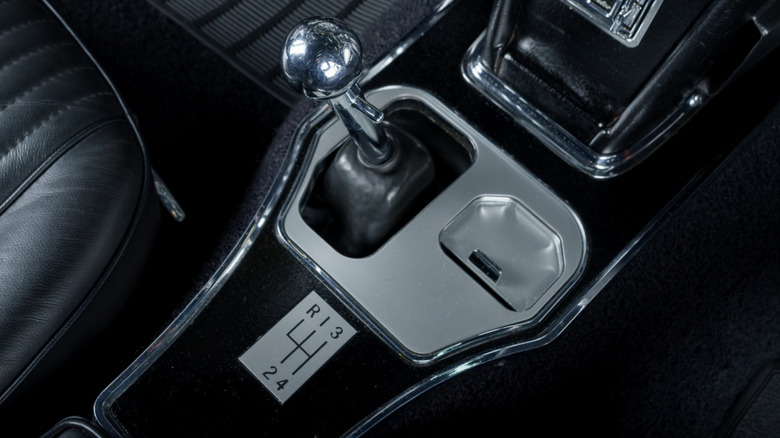
This definitely sounds like the setup to a joke that's only funny to a hyper-specific audience. "What's the difference between a close ratio and a wide ratio transmission? About a second and a half through the quarter mile!" Yeah, that's the daddest dad joke ever, but it really does illustrate the main difference between transmissions with "wide" ratios and "close" ratios.
In cars with traditional internal combustion engines, drivers have to constantly balance vehicle speed and engine powerband, or the revolutions per minute (rpm) range where the engine makes the most torque. Try starting out in top gear from a dead stop, for example. Unless your engine has the torque of an earthmover you'll just stall out. Try to drive highway speeds in first gear and you'll probably force the engine to spin so fast that the valves might slam into the pistons. (If you're having difficulty shifting that severely, maybe you need to practice on one of those H-pattern shift pens at your desk.)
The point is, your transmission has multiple gears with varying ratios, each is designed to bring your vehicle up to a speed where the engine's powerband can increase and maintain the car's velocity. Even engines with wide, flat torque curves still have a power peak somewhere in their rev range. Giving a car a "close" ratio transmission lets the engine stay closer to that power peak with each shift, improving acceleration. A "wide" ratio transmission will allow rpms to fall much more during shifts, which can place the engine's rpms further from peak power when selecting a higher gear.
Let's stay on track and shift gears
In the above video from Moore Motorsports Garage, you can clearly hear and see the difference when switching from a wide ratio to a close ratio transmission. The first-to-second shift with the wide ratio transmission sees the rpm drop from about 7,500 to about 4,250. After swapping to a gearbox with more advantageous gear spacing, a first-to-second shift drops from 7,500 rpm to a much more neighborly 5,250 rpm or so. The car's 0-60 time also drops from 8.87 to 7.2 seconds.
These days, buyers can't choose different transmissions with varying gear ratios in a new car. Sometimes you can opt for packages that change the final drive ratio, like how standard C8 Corvettes have a ratio of 4.89:1 but Z51s have 5.17:1, but the days of checking off boxes on option sheets for specific transmissions are gone. So let's go back in time to 1967 and look at three transmissions you could have selected on your new Chevy: The Muncie "Wide-Ratio" M20 and the "Close-Ratio" M21/M22.
For all Muncie four-speed transmissions, top gear was the same at 1:1, which means input and output shafts turned at the same speed. Go down to third gear, and the M21/M22 would be 1.28:1 while the M20 would be at 1.46:1. Second gear is 1.64:1 for M21/M22s and 1.88:1 for M20s. First gear is 2.20:1 for M21/M22s and 2.52:1 for M20s. While it might seem like the M20's lower first would give that transmission an advantage off the line, keep in mind that someone stepping up to the stronger, whinier M22 "Rock Crusher" would likely also have a lower differential ratio to compensate, and would then be able to keep that L88 427 on boil through an acceleration run.
Closer is smoother
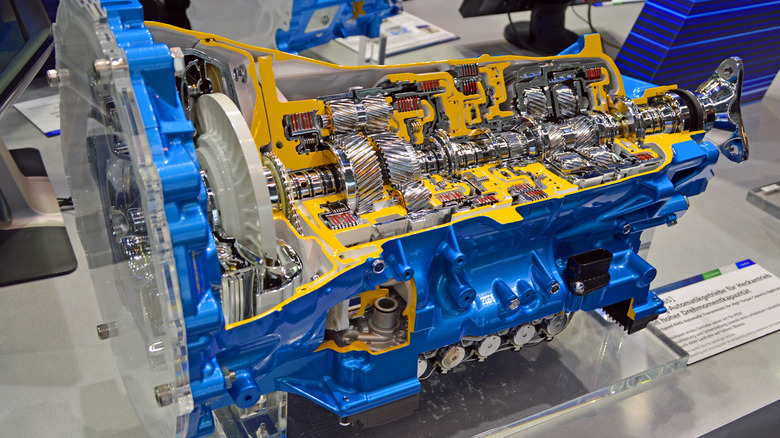
Close ratios aren't all about rip-roaring acceleration runs. The Ford/GM 10-speed automatic you'll find in Mustangs, Camaros, and F-150s has a fairly narrow gear spread, narrower even than transmissions with fewer gears. This allows, in theory at least, for incredibly smooth shifts that are especially useful for maintaining control during towing, aka the worst time to have jarring, bucking shifting going on. Ford's 10-speeds can have issues with harsh shifting, but this isn't a fault of them having 10 forward gears.
The numerous, close ratios also help improve fuel economy. Imagine you're going uphill at such an angle that the engine can't make enough power to maintain speed in top gear. You'll have to shift down, right? Well, if you have a couple of other close overdrives to choose from, you can find an optimal gear to keep revs down, yet produce enough torque to continue accelerating. If the transmission ratios are too wide, the next gear down might be much farther away, increasing revs beyond where they really need to be and wasting fuel.
Of course, if you just want the closest ratios possible, then you want a continuously variable transmission. It will give you an infinite number of gears that are infinitely close, providing the smoothest possible acceleration and optimal ratios for fuel efficiency. The main downsides are the everything else about them. Keeping an internal combustion engine right at its power peak during acceleration transforms what could be a musical, intoxicating exhaust note into a drone. Are the possible performance and economy gains worth the damage to your soul?