

Every Company That's Owned Lamborghini, So Far
Cracking open a stack of Automobile, Car and Driver, and Motor Trend magazines dating back to the '70s is illuminating. With each new Lamborghini model and confirmation of the company's purchase by yet another investor, the writer always mixed hope and apprehension. 1991's "Lamborghini" coffee-table book from the Auto Editors of Consumer Guide is also enlightening, as it came from one of the greatest eras of Lamborghini optimism — when it was still receiving plenty of support from Chrysler to develop the Countach-succeeding Diablo and the firm's first bespoke racing engine, the 3.5-liter F1 V12.
Chrysler is but one of many owners in Lamborghini's past, though. The first was, of course, Ferruccio Lamborghini himself. Founder Ferruccio Lamborghini made his fortune building HVAC equipment and tractors for postwar Italy. He indulged himself in fast cars, but each had flaws that irked him.
If you believe the stories, the seed of this legendary sports car company revolves around Lamborghini's frustration with his Ferrari, and more specifically, its constantly burned-out clutch, and even more specifically, Enzo Ferrari's retort after Lamborghini told Il Commendatore he knew Ferrari was using the same clutches installed in Lamborghini's tractors. According to veteran Lamborghini test driver Valentino Balboni, per Car and Driver, Ferrari replied: "You are a tractor driver, you are a farmer. You shouldn't complain driving my cars because they're the best cars in the world." Lamborghini shot back: "Oh, yes, I am a farmer! I'll show you how to make a sports car."
Lamborghini vs. the world
Ferruccio Lamborghini told a similar story, though there's no way of knowing what he and Enzo Ferrari actually said to each other behind closed doors unless you're particularly skilled at seances. Regardless, Lamborghini was dead set on building a fast, competent Grand Touring car that would impress everyone, Ferrari especially. Lamborghini even hired Ferrari's old engineer, the late, legendary Giotto Bizzarrini to make him a 3.5-liter V12 to power the 350GTV prototype.
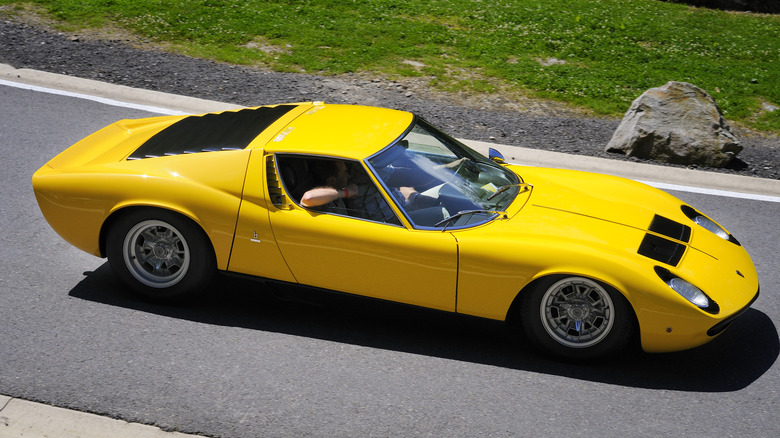
After a series of cars with sort-of-all-right sales, including the 350GT and 400GT, the Ford GT40-inspired Miura exploded into the sports car world. A bare chassis debuted at the 1965 Turin auto show, with a completed car following in 1966. The swooping waist-high body was the work of coachbuilder Bertone, designed by some mix of Giorgetto Giugiaro and Marcello Gandini. It's still a source of argument as to who designed how much.
After having trouble sourcing tractor parts and issues with labor unrest in Italy, in 1972 Lamborghini sold 51% of his company to Swiss businessman Georges-Henri Rosetti. Then the company canceled the brilliant Miura for some unfathomable reason and Lamborghini sold the rest of the enterprise to Rene Leimer, also Swiss and a colleague of Rosetti's. Neither man had experience in the automotive industry, which is kind of a problem when running an automobile company, especially one building expensive sports cars during the 1973-1974 energy crisis.
Lamborghini makes BMW mad, FMC mad, and even Italy mad
BMW tapped Lamborghini in the late 1970s to build the M1 supercar, but that relationship ended with BMW employees breaking into the factory in the middle of the night and taking back all of the company's parts, tooling, and prototypes. Lamborghini also got a loan from the Italian government to develop an off-roader for the U.S. military called the Cheetah, except Lamborghini and partner MTI were sued for stealing the design from FMC. Things weren't going well for Lamborghini.
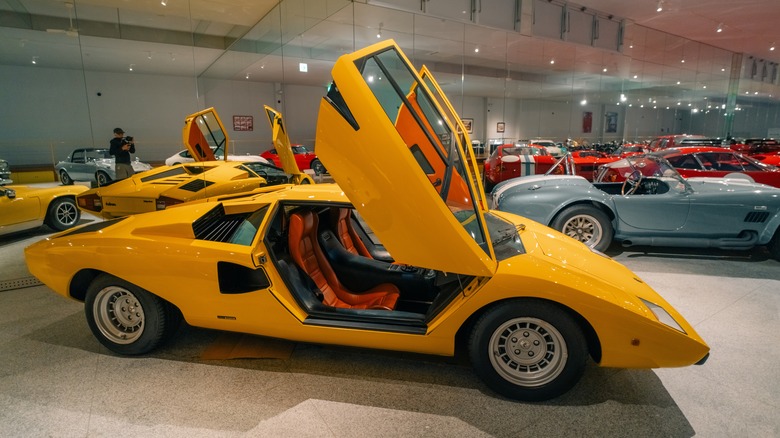
One bright spot from the Rossetti/Leimer era was the Gandini-designed 1974 Lamborghini Countach LP400. The Countach is what you picture when someone says, "exotic sports car." From 1974 to 1990, it was the de facto bedroom wall poster car. But even this masterpiece couldn't prevent financial woes. In 1978, the Italian government placed Lamborghini in receivership.
Lamborghini was saved (again) by a pair of businessmen (again). In July 1980, French brothers Patrick and Jean-Claude Mimran purchased the automaker and incorporated it as Nuova Automobili Ferruccio Lamborghini S.p.A. This era was peak Lamborghini insanity. The Mimrans dusted off that military-vehicle idea and created the Lamborghini LM002, aka the "Rambo Lambo", which our Andy Kalmowitz got to drive, the lucky dog. Countaches increased displacement to 5.2 liters and doubled the valves for a total of 48. A solid low-end Lamborghini finally appeared in the form of the successful Jalpa. Then, as Lamborghini's fortunes were finally turning, the Mimrans decided to sell.
Lamborghini gets flipped for profit into the lap of Chrysler
The brothers took the company they'd purchased for $3 million and increase its value enough that Chrysler was willing to spend $25 million for Lamborghini in 1987. Only a few years earlier, Countaches were gray-market cars in the U.S., and now the company's owner was as American as steering-wheel-mounted cigarette dispensers. Then-CEO Lee Iacocca had big dreams for Lamborghini, entering it into motorsports for the first time by hiring ex-Ferrari engineer Mauro Forghieri to design a 3.5-liter V12 for Formula 1.
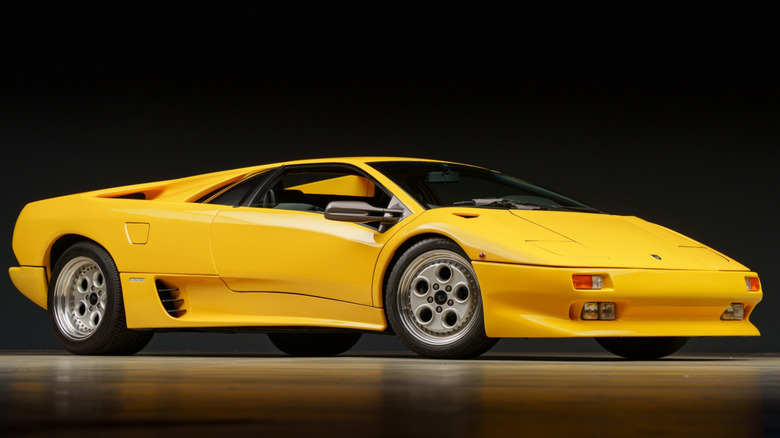
Chrysler also pushed for Lamborghini to create a successor to the Countach, which eventually became the Gandini-designed Diablo. You know, the car from "Dumb and Dumber." Iacocca was proud to have Lamborghini as a feather in Chrysler's cap. In a massive foldout advertisement with all of Chrysler's performance cars, including the upcoming Viper, it was the Diablo that Iacocca stood next to.
In Car and Driver's February 1994 issue, there's a news item titled, "Chrysler Puts Lambo Out To Stud." It reports that Chrysler has sold Lamborghini to MegaTech Ltd., based in Bermuda but owned by Indonesians, for a "rumored" $40 million. All of Chrysler's plans for Lamborghini had fizzled by the early '90s. The F1 engine wasn't winning races, Lee Iacocca wanted a Lamborghini minivan, and a global recession stalled Diablo sales. Rather than bleed cash, Chrysler yard-saled Lamborghini to a company with a name a G.I. Joe villain would find a little goofy.
MegaTech, the Anti-Chrysler
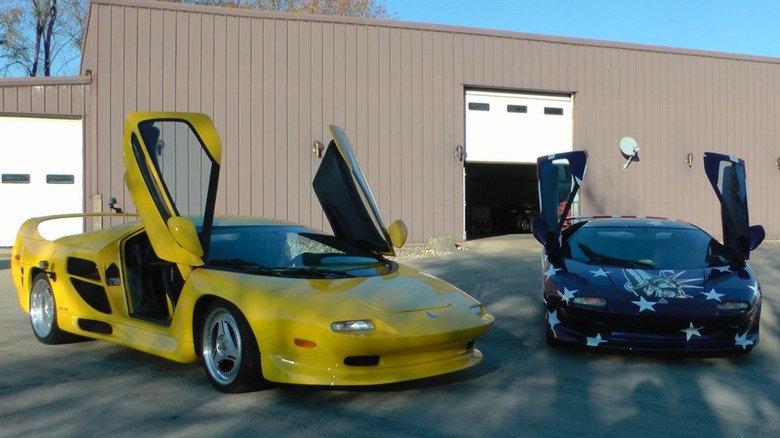
The alleged purpose for buying Lamborghini was to develop commercial vehicles for Indonesia, an idea best described as "clinically insane." MegaTech was controlled by Tommy Suharto, the son of the president of Indonesia, and partnered with a Malaysian company called Mycom Setdco. Yeah, everything about MegaTech and Suharto screamed, "shady." By way of example, Tommy Suharto later went to prison for four years after hiring hitmen to kill a judge.
Megatech also orchestrated a hostile takeover of Vector Aeromotive, maker of the half-baked W8 "supercar." In October 1995, Vector founder and former owner Jerry Wiegert detailed to Car and Driver his $5 million lawsuit over the loss of his company, designs, and equipment, saying, "I want compensation for the suffering and damage ... to get back what I deserve ... the machinery, equipment, clothes, and other personal possessions. They even took the basketball hoop from out back. And all the basketballs."
Aside from putting Lamborghini V12s in Vector M12s, which looked more like redesigned W8s, MegaTech didn't do much with its sports car company other than update the 5.7-liter V12 Diablo when it was convenient. There was the briefest whiff of a new model when MegaTech had Ital Design, Giorgetto Giugiaro's design firm, freshen up the mid-1980s V10-powered P140 concept that was intended to replace the Jalpa, but nothing materialized. In 1998, it seems MegaTech realized it wouldn't have the funds to develop a Diablo followup, so it pounded a "Lamborghini For Sale" sign in the ground.
Goodbye, MegaTech. Howdy, Audi!
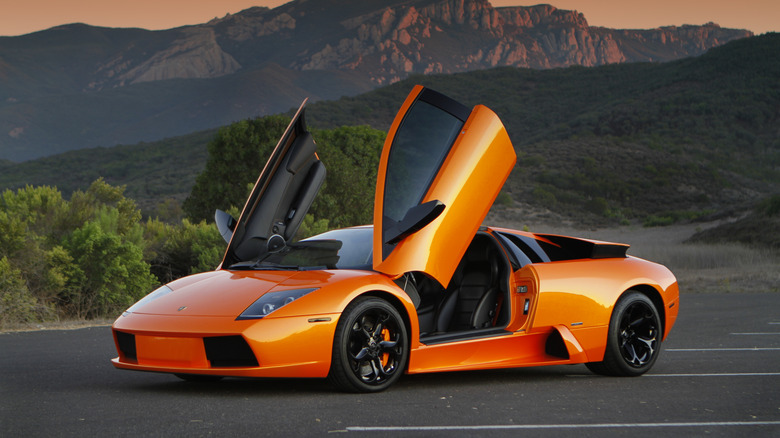
Fortunately for Lamborghini, then-Volkswagen Group Chairman Ferdinand Piëch was on a tear, consolidating a bevy of brands under the massive Volkswagen pergola, including Bentley, Bugatti, Porsche, and even Rolls-Royce (for about five minutes). And so, Volkswagen paid MegaTech a reported $110 million and folded Lamborghini into Audi like an automotive turducken.
Rather than the VW acquisition being another springboard for a comedy of errors, Lamborghini flourished. Things started slowly with a facelifted Diablo featuring a larger 6.0-liter V12. A proper successor arrived late in 2001 with the V12 Murciélago, joined by the stupendously successful V10 Gallardo in 2004.
These were followed by the phenomenal Aventador and Huracán. The current lineup is entirely hybrid, and includes the V12 Revuelto, the 10,000-rpm twin-turbo V8 Temerario, and the Urus SUV, which is essentially a Porsche Cayenne/Audi Q7 and Q8/Bentley Bentayga/Volkswagen Touareg underneath.
As for the company's founder, Ferruccio Lamborghini left the automotive industry, built a museum for his cars, and started making wine, known colloquially as "Blood of the Miura." It seems Lamborghini lamented the car's premature cancellation, for in an interview in the aforementioned "Lamborghini" coffee table book, he was asked which was his favorite Lamborghini to drive, and he answered, "The Miura." Most of us will never experience a Miura in person, but if you want to hear a prime example, crank Van Halen's "Panama" to enjoy Eddie Van Halen's Miura S revving in between David Lee Roth's banter.