

Ford 7.3 Power Stroke Owners Say These Are The Most Common Problems
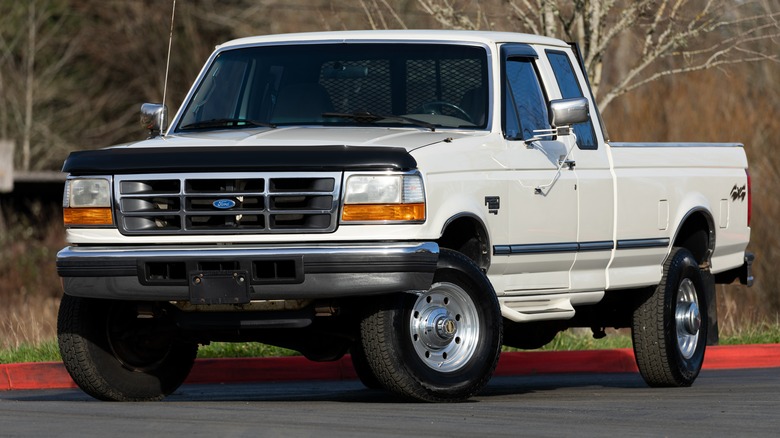
Few oil burners carry as much weight as the 7.3. It was the first Ford engine to bear the now legendary Power Stroke name, and its mechanical ingenuity meant it not only created a buzz but also defined an era. The 7.3 Power Stroke came about as a result of years of collaboration between Ford and the International Truck and Engine Corporation, ITEC (later Navistar) that started with the introduction of the ITEC-supplied, naturally aspirated 6.9-liter Indirect Injection (IDI) diesel engine in 1983.
In 1988, the engine's displacement was increased to 7.3 liters thanks to a bigger bore, yielding more power in the process. Further improvements were made in 1993, with the 7.3 IDI receiving a turbocharger. However, it wasn't until 1994 that the original Power Stroke turbodiesel engine was born. Facing tough competition from the Cummins turbo diesel engine which was introduced for the Dodge Ram trucks in 1989, Ford had International Navistar develop an engine that could withstand Chrysler's onslaught, hence the 7.3 Power Stroke brought more than its predecessor.
Compared to the departing 7.3 which had a mechanical fuel system with indirect injection, the 7.3-liter Power Stroke used an electronically-controlled fuel system with direct injection, where the HUEI fuel injectors spray the diesel directly into the combustion chambers at up to 21,000 psi. Popular among Jalopnik readers, the original Power Stroke engine also had forged steel connecting rods (later models were equipped with powdered metal connecting rods) as well as cast iron block and cylinder heads, with six 12-millimeter head bolts per cylinder. The result? An enormously successful engine that built up a reputation for reliability throughout its production run, which lasted through early 2003. But that's not to say it was perfect, as owners encountered problems, including with the cam position sensor and injector driver module.
Leaking exhaust manifold up-pipes are among the most frequent 7.3 Power Stroke issues reported by owners
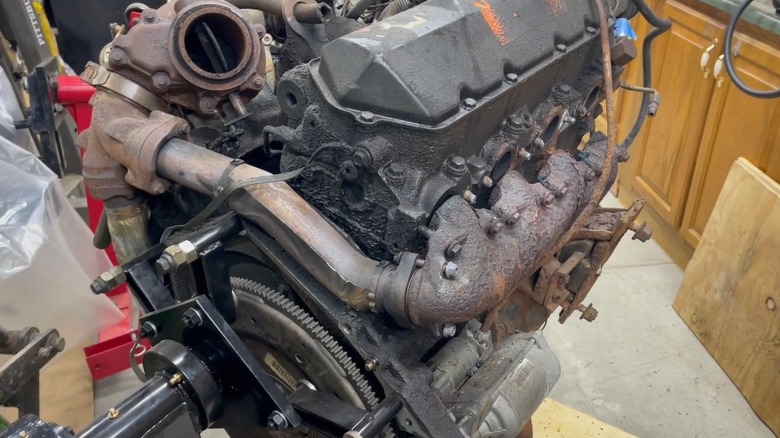
Loads of posts by owners on various forums and Reddit threads suggest exhaust up-pipe faults are among the biggest issues facing drivers of Ford vehicles powered by the 7.3 Power Stroke. The factory-installed pipes are known to leak gases due to the pipe's ends getting chewed out from the seal, according to a post by member kaya on the Power Stroke forum. Per a MotorTrend post, the engine's design features a crushed donut gasket that seals the up-pipes to the turbocharger's Y-collector to prevent the exhaust gas emitted from the engine from leaking.
However, these donut gaskets tend to wear out prematurely due to heat and pressure, leading to the very exhaust leak issue they aim to avoid occurring. Naturally, this lost air pressure limits the amount of exhaust gas getting in to spin the turbine wheel. As the air-fuel ratios are disrupted, owners will normally experience reduced engine power and decreased fuel efficiency, due in part to the engine working hard to compensate.
Persistent leak can also make the engine prone to excessive exhaust gas temperatures, which can eventually damage the turbocharger if left too long, thus necessitating a replacement. If your situation demands such change, some 7.3 Power Stroke owners recommend replacing the factory units with bellowed up-pipes that allow for expansion and contraction without failure as a solution for this problem.
The 7.3 Power Stroke can suffer from a faulty camshaft position sensor and other problems
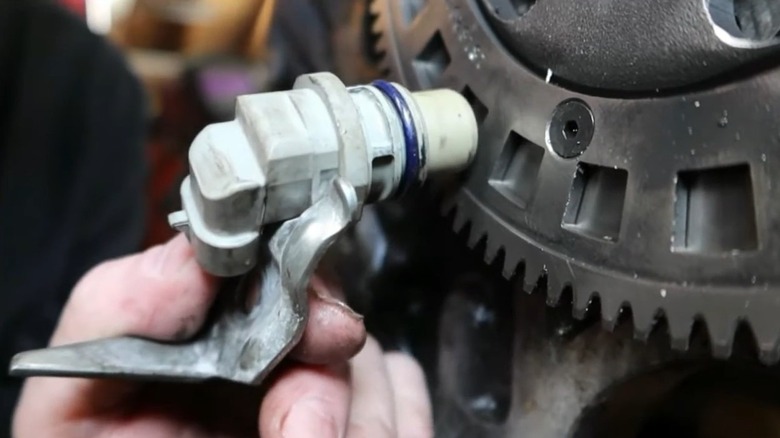
As you may already be aware, the camshaft position sensor is a device that measures the exact speed and position of the crankshaft together with the crankshaft sensor. Then it relays this information to the engine control module (ECM) so it can determine when to spray fuel and how much fuel to inject. Sadly, owners say the cam position sensor on the Ford 7.3 Power Stroke engine can fail or wear out prematurely. This affects the transmission of information to the ECM, and is usually among the common reasons why your engine won't start. Thankfully, replacing the 7.3 Power Stroke cam position sensor is a relatively easy and affordable undertaking that shouldn't cost you too much, as it can be accessed without much difficulty and isn't costly to buy.
Another device that can cause starting issues (and the vehicle running rough and stalling intermittently) with the 7.3 Power Stroke engine when faulty is the injector driver module (IDM), which helps control fuel injectors, ensuring that they fire at the correct times. This component can be damaged by water entering through vents in the IDM, compromising the device. When this happens, the 7.3 Power Stroke may refuse to start, misfire, stall, or lose power unexpectedly. Other common problems owners have reportedly experienced with the 7.3 Power Stroke engine include issues with the under valve cover harness connectors (UVCH), failing injector control pressure sensor, and clogged fuel filter, which can decrease engine performance, reduce fuel economy, and even cause some overheating.